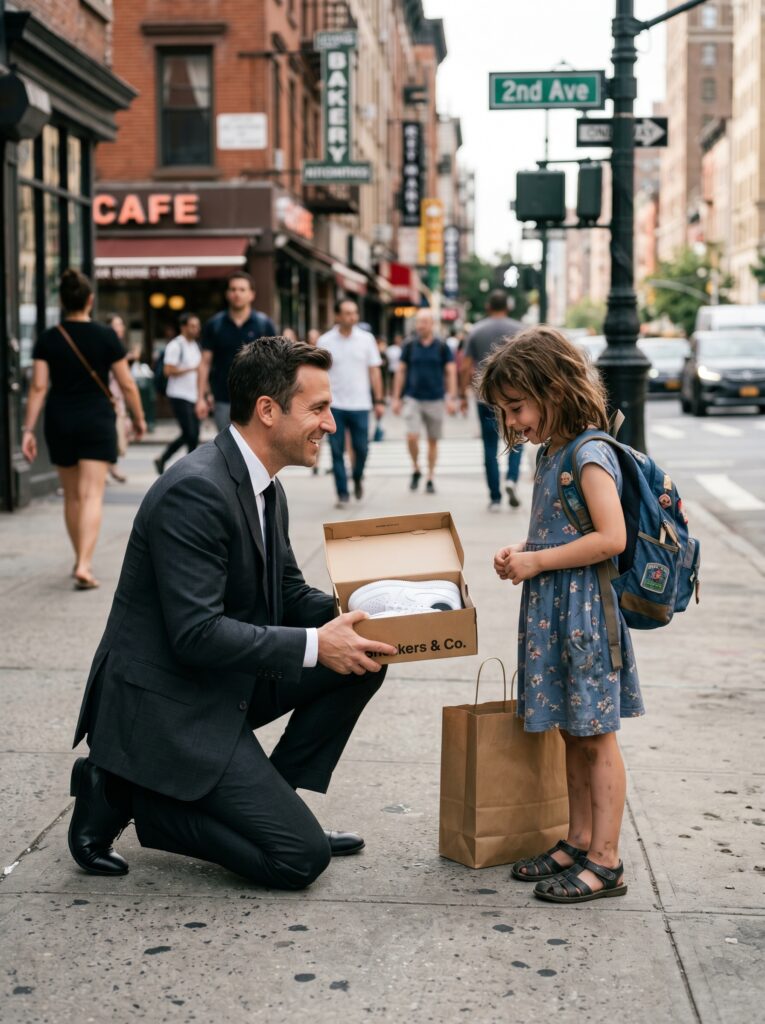
Claire looked at me with those exhausted, beautiful eyes and took the slowest breath I have ever watched a person take, and then she said “Mr. Harrison, Sophie isn’t just any little girl” and something in her voice made me pull the chair closer to her bed because I knew instinctively that whatever came next was going to require me to be sitting down. She told me that five years ago she was a first year nurse at this very hospital, working double shifts, barely sleeping, sending every extra dollar home to her own mother in Tennessee, when she met a man named Daniel who came in as a patient after a car accident — charming, kind, said all the right things, made her feel seen in a way nobody ever had before, and within six months she was pregnant and within eight months he was gone, vanished completely, blocked her on everything, left no forwarding address, and Claire was suddenly alone, twenty-five years old, pregnant, working night shifts and hiding her belly under scrubs for as long as she possibly could. She raised Sophie entirely by herself, worked until her body physically wouldn’t let her anymore, and eight months ago she started getting headaches that wouldn’t stop, vision that kept blurring at the edges, and the doctors here — the same hospital where she used to work, the same hallways she used to walk in her scrubs — told her it was a brain tumor, aggressive, already in a difficult position, and that treatment could buy her time but probably not enough of it. I sat there completely unable to speak. Claire reached over to the nightstand and picked up a folded piece of paper and held it out to me with a hand that trembled slightly and said “I found out who you were after Sophie came back with the shoes, I looked you up, and I need to ask you something that I have absolutely no right to ask a stranger.” I took the paper. Unfolded it slowly. And what I saw on that page made the air leave my body completely — it was a hand-drawn picture, crayon on notebook paper, clearly made by a five-year-old, showing two stick figures holding hands outside what looked like a school, and at the top in crooked letters that a child had carefully spelled out were the words MY MOM AND ME FOREVER and underneath Sophie had drawn a sun so large it took up half the page, bright yellow, with rays shooting out in every direction, and right there in that sterile hospital room under those cold fluorescent lights I felt something crack open inside my chest that I don’t have a word for even now. Claire said “I’m not asking you for money, I want you to know that, what I’m asking is so much bigger than money and so much harder and you can absolutely say no and I will understand completely” and I looked up from that drawing and said “just tell me” and she closed her eyes for a moment and then opened them and said “I need someone to make sure Sophie knows she was loved. Not just by me. But by the world. Because I won’t be here to show her myself and there is not a single person I trust enough to do it.” The machines beeped quietly in the background. Somewhere down the hallway a door opened and closed. And I sat in that chair holding a crayon drawing made by a little girl who had no idea her mother was asking a billionaire stranger to help carry the most precious thing in her world. I thought about my empty apartment. The quiet refrigerator hum. Every congratulations in every boardroom that had never once filled the silence waiting for me at home. And then I thought about white sneakers with pink trim and a tiny chin lifting stubbornly and a voice saying “my mom says promises matter.” I looked at Claire and I said “I’m not going anywhere” and she exhaled like she had been holding that breath for eight months straight. But what happened over the next seventy-two hours — what Claire told me the following morning, what Sophie said when she walked into that hospital room and found me sitting there, and the single phone call I made that changed three lives simultaneously — that is something I am still processing every single day, and I need you to stay with me for Part 4 because I promise you, on everything I have, that the best and most heartbreaking and most beautiful part of this story is still coming.
I went home that night and I sat in my silent apartment and I did something I had not done since I was a child — I cried, not politely, not quietly, but the kind of crying that comes from somewhere so deep inside you that it surprises you, the kind that makes you realize you have been holding something heavy for so long that you forgot you were even carrying it, and I cried for Claire who was thirty years old and dying in a hospital where she used to save other people’s lives, and I cried for Sophie who was five years old and drawing suns that took up the whole page because she still believed the world was mostly bright, and somewhere in the middle of all of it I cried for myself too, for the forty-two years I had spent building a life that looked extraordinary from the outside and felt completely hollow from the inside, and when I finally stopped I washed my face and I sat at my desk and I opened my laptop and I started making calls. The first call I made was to the best neurological team in the country — not in Chicago, in Houston, at MD Anderson, the hospital that has done more for brain tumor patients than anywhere else in the world — and I will not pretend it was difficult to get someone on the phone because when you have the resources I have, doors open, and I am not proud of that inequality but that night I used every bit of it without hesitation and by midnight I had a neurosurgeon named Dr. Patricia Chen on the phone who had reviewed Claire’s scans that the hospital had sent over digitally and she said something that made me grip the edge of my desk so hard my knuckles went white — she said “Mr. Harrison, this is operable, it is extremely complex and there are no guarantees but I have seen cases like this and I would like to meet this patient.” I did not sleep that night. I was back at St. Augustine at seven in the morning and when I walked into room 412 Claire looked at me like she was seeing something she had decided not to believe in anymore and I sat down and I told her everything and she shook her head slowly and said “I can’t let you do this” and I said “Claire, you asked me last night to make sure Sophie knows she was loved by the world, and I am telling you right now the world starts here, it starts today, so please let me do this” and she pressed both hands over her face and her shoulders shook and she nodded, just once, but it was enough. We flew to Houston four days later, Claire and Sophie and me, and I watched Sophie press her face against the airplane window in absolute wonder, she had never been on a plane, had never left Illinois, and she kept pointing at the clouds and saying “we’re inside the sky” over and over until the flight attendant brought her a cup of apple juice and she held it with both hands like it was something precious. Dr. Patricia Chen met us at the hospital and she was exactly the kind of person you want standing between someone you care about and the worst possible outcome — calm, direct, brilliant, and kind in the specific way that only people who have sat with real suffering can be kind — and she spent two hours with Claire going over everything while I sat in the waiting area with Sophie doing crayon drawings on the back of hospital intake forms, and Sophie drew me into one of her pictures that afternoon, a stick figure with what I can only describe as an aggressively large head, standing next to her and her mom under that enormous sun, and she wrote at the top in her careful crooked letters OUR FREND MISHEL and I folded that piece of paper and put it in my jacket pocket and it has not left my possession since. The surgery was scheduled for eleven days later and those eleven days were the strangest and most alive I have ever felt — I rented a house in Houston big enough for all of us, hired a nurse to help with Claire’s care, and every evening the three of us ate dinner together at a big wooden table and Claire would tell Sophie stories about when she was a little girl in Tennessee and Sophie would fall asleep on the couch and Claire and I would sit across from each other with cups of tea and talk about everything and nothing, about life and regret and second chances and what it means to be brave, and I told her things I had never told another person, about the loneliness, about the emptiness behind all the success, and she listened the way people listen when they know time is not guaranteed and therefore every word matters. The morning of the surgery I held Claire’s hand until they wheeled her through the doors and Sophie stood beside me in her white sneakers with the pink trim — she had worn them every single day since I bought them — and she slipped her small hand into mine and looked up and said “she’s going to be okay right?” and I looked down at this tiny fierce little person who had stopped a billionaire on a sidewalk with nothing but honesty and a broken pair of shoes and I said “she is fighting as hard as she possibly can and so is everyone in that room” and Sophie nodded seriously like she was accepting a mission and then she said “then I’m not going to cry until after” and she didn’t, she sat in that waiting room for six hours drawing pictures and eating crackers and humming quietly to herself and I have never in my life witnessed anything as quietly courageous as that little girl keeping herself together by sheer five-year-old willpower. Dr. Chen came out at hour six and when I saw her face I grabbed Sophie’s hand without thinking and the surgeon looked at both of us and she said “she came through, we got it, it is early and recovery will be long and hard but she is out and she is stable” and Sophie looked up at me and said “now?” and I said “yeah, now” and she burst into tears immediately, great heaving sobs of pure relief, and I picked her up and held her and she cried into my shoulder and I let her cry every single tear she had been saving for six hours because she had earned every one of them. Claire’s recovery was long — three weeks in the hospital, two months of rehabilitation, follow-up treatments that stretched across most of the year — and I was there for all of it, not because I had nothing else to do, not because my calendar wasn’t full, but because somewhere between a sidewalk in Chicago and a hospital room in Houston I had stopped being a person who prioritized the wrong things, and I was not willing to go back to being that person ever again. Sophie started at a new school in Houston and on her first day she wore her white sneakers and came home and told me that nobody had laughed at her shoes, that in fact a girl named Maya had said they were cool, and the pride on her face when she said it made me feel richer than any deal I have ever closed. I am not going to stand here and tell you this story has a perfect ending wrapped in a bow because life does not work that way — Claire still has follow-up scans every three months and every time we sit in that waiting room my heart is in my throat, and there are hard days, days when the fear creeps back in, days when Sophie is quiet in a way that tells you she is carrying something too heavy for her age, and we talk about those days, we do not pretend they are not happening, because one of the things Claire taught me in that hospital room in Chicago is that pretending is the loneliest thing a person can do. But here is what I can tell you — tonight I am going home to an apartment that is not quiet anymore, there are shoes by the front door, small white sneakers with pink trim, there are crayon drawings on my refrigerator held up with magnets, there is a spare room with glow-in-the-dark stars on the ceiling because Sophie said she needed to be able to see the sky even when she was inside, and there is a woman sitting at my kitchen table right now who almost didn’t make it and who laughs in a way that makes the whole room feel warmer, and none of this, not one single piece of it, would exist if a five-year-old girl with holes in her shoes had not looked up at a hollow billionaire on a Thursday afternoon and decided he looked like someone worth trusting. I bought Sophie a $45 pair of shoes. What she gave me back was a family. I had spent forty-two years building a life everyone else wanted and about forty-five minutes with Sophie understanding what I actually needed. So if you are walking down a sidewalk today and a small voice says “mister” — please, I am begging you, stop. You have absolutely no idea what is waiting on the other side of that moment. And neither did I.
SUMMARY:
What started as an ordinary Thursday afternoon in Chicago turned into the most extraordinary moment of one man’s life. Michael Harrison was a 42-year-old billionaire who had everything the world told him to want — money, power, success — and yet he went home every night to a silent apartment with nobody waiting. Then a five-year-old girl named Sophie stopped him on a sidewalk with holes in her shoes and honesty in her eyes, and for $45 he bought her a pair of white sneakers with pink trim. He thought that was the end of the story. It was actually the beginning. What followed revealed a dying mother watching from a hospital window, a secret carried alone for months, a surgery that changed everything, and a billionaire who finally discovered that all his wealth had never once bought him the one thing he was actually starving for — human connection, purpose, and a place to truly belong. Michael didn’t save Sophie and Claire. They saved him. And the most powerful part of the whole story is this — it started with a child who had nothing except her honesty and her courage, and that turned out to be more than enough to change everything.
THE LESSON:
The world will spend your entire life convincing you that success is something you build, accumulate, and protect. More money. More status. More things. But Michael Harrison had all of that and was dying on the inside just as quietly as Claire was dying in that hospital room — the difference was that nobody could see his emptiness from the outside because it was hidden behind a company worth hundreds of millions. The real lesson this story teaches us is not about charity. It is not about giving money to people who need it. It is about what happens when you actually stop — stop walking, stop rushing, stop moving from one expensive room to the next — and allow yourself to be present for another human being for no reason other than basic decency. Sophie didn’t stop Michael because she knew he was rich. She stopped him because he looked like someone worth trusting. And that says everything about who we choose to show up as in the world, not what we own or what our title is, but whether a child on a sidewalk would look at our face and decide we seem safe enough to ask for help. Every single one of us will have a Sophie moment in our lifetime — a moment where something small is asking for our attention, our kindness, our presence — and the only question that matters is whether we will be too busy, too distracted, or too hollowed out by our own ambitions to notice it. Michael noticed. And it gave him back his entire life. Never underestimate the power of stopping for someone. You may think you are helping them. But they might be the one who saves you.