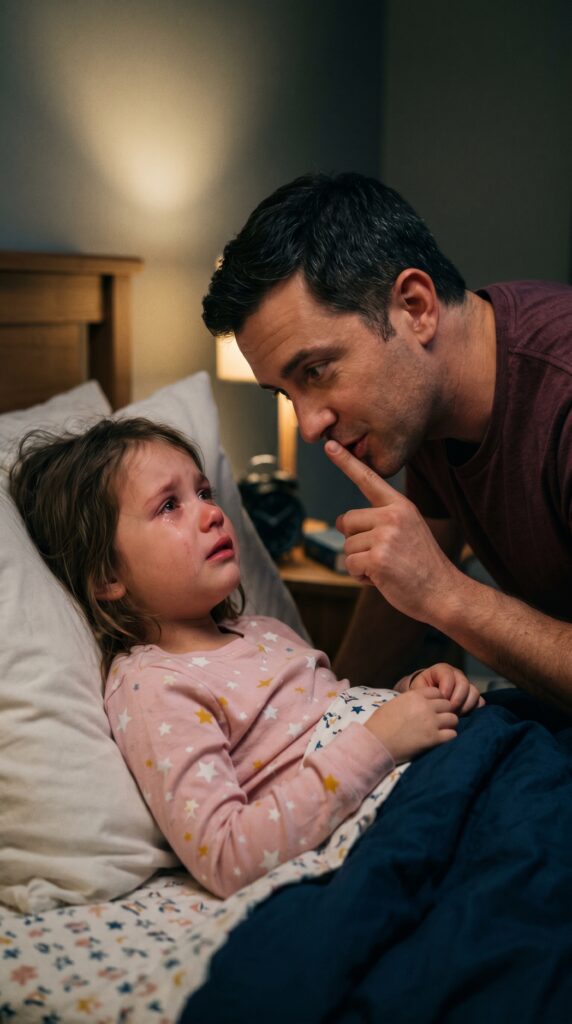
She smiled at me like I was supposed to smile back and I almost did — because that is what eight years of habit looks like, that is what muscle memory does to a person, your face starts moving before your mind gives it permission — but I stopped myself and just stood there in the kitchen doorway looking at the woman I had built a life with and trying to find the person I thought I knew somewhere behind her eyes, and I couldn’t find her, and I don’t know if that was the most terrifying moment of the night or if what came next was. I said her name. Just her name. Nothing else. And something in my voice must have landed differently than it ever had before because her smile didn’t fade slowly the way smiles usually do — it dropped, all at once, like something that had been held up by a string and the string had just been cut. She said “what’s wrong” and I said “I need you to tell me what happened to Sophie’s back” and I watched her face go through five different expressions in three seconds — surprise, then calculation, then something that tried very hard to look like confusion, then concern, then a version of innocence that was assembled too deliberately and too quickly to be real. She said “what do you mean, she fell, I told her to be careful on the stairs” — and there it was, the answer ready before I had even finished asking the question, the story already constructed, already waiting, and something about how fast it came out made the bruise on my daughter’s back feel ten times larger than it already was. I told her that was not what Sophie said. She told me Sophie was a child and children exaggerate. I told her Sophie did not look like a child who was exaggerating. She told me I had been away for a week and maybe I didn’t know what had been going on as well as I thought I did, and she said it in that particular tone, the one that had always made me second-guess myself in the past, the one that made me feel like my concern was actually arrogance, like my instincts were actually ignorance, like loving my daughter too loudly was somehow a character flaw — and for a moment, just a moment, I felt the old familiar pull of it, the way that tone had worked on me a hundred times before. But then I thought about Sophie’s hands gripping my sleeve. I thought about the word “please.” I thought about a little girl who had spent an entire day unable to sleep, unable to tell anyone, pressing pain down inside herself because she had been taught that the truth would only make things worse. And the tone stopped working. I told my wife I wanted her to look me in the eye and tell me she had never laid a hand on our daughter in anger. The kitchen went so quiet I could hear the refrigerator humming. She didn’t answer immediately. And in that silence, every unanswered question from the last year started rising to the surface all at once — every time Sophie had gone quiet when her mother entered the room, every time she had stopped mid-sentence and looked down, every time I had called home and heard something underneath my daughter’s voice that I could not name but that had always left me uneasy in a way I kept pushing aside because I did not want to know what it meant. My wife finally said “I cannot believe you are doing this right now, you just walked in the door” and I said “yes, I did, and I am so grateful that I did” and I turned around and walked back to Sophie’s room because I needed to be where my daughter was, and because I did not trust what my face was about to do. Sophie was sitting on the edge of her bed with her hands folded in her lap, still wearing her pajamas, still watching the door — and when she saw me come back in, her whole body exhaled. She said “is she mad?” and I sat down next to her and I said “the only thing that matters right now is you” and I meant it more completely than I have ever meant anything in my life. I made a decision in that moment — quiet, certain, the kind that doesn’t need to be announced because it is already permanent — and I picked up my phone and did the thing I should have done the moment I lifted my daughter’s shirt and saw what was underneath it. Because some doors, once opened, cannot be closed. And I had just walked through one.
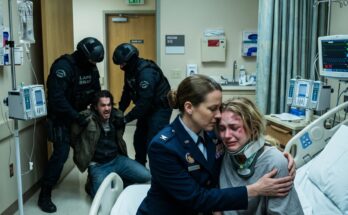
The phone felt heavier than it should have as I dialed, sitting on the edge of Sophie’s bed with my free hand resting gently on her knee, and when the dispatcher answered I heard my own voice come out steadier than I expected, steadier than I felt, because something had taken over that was no longer about emotion but about function, about doing the next right thing and then the next one after that, and I told them my daughter had been injured, I told them I needed someone to come, I gave them our address, and I felt Sophie’s small fingers wrap around my wrist the entire time I was talking like she was afraid I might disappear if she let go — and I covered her hand with mine and I did not let go either. My wife appeared in the doorway before I had finished the call and her face had shifted again into something I had never seen on her before, not in eight years, not once — something stripped of all its usual architecture, no performance left in it, just raw exposure, the look of someone who has just realized that the story they were controlling has slipped out of their hands entirely and there is no way to catch it. She said my name. She said “please don’t do this, we can talk about this, this is our family” and I looked at her and I felt grief and rage and sorrow all occupying the same space inside my chest simultaneously, not taking turns, all at once, because she was right that it was our family and that was exactly why I was doing it, that was exactly why there was no version of this night where I put the phone down and pretended my daughter’s back was a staircase accident and went to sleep in my own bed like a man who could live with that — I could not live with that, I would not live with that, and the version of me who might have been talked into living with that had ceased to exist the moment Sophie flinched away from my hand. The officers arrived in under ten minutes and in those ten minutes I sat with Sophie and I told her she was safe and I told her she had done nothing wrong and I told her that brave was not the absence of fear but doing the hard thing while the fear was still sitting right there beside you, and she looked up at me for the first time all evening with something approaching steadiness in her eyes and said “Dad, I was so scared you wouldn’t believe me” and that sentence will live inside me for the rest of my life in a place nothing else will ever be able to reach. I told her there was not a single version of any story she could ever tell me where I would not believe her. I told her that was not something she needed to earn. I told her that was just what I was. When the officers came in I showed them the bruise and I watched their faces change the same way mine had and I answered every question they asked with Sophie sitting close against my side, and my wife stood in the hallway and said very little, because there was very little left to say, because a bruise the size of a fist on an eight year old’s spine says most of what needs to be said without any words attached to it. There were calls made and reports filed and a visit from a medical professional who documented everything carefully and spoke to Sophie in a voice so gentle it almost undid me completely, and through all of it Sophie sat with her chin slightly raised in a way I had never seen from her before, a posture that did not belong to the child who had been hiding behind the bedroom door two hours earlier — it belonged to a child who had told the truth and watched the truth do exactly what truth is supposed to do, which is change things, which is crack open the version of reality that was hurting her and let real air into it for the first time. That night I made a bed for Sophie on the couch in the living room with every pillow and blanket I could find and I sat in the chair beside her until her breathing slowed and her face went soft and the furrow between her brows that I now realized had been there for months finally, finally released — and I stayed there long after she fell asleep, in the quiet of a house that felt nothing like the one I had walked into a few hours before, and I thought about every trip I had taken, every reassurance I had accepted too easily, every instinct I had filed away under “probably nothing” because probably nothing is so much more comfortable to live inside than probably something. I will not make that mistake again. What followed in the weeks after that night was long and painful and ongoing and not mine alone to tell in detail, but what I can tell you is that Sophie is getting the help she needs, she is sleeping better, she laughs more freely now, and last Tuesday she ran to the door when she heard me coming up the steps — actual running, actual laughter, the kind I had been missing without fully knowing I was missing it — and she threw her arms around me and said “Dad you’re home” with her whole body, the way children are supposed to greet the people who love them, the way she used to before something in this house taught her to make herself smaller than she was. I am sharing this not because I have arrived at any clean or comfortable ending, because I haven’t, and I won’t pretend otherwise — I am sharing this because somewhere out there is a parent just like I was, coming home tired, accepting the silence, filing the unease away, choosing “probably nothing” over and over again because the alternative is too heavy to lift. Lift it anyway. Check on your children the way Sophie needed me to check on her — not just whether they are fed and clothed and present, but whether they are safe in the places and with the people they cannot yet protect themselves from. Because my daughter needed me to walk through that door and refuse to look away. And the most important thing I have ever done in my life was refuse to look away. If this story reached something in you, share it — because somewhere in your circle there is a child waiting for someone to believe them, and maybe this is the thing that reminds the right person to ask.
SHORT SUMMARY:
A father returns home from a work trip expecting a normal evening — but instead of the usual laughter and hugs at the door, he is met with silence. Within minutes, his eight-year-old daughter Sophie whispers something from the bedroom that shatters everything he thought he knew about his own home. She had been carrying a bruise the size of a fist on her back for over a day, too afraid to speak, too afraid that telling the truth would only make things worse. What follows is a father’s most painful and most important night — the moment he stops accepting the silence, starts asking the harder questions, and refuses to look away from what his daughter needed him to see. It is a story about betrayal inside a home that was supposed to be safe, about a little girl who found the courage to whisper the truth to the one person she still believed in, and about a father who chose his daughter over his comfort, over his disbelief, over everything — and changed the course of her life because of it.
THE LESSON:
The most dangerous thing a parent can do is choose comfort over instinct. We tell ourselves “probably nothing” because “probably something” is too heavy to carry — but our children cannot afford for us to put that weight down. Sophie did not need a perfect father. She did not need a father who had all the answers or who was always present or who never made mistakes. She needed a father who, when she finally whispered the truth, believed her without hesitation and acted without delay. That is the lesson. When a child finds the courage to tell you something — especially something they were warned to keep silent — the greatest gift you can give them is to make sure they never regret saying it out loud. Believe your children. Check on them not just with your eyes but with your presence. And when something feels off, do not file it away under “probably nothing.” Lift it. Look at it. Because some silences, if we let them go on long enough, leave marks that last far longer than any bruise ever could.