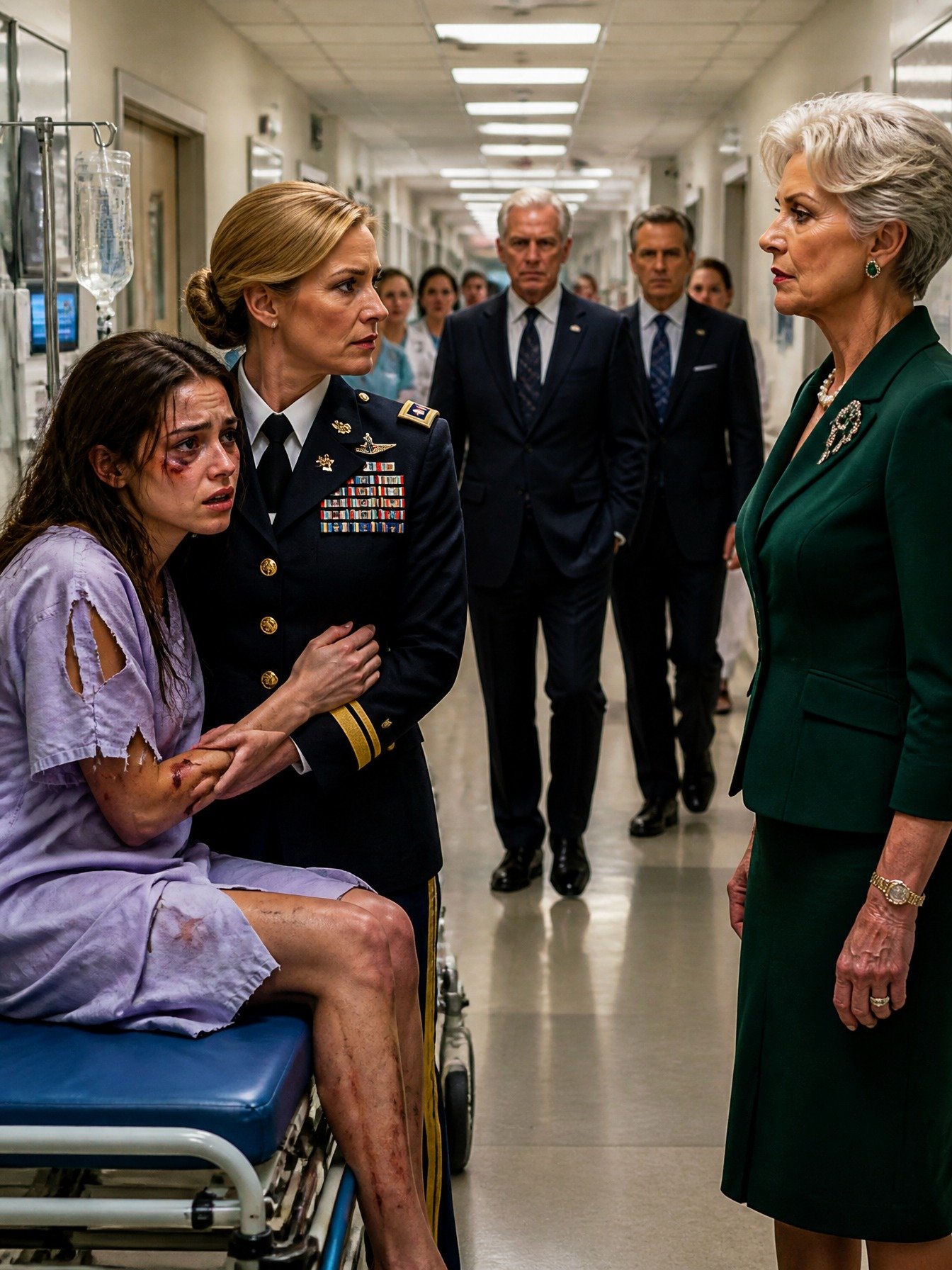
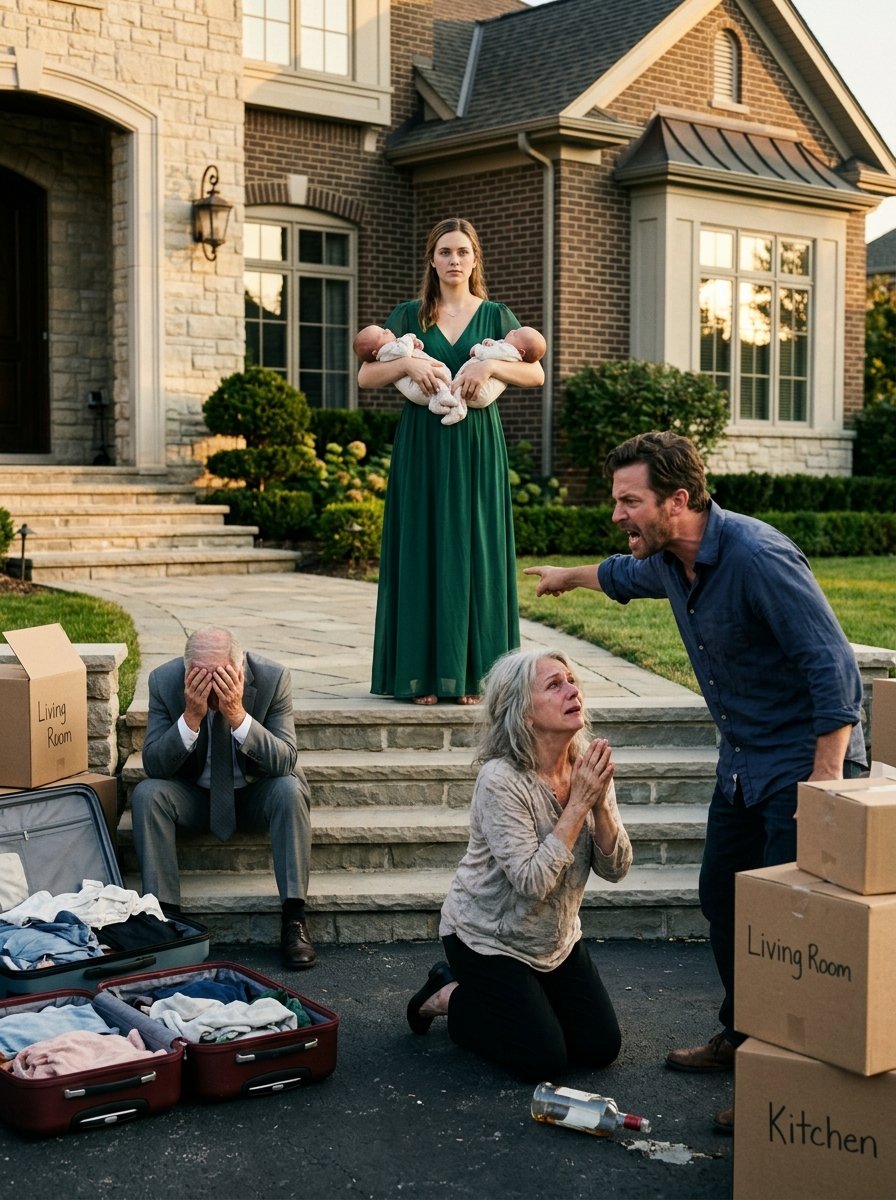
Alejandro Herrera stood three feet in front of me and the air between us was the kind of air that precedes something irreversible. He was not a small man. He carried the weight of money and authority the way some men carry a second skeleton — it was in his posture, his jaw, the way his eyes moved slowly like he had never once had to rush for anything in his life. He looked at me the way you look at a nail that has come loose in an expensive piece of furniture. An inconvenience. Something to be dealt with and forgotten. “Rafael,” he said, low and measured, “I don’t know what my son said to you, but I suggest you think very carefully about your next words.” And I thought about Mateo’s back. I thought about the way he pulled his shirt down and apologized. I thought about eight years old and already knowing how to make yourself smaller so the pain would stop. And I said, “Call Mateo down here. Just ask him to come downstairs. That’s all I’m asking you to do.” Valeria moved fast. Faster than I expected. She stepped between us, her hand touching Alejandro’s arm, her voice dropping into something private and practiced, something she had clearly used on him before, soft and certain and designed to redirect. “Alejandro, this man has overstepped every boundary. He needs to be removed. I’ll call security.” But Alejandro didn’t move. He was looking at me. And I don’t know what he saw — maybe it was the fact that I hadn’t raised my voice, hadn’t threatened, hadn’t done anything except stand completely still in that entryway with my hands at my sides and my eyes steady — but something made him pause. Something made him hold up one hand toward Valeria without looking at her. She stopped talking. And he said, quietly, to no one in particular, “Mateo.” Just the name. A few seconds passed. Then small footsteps at the top of the stairs. Mateo appeared, backpack still on, standing at the top like he was deciding whether the ground below was safe. Alejandro looked up at his son. And even from where I stood I could see it — the moment a father’s eyes really look at his child, maybe for the first time in a long time, and notice something is wrong. Not wrong the way children are sometimes moody or difficult. Wrong the way a living thing is wrong when it has been hurt in the dark for a long time. “Come down, hijo,” he said. Mateo came down the stairs one step at a time, the same careful way he had walked out of school that afternoon, and I understood again watching him move that this child had learned to manage his own body around pain so well that it had become his normal. He stopped at the bottom of the stairs. He didn’t look at Valeria. He looked at me. And I gave him the smallest nod I could. Alejandro crouched down in front of his son, which surprised me, because powerful men rarely make themselves smaller, and he said, “Are you okay?” Mateo said nothing. Alejandro looked at him for a long moment and then said, very carefully, “Did something happen to you?” The room held its breath. Valeria’s hand tightened around her own wrist. I could see it from across the room, her knuckles going pale, the only crack in all that composure. And Mateo, this eight year old boy who had been told that telling the truth would make him disappear, who had been apologizing for his own wounds, who had survived inside that house by becoming invisible — Mateo looked at his father and said nothing. But he reached down and lifted the hem of his shirt. Just a few inches. Just enough. And the sound Alejandro Herrera made was not a word. It was not a sentence. It was the sound of a man’s entire understanding of his own life breaking open at the seams. He reached out and touched his son’s back with one hand, so gently, the way you touch something you are terrified of damaging further, and then he stood up slowly and turned around. And Valeria Castillo was already backing toward the hallway. She had read the room. She had read his face. And she knew that the version of events she had been constructing for a year — the troubled boy, the difficult child, the lies he tells — had just collapsed in four seconds in a marble entryway in front of the one person whose belief she needed most. “Valeria,” Alejandro said. Just her name. Nothing else. But the way he said it. The way he said it made me take one step back because I have heard grief before and I have heard rage before but I had never heard both of them occupying the same single word in a man’s mouth at the same moment. She stopped backing away. She straightened. And then she did something I did not expect. She smiled. Not the camera smile. Not the practiced sweetness. A different smile entirely. Cold and certain and calculated. And she said, “You will never be able to prove any of this.” That was her mistake. Not because she was wrong about proof. She may have believed she was right about proof. Her mistake was saying it out loud in a house with marble floors and high ceilings that carried sound like a cathedral — in front of a father who had just touched the wounds on his child’s back with his own hand, and a driver who had already quietly pressed record on his phone the moment he stepped out of the SUV and walked through that gate.
The word “prove” hung in that marble entryway like smoke. Valeria said it with the confidence of a woman who had spent a lifetime understanding how power works — who gets believed, who gets dismissed, who gets to write the story and who gets erased from it. She had calculated everything. The staff who looked away. The father who traveled. The boy who had been taught that silence was survival. She had built a fortress out of other people’s willingness not to look. What she had not calculated was me. I am not a lawyer. I am not a doctor. I am not a man with connections or a last name that opens doors. I am a driver. But I had been in that car with Mateo for almost a year. I had watched him fade week by week, Monday through Friday, the same route, the same silences, and somewhere along the way without ever planning to, I had started keeping record. Not because I knew what was happening. But because something in me knew that children do not fade like that without a reason, and that reasons like that have a way of needing a witness. On my phone I had fourteen short voice memos. Mateo talking in the backseat on the days he couldn’t hold it in anymore. Small fragments. A sentence here. A few words there. Nothing he said directly. Nothing that named her. But his voice. His eight year old voice, quiet and careful and exhausted in a way that no child’s voice should ever be exhausted. And I had the recording from today. From the moment I stepped out of the SUV and walked through that gate. Every word. Her voice. Measured and cold and completely certain she was untouchable. I looked at Alejandro. He was already looking at me. I held up my phone. I did not say anything. I did not need to. His jaw tightened. He turned to Valeria and in that moment every trace of the man who had tolerated her presence in his home, who had accepted her framing of his own son, who had chosen comfort and convenience over the quiet evidence his own eyes had been trying to show him for months — all of it left his face at once. What replaced it was something much older and much simpler than power or pride. It was a father. Just a father. Standing in his own house realizing how long he had left the door open to the wrong person. “Get out,” he said. Valeria did not move. “Alejandro, listen to me, you need to think about what you are doing, this man has manipulated—” “Get out of my house.” His voice did not rise. It did not need to. There is a register of quiet that is louder than shouting and Alejandro Herrera had just found it. Valeria looked at him for a long moment. Then she looked at me. And I want to be honest — the look she gave me was not fear and it was not shame. It was something colder than both of those things. The look of a person recalculating. Deciding which exit to take. She picked up her bag from the side table near the door, the one she had clearly set there herself like she lived there, like she already owned the place, and she walked out. The gate clicked shut behind her. The house went so quiet I could hear Mateo breathing. Alejandro stood completely still for what felt like a very long time. Then he turned to his son. And he did something I will remember for the rest of my life. He sat down on the floor. Right there on those cold marble floors in his expensive suit, this man who commanded boardrooms and moved money across entire states — he sat down on the floor so he could be at eye level with his eight year old son. And he said, “I’m sorry, Mateo. I’m sorry I didn’t see it. I’m sorry I wasn’t paying attention. That is my fault and not yours. None of this is yours.” Mateo stood very still. Children who have been hurt for a long time do not rush toward comfort. They have learned that comfort can be withdrawn. They wait to see if it is real. But Alejandro didn’t move away. He stayed on that floor and he opened his arms and he waited. And after a moment that felt as long as the whole year had felt — Mateo stepped forward and let his father hold him. And he cried. Not the quiet careful crying of a child who has learned to cry without making noise so no one comes. He cried out loud for the first time in what I suspected was a very long time. The kind of crying that means something has finally been allowed to exist that was forced underground for too long. I turned toward the door because that moment did not belong to me. But before I could take a step, Mateo’s voice came from behind me, muffled against his father’s shoulder, and he said the thing that has not left me since. He said, “I knew Mr. Rafael would tell you. I knew he would.” I stopped walking. I stood at that door with my back to them and I took one breath and then another because I needed to hold myself together for just a few more seconds and I was running out of room to do it. He knew. This child had climbed into the back of my car that afternoon and whispered that his back hurt not just because he was in pain but because somewhere underneath all that fear and all that silence and all that careful survival — he had decided to trust me. He had chosen me. And the weight of that, the weight of being chosen by a child who had every reason to trust no one — that is not something you put down easily. That is something you carry. That night I filed a formal report with the authorities. I submitted the recordings. I gave a full statement. Valeria Castillo was detained within forty eight hours. The investigation that followed uncovered things I will not detail here because some truths are too heavy to place in a caption and some wounds deserve privacy even when the person they belong to is finally safe. What I will tell you is this. Mateo Herrera is no longer fading. I know because three weeks after that afternoon, Alejandro called me. Not to discuss schedules. Not to talk about routes or pickups. He called to tell me that Mateo had asked if Mr. Rafael could still be his driver. And then he said something I did not expect from a man like him. He said, “I failed my son. You didn’t. Thank you for not looking away.” I went back to work the following Monday. Same route. Same school. Same black SUV waiting out front. But when Mateo came through those school doors and saw the car, he did not walk slowly and carefully like a child managing pain. He ran. He ran across that courtyard the way eight year olds are supposed to run — loud and unguarded and completely unafraid — and he yanked open the back door and threw his backpack in and said “Mr. Rafael, guess what happened today” before he had even sat down. And I said, “Tell me everything.” And he did. The whole ride home. He talked the entire way without stopping once. And I drove and I listened and I did not say much because I did not need to. Because a child who has found his voice again does not need you to fill the silence. He needs you to stay in the car and keep driving and let him know that this time, someone is going to keep listening. I am just a driver. But I have learned that sometimes the most important thing a person can do is simply refuse to pretend they did not see what they clearly saw. You do not need a title or a platform or a powerful last name to protect a child. You only need the willingness to stay when every comfortable instinct is telling you to drive away. Stay. Please. Whatever you are witnessing in a child’s eyes, in their posture, in the careful way they have learned to take up less and less space in the world — stay. Ask the question. Sit in the silence with them. Be the person they were hoping would finally notice. Because children do not whisper that they are hurting to people they do not believe will listen. When a child tells you something, they are not just telling you. They are choosing you. Do not make them regret it.
SUMMARY:
This is the story of Rafael, a driver who picked up eight-year-old Mateo from school every day. On the outside, Mateo had everything — a wealthy father, a prestigious school, a perfect life. But for almost a year, Rafael noticed the boy slowly fading. Less laughter. Less light. Less life. Then one afternoon Mateo whispered three words that changed everything — “my back hurts.” What Rafael discovered beneath that school uniform was not just physical wounds but an entire secret world of suffering happening behind closed doors, inflicted by Valeria, the woman about to become Mateo’s stepmother. Instead of staying silent and driving away like his job required, Rafael made the hardest and most human decision of his life. He stayed. He spoke. He recorded. He refused to look away. And because one ordinary man chose courage over comfort, a little boy who had learned to cry without making noise finally cried out loud — safe, held, and no longer alone.
THE LESSON:
The most dangerous thing that happens to an abused child is not the abuse itself. It is the silence of every adult around them who noticed something was wrong and decided it was not their place to act. Rafael was not a social worker. He was not a doctor or a teacher or a family member. He was a driver. And he saved that child’s life not with credentials or authority but with the simple and radical decision to take what he saw seriously. We live in a world that trains us to mind our business, stay in our lane, and not get involved in things that do not concern us. But a suffering child concerns all of us. Every single one of us. You do not need a title to ask a child if they are okay. You do not need permission to believe them when they answer. You do not need to be powerful to refuse to look away. What you need is exactly what Rafael had — the willingness to let what you see actually land in your chest, and the courage to let that feeling move you into action before it is too late. Children do not whisper their pain to people they think will ignore them. When a child chooses to tell you something, they are not just sharing a secret. They are handing you their last remaining hope. Handle it with everything y