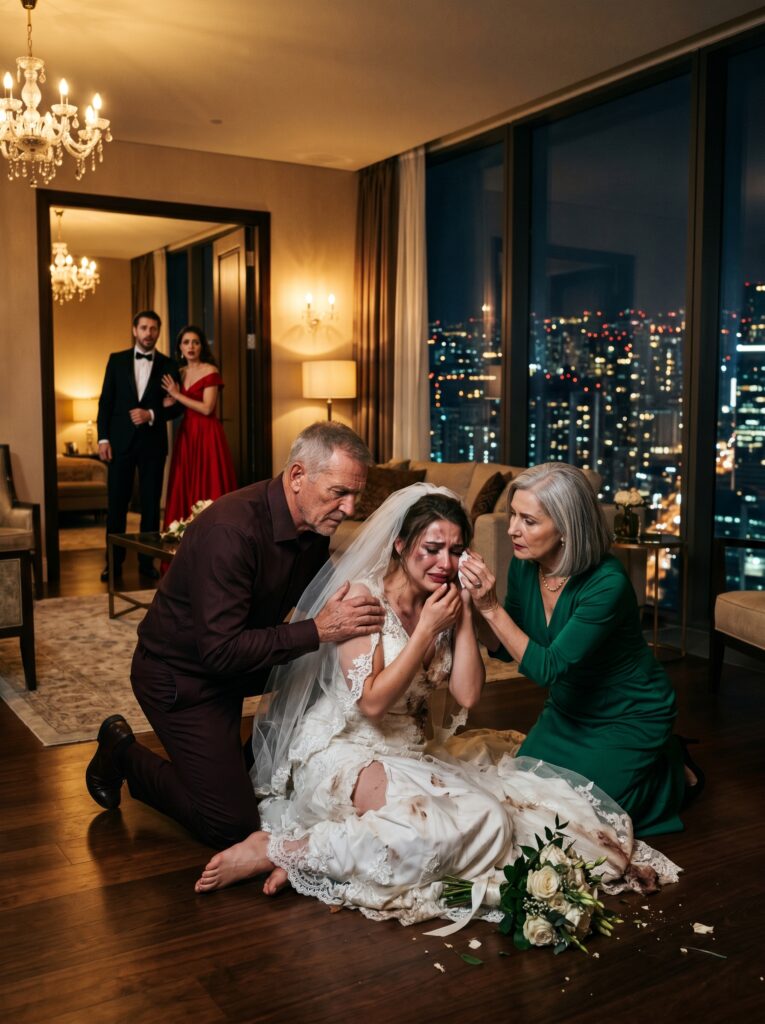
Nobody answered Sofia’s question out loud, because honestly, none of us wanted to say what we were all starting to think, so instead Alexander did what he does best — he got to work. He called a private investigator he’d used years ago during a business dispute, a quiet, methodical woman named Renata who he said “doesn’t sleep until she has answers,” and by 3PM that same day, Renata called back with a preliminary report that made the room feel like it had dropped ten degrees. Carmen Robles wasn’t just “traditional” or “old-fashioned” — Carmen Robles was in debt. Serious debt. The kind that comes with liens, late notices, and a second mortgage on a house she’d told everyone was paid off years ago. The gold jewelry, the designer bags, the talk of “what kind of family” we were — it was all surface. Underneath it, Renata found three maxed-out credit lines, a defaulted business loan tied to a failed boutique Carmen had opened two years ago, and — this was the part that made Alexander go very still — a property management company Carmen had quietly registered four months ago. Four months ago. The exact same time Javier lost his job. The same property management company, Renata explained, had exactly one listing in its system. An Uptown Dallas condo. Sofia’s condo. They had already started the paperwork to manage it — before the wedding had even happened. Sofia’s hands started shaking again, but this time it wasn’t fear, it was something closer to disbelief curling into rage. “They planned this,” she whispered. “Before I even said yes to Javier… they already had a company ready for my condo?” Alexander nodded slowly. “It looks that way.” But Renata wasn’t done. She’d also pulled basic background on the “six women” Sofia described being in that hotel room — and identified two of them through a family event Facebook page Carmen had forgotten was set to public. One was Carmen’s sister. The other was Javier’s aunt — who, it turned out, was a notary public. A notary. In the room. On Sofia’s wedding night. Why would you need a notary in the room while pressuring someone to sign over property… unless you were hoping to get a signature notarized on the spot, that same night, while the bride was frightened, exhausted, and isolated? Alexander sat back down, rubbing his face with both hands, and said quietly, “Sofia, if you had signed anything last night… it would have looked completely legal by morning.” The room went silent again. Then Sofia’s phone, which Alexander had turned back on to check for “patterns,” buzzed with a new message — not from Javier this time. From Carmen. Just four words: “We need to talk privately.” Alexander looked at the message for a long moment, then looked up at Sofia and asked her something that surprised both of us: “Do you trust me enough to let her think she’s winning… for just a little longer?”
Sofia looked at her father for a long moment, then at me, then down at the bruises still purple on her own arms, and finally she said the words that changed the direction of everything: “Yes. Let her think she’s winning.” So Alexander laid out a plan, simple but precise — Sofia would reply to Carmen, agree to “talk privately,” and suggest meeting at the same hotel that evening, in a private lounge, somewhere with cameras, witnesses, and — unknown to Carmen — Renata sitting two tables away with a recorder running and a clear line of sight, while Alexander waited in the car outside with copies of everything Renata had pulled that afternoon. At 6PM, Carmen arrived looking polished and composed, gold bangles clinking, the same confident smile she’d worn the very first day she walked into my living room and started pricing my furniture with her eyes, and she sat across from Sofia, reached for her hand like nothing had happened, and said, “I’m glad you’re being reasonable. Family disagreements shouldn’t go outside the family.” Sofia, to her credit, didn’t flinch. She said quietly, “I just want to understand something. Why my condo specifically? Why not ask for help, if things were… difficult?” And Carmen — confident, cornered without knowing it yet — made the mistake people like her always make. She got comfortable. She talked. She told Sofia that “every family has obligations,” that Javier’s “career setback” was temporary, that the condo would “stay in the family either way” since Sofia was “marrying into it,” and then, almost as an afterthought, she said the line that ended everything: “Last night was unfortunate, but you have to understand — once you sign, none of this needs to come up again. No hospital. No police. No embarrassment for anyone. Including you.” A threat. Recorded. In her own voice. Sofia kept her composure just long enough to say, “I understand,” and excuse herself to the restroom — where Alexander was waiting with Renata, who had already started transferring the recording to three separate secure locations. Within forty minutes, that recording was in the hands of a family law attorney, a criminal attorney, and — because Javier had once represented clients before the State Bar — an ethics complaint was already being drafted, because if Javier had known about and participated in coercing his wife to sign over property under duress on their wedding night, his legal career, if he ever planned to return to one, was finished before it started. The next morning, Sofia filed a police report, this time with bruises documented by a doctor, photos from Alexander, and an audio recording of Carmen Robles essentially confessing to extortion and admitting she knew about the assault. Carmen was arrested within 48 hours on charges including assault and attempted coercion. Javier, it turned out, hadn’t just lost his job — Renata’s deeper dig found he’d also been quietly siphoning money from his mother’s failing business accounts, which meant the very family that tried to strip my daughter of everything was already collapsing from the inside, and Sofia’s wedding had simply been their last desperate move to save themselves using someone else’s name on someone else’s deed. Sofia filed for an annulment within the week — citing fraud and duress — and because the marriage was barely twelve hours old before the assault occurred, the court moved quickly. Six months later, Sofia still owns her condo. Every brick of it. Carmen Robles is awaiting trial, Javier has been disbarred before he ever truly practiced, and the two of them are now fighting each other in court over what’s left of their finances — turning on one another the same way they once turned on my daughter. As for Alexander, he and Sofia talk every single day now. Sometimes about court dates and lawyers, but increasingly, just about life — dinners, old memories, plans for the future. Ten years of silence, broken in one terrifying night, rebuilt one phone call at a time. Sofia is doing better. She’s in therapy, surrounded by people who actually love her, and she told me last week, “Mom, I used to think loving someone meant ignoring the warning signs. Now I know it means listening to the people who love you enough to point them out.” Carmen Robles thought she could break a young bride into silence with her fists and a notary in the next room. Instead, she broke her own family wide open — and gave my daughter back the father she’d lost for a decade. If you read this far — share it. Somewhere out there, another mother needs to hear that it’s never too late to make that call, and another daughter needs to know her voice, and her name on her own deed, matters more than anyone’s approval.
Here’s the short version: A mother’s daughter, Sofia, comes home bloodied on her wedding night after her new mother-in-law Carmen and a group of women assault her, demanding she sign over her $1.8 million condo. Sofia’s estranged father Alexander reunites with the family after a decade of silence and helps uncover that the wedding was actually a calculated scheme — Javier had secretly lost his job, his mother was drowning in debt, and they’d already set up a property management company for Sofia’s condo before the wedding even happened, complete with a notary on standby to make a forced signature “legal.” Instead of folding, the family turns the tables, secretly records Carmen confessing to the threat, and uses it to get her arrested, annul the marriage, and protect Sofia’s property. In the end, Carmen faces criminal charges, Javier is disbarred, and Sofia rebuilds her relationship with her father.
The lesson: predatory people often reveal themselves early through small red flags — comments about money, property, or “what kind of family” someone comes from — and those early warning signs are worth taking seriously, even when love and excitement make it tempting to dismiss them. It’s also a story about how isolation is often the first tool an abuser uses (cutting Sofia off, threatening her not to call for help), and how reconnecting with people who genuinely care — even after years of distance — can be the thing that turns a crisis around. And practically: keeping major assets like property solely and clearly in one person’s name, with documentation, isn’t paranoia — it’s protection.