Part 2 — The Moment After
The knife didn’t move again.
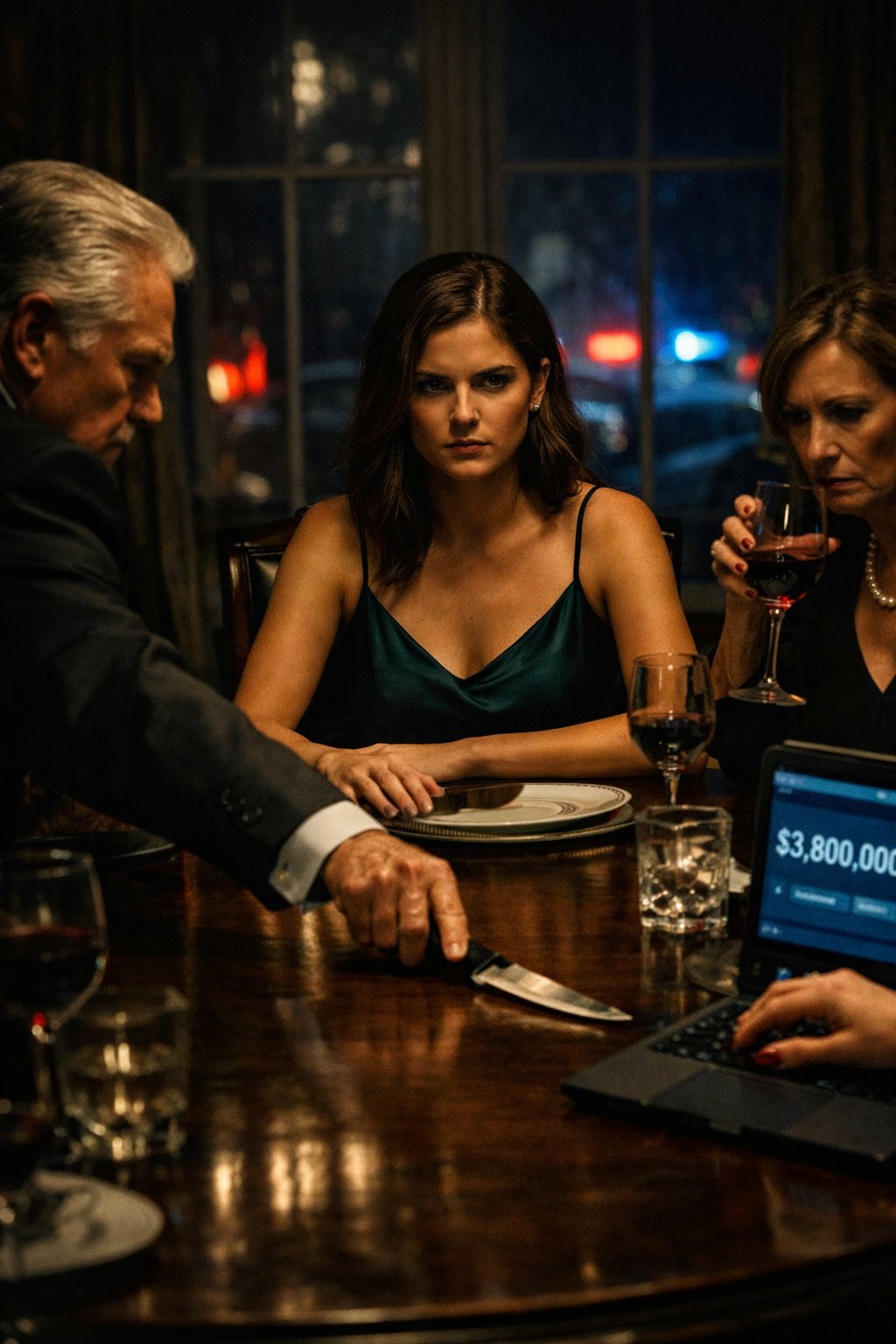
Jessica’s finger pressed the “Transfer Funds” button, and the laptop emitted a soft chime — the kind of sound that usually means success. My father exhaled, a satisfied, heavy breath that smelled faintly of whiskey and victory. My mother’s shoulders dropped, her hand trembling as she set down her glass.
Then the silence changed.
It wasn’t the sound of money moving. It was the sound of a system waking up.
The laptop screen flickered once, twice, then froze. A small icon appeared in the corner — a blue shield with a white star.
Jessica frowned. “What—”
The dining room lights dimmed for a fraction of a second as the router overloaded. My phone buzzed in my pocket. One word flashed across the screen: Activated.
Outside, tires screeched.
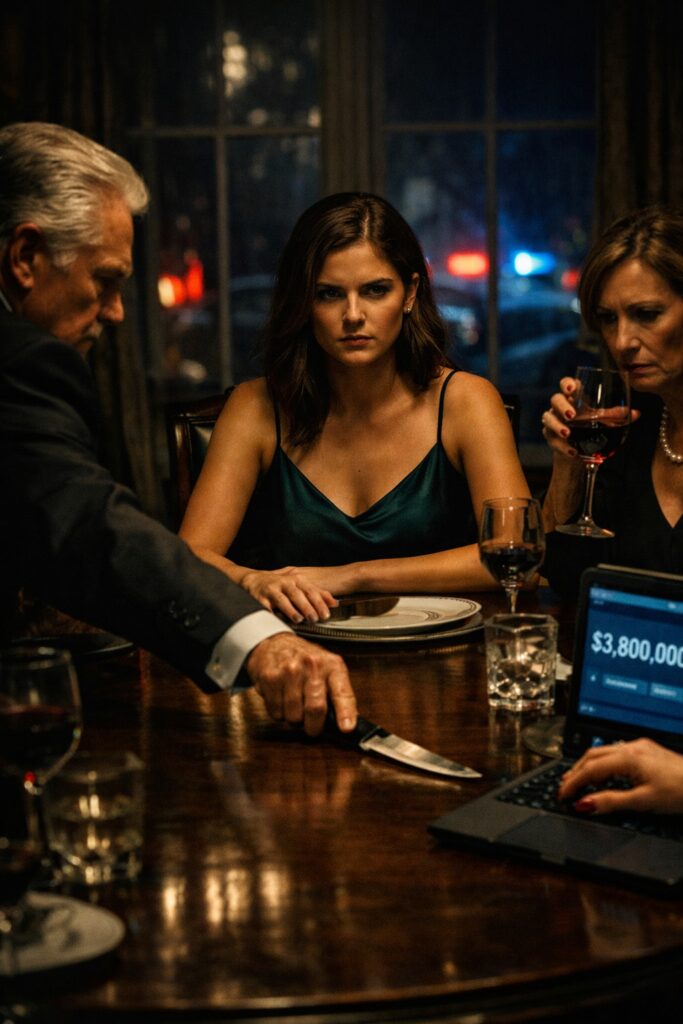
My father turned toward the window just as red and blue lights cut through the curtains. The reflection splintered across the crystal glasses, painting the table in fractured color. My mother’s wine glass tipped, spilling a thin line of red across the linen — a perfect imitation of blood.
“Rosalind,” my father said, his voice suddenly hoarse. “What did you do?”
I stood slowly, pushing my chair back with deliberate calm. “You wanted a transfer,” I said. “I made one.”
The front door shook under the force of a knock — not polite, not hesitant.
“State Police!” a voice shouted. “Open up!”
Jessica’s hands flew to the laptop, trying to close the window, but the screen had already changed. The fake bank interface dissolved into a live feed — the dining room itself, captured from the hidden camera in the chandelier.
My father’s face appeared on the monitor, frozen mid‑gesture, knife still glinting under the light.
He lunged for the laptop. “Turn it off!”
I stepped back. “You can’t.”
The knock came again, louder this time.
My mother whispered, “You wouldn’t—”
“I would,” I said. “And I did.”
The deadbolt clicked open from the outside — a master key, courtesy of the warrant I’d signed two days earlier. Officers flooded the hallway, their boots echoing against the marble. My father’s hand tightened around the knife, but the moment he raised it, a voice barked, “Drop it!”
He froze.
Jessica’s sob broke the silence. My mother’s glass shattered against the floor.
I turned toward the officers, calm as the night I’d planned this. “They’re all yours,” I said.
One of them nodded, stepping forward to cuff my father. Another retrieved the laptop, still displaying the frozen image of the family that had tried to destroy me.
As they led them out, my mother looked back, her voice trembling. “You set us up.”
I met her gaze. “No,” I said softly. “You set yourselves up. I just made sure someone was watching.”
The door closed behind them, leaving the house in silence. The chandelier hummed faintly, the camera light blinking once before shutting off.
I poured myself another glass of wine — not to celebrate, but to mark the end.
The merlot tasted different now.
Not metallic.
Just free.
The house was silent long after the sirens faded. I sat at the dining table, the wine glass empty, the knife still glinting faintly under the chandelier. The air smelled of spilled merlot and fear.
By morning, the marble floors were scrubbed clean, but the memory wasn’t. The police had taken everything — the laptop, the knife, the family portraits from the hallway. They’d left behind only the echo of boots and the faint hum of the refrigerator.
I didn’t sleep. I watched the sunrise through the kitchen window, the light crawling across the countertops my mother once called “vulgar.” It looked beautiful now — honest, unpretentious, mine.
At 9 a.m., my phone rang. Detective Harris. “Rosalind Campbell?” “Yes.” “Your parents and sister are in custody. We’ll need you to come down to the station for a statement.”
I agreed. Calmly. Because this was the part I’d prepared for.
The interrogation room smelled of coffee and paper. Detective Harris was kind enough not to pretend he understood. “You planned this,” he said, flipping through the file. “The fake bank site, the camera, the warrant. You knew they’d try.” “I didn’t know,” I said. “I just knew they couldn’t resist.”
He studied me for a long moment. “You could’ve just walked away.” “I did,” I said. “They followed.”
He nodded slowly, closing the file. “You’re free to go. But you should know — your grandmother’s foundation account wasn’t touched. You protected it.”
I smiled faintly. “She built it for people who needed help. Not for people who thought they deserved it.”
Outside, the city was alive — horns, footsteps, the smell of rain on concrete. I walked past a newsstand where the headline already screamed: “Boston Heiress Outs Family in $3.8 Million Sting.”
My reflection in the glass looked unfamiliar — sharper, steadier. Not the daughter they mocked. Not the embarrassment. Just the woman who finally stopped apologizing for surviving.
That night, I returned to my apartment. The quartz counters gleamed under the kitchen light. I poured a glass of wine — not merlot this time, something better — and opened my grandmother’s old journal.
Inside, her handwriting curved across the page: “Money reveals character. But loss reveals truth.”
I closed the book and looked out at the city lights. Somewhere downtown, my family was learning what truth felt like when it wasn’t gilded.
And for the first time in years, I felt something close to peace. Not triumph. Not revenge. Just freedom — quiet, earned, and absolute.