“The long phone charger,” I said. I was sitting on the edge of the bed with both hands on my belly. “I didn’t pack it.”
“Side pocket.” Andrew was kneeling on the bedroom floor beside the hospital bag. “Charger, slippers, and that lavender lotion you pretend you don’t love.”
“I don’t love it.”
“You put it on every night, Em.”
“Socks?”
“Two pairs. The fuzzy ones.” He zipped the pocket. Then he reached under the folded clothes and pulled something out, grinning like a kid who’d hidden a frog in his teacher’s desk. “And this. For afterward.”
It was my caramel-filled chocolate bar, the expensive kind in the gold wrapper that I only let myself buy on birthdays. It crinkled in his fingers. I laughed so hard the girls kicked, both of them at once, one high and one low, like they were in on the joke.
“You’re ridiculous,” I said.
“I’m prepared. There’s a difference.”
He tucked the chocolate bar back into the bag, right on top, where I’d see it first.
His phone buzzed on the dresser.
He got up, glanced at the screen, and his shoulders sank a little. It was a small thing. Most people wouldn’t have noticed. I’d been married to him for eleven years. I noticed.
“It’s Mom,” he said.
He put her on speaker and set the phone on the bed between us, which is what he always did with his mother. I think it made him feel less alone with her.
“Andrew, darling,” she said. Her voice was as sweet as cough syrup. “I’ve been thinking. I’ll come stay with you after the discharge. Someone has to help properly.”
Andrew rubbed his eyes.
“Thanks, Mom. But Helen’s already coming. She’ll be with us for the whole recovery. It’s all settled.”
There was a pause on the line.
“Helen,” his mother said. “Well. How lovely for Helen.”
“Mom.”
“I only meant it’s lovely. Really. Call me the second anything happens. I am the grandmother, after all.”
The line clicked off.
I stared at the phone on the bedspread.
“Is she upset?” I asked.
“That was just Mom being Mom,” Andrew said, rubbing the back of his neck.
I let it go. It was our day. We’d waited ten years for it, and I wasn’t going to give one minute of it to Carol.
Carol was Andrew’s mother.
She was sixty-four and had raised Andrew mostly by herself after his father left when Andrew was nine. She wore pearls to the grocery store. She sent thank-you cards for thank-you cards. She called Andrew every single day, sometimes twice, and if he didn’t pick up, she’d call me to ask if he was alive.
She’d never liked me. She’d never said so. She didn’t have to.
At our wedding, she’d hugged me in the receiving line and whispered, “He’s very sensitive, you know. Be careful with him.” I thought it was sweet at the time. I was twenty-four. I didn’t know yet that Carol said almost everything in a way that sounded sweet and wasn’t.
Helen is my mother. She’s the opposite of Carol in every way that matters. She wears sweatpants to the grocery store. She forgets birthdays. She once drove four hours in a snowstorm because I’d called her crying about a work presentation. She’d planned to stay with us for six weeks after the birth. She’d already bought an air mattress.
I think that was the part Carol couldn’t stand.
Later, when the bag was by the door and my coat was on, Andrew went quiet.
I found him standing in the nursery doorway.
He was looking at the two white cribs he’d built with his own hands. He’d done it in March, over two weekends, with the instructions laid out on the floor in order and every screw sorted into little paper cups. He’d made a schedule for it. An actual written schedule. Saturday a.m.: crib one, frame. Saturday p.m.: crib one, slats.
Above the cribs were two wooden letters he’d painted himself, one yellow and one green. I and N. Ivy and Nora. We’d picked the names three years before we were even pregnant, on a night when we weren’t sure we ever would be.
“Can I say something dumb?” he asked.
“Only smart things allowed today.”
He didn’t smile.
“Ten years,” he said. He swallowed. “All those needles. All those waiting rooms. The doctors said it plain, you know. It was me. My numbers.”
He went quiet. Then he hung his head.
“If I’d just been different,” he said, “you wouldn’t have had to go through any of it.”
I had heard him blame himself before. Lots of times, in the car after appointments, at two in the morning, on anniversaries.
I hadn’t expected to hear it today.
I crossed the room as fast as a woman carrying twins can cross a room, which is not very fast. I took his face in my hands.
“Listen to me,” I said. “I don’t see our girls as something you failed to give me. They’re ours.”
He didn’t look up.
I smiled.
“Your side, my side, a lab dish, and a whole lot of luck,” I said. “We did this together.”
“I know. I just…”
“We did it together,” I said again. “And in a few hours, we get to meet them.”
His forehead dropped against mine. He let out a shaky breath.
I remembered the bathroom floor then, just for a second.
It was the cold tile against my back and the test on the rim of the tub with its one stubborn line.
That was the fourth round, maybe. Or the fifth. After a while, they blurred together. I just remember that I’d been so sure. My breasts had been sore. I’d been tired. I’d let myself believe it.
I sat down on the bathroom floor and cried until I couldn’t breathe.
Andrew had come home from work and found me there. He didn’t turn on the light. He just slid down the wall and sat beside me without a word.
He didn’t say it would be okay.
He didn’t have an answer.
He just sat there, his shoulder pressed against mine, for an hour. Maybe longer. Until the light from the window went orange and then gray.
That was what mattered. He stayed.
I’d thought about that night a hundred times over the years. Whenever I wondered whether I’d married the right man, I thought about him sitting on that cold tile in his work clothes, not leaving.
Today, we would finally meet the babies we’d bring home.
Andrew picked up the bag. He held the front door open for me. He walked me down the steps to the car one at a time, like I was made of glass.
“You’ve got the chocolate?” I said.
“I’ve got the chocolate.”
“Don’t eat it.”
“I would never.”
“You ate my Easter eggs.”
“That was 2019. I’ve grown as a person.”
I laughed all the way down the driveway.
At the hospital, the tests took longer than they should have.
They’d scheduled the C-section for eleven. Baby A, Ivy, had been sitting breech for weeks, and Nora was curled up sideways behind her like she was hiding. The plan had always been a C-section. Spinal block. I’d be awake. Andrew would be beside my head in a paper gown. They’d lift the girls over the curtain so I could see them. I’d watched videos. I’d cried at every single one.
But at ten, the nurse came back to redo my blood pressure. Then again at ten-fifteen. Then someone came and took more blood. Then someone else came and looked at the monitor for a long time without saying anything.
Andrew held my hand. His palm was sweating.
“Is this normal?” I asked the nurse.
“The doctor will be in to talk to you,” she said.
That is never what you want to hear.
Then a doctor with kind, tired eyes came in.
His name was Dr. Okafor. I’d met him twice before. He had a gray beard and reading glasses pushed up on his head that he never seemed to use.
“There’s a complication,” he said. He sat down on the stool and rolled it closer. “Your platelet count has dropped quite a bit since yesterday. And your blood pressure is higher than we’d like. It’s not an emergency yet. But it means a spinal block isn’t safe for you today.”
“What does that mean?” Andrew said.
“It means we’ll need general anesthesia.”
My stomach dropped.
“So I won’t be awake?”
“No,” Dr. Okafor said gently. “But you’ll be safe. And so will they.”
I gripped Andrew’s hand until my knuckles went pale.
Ten years, and I wasn’t going to see them come into the world. I wasn’t going to hear their first cry. Someone else would hold them first. Someone else would count their fingers.
“Andrew,” I said. “You’ll be there? You’ll see them first?”
“They’ll bring him in as soon as the girls are out,” Dr. Okafor said. “He can do skin-to-skin while you’re in recovery.”
I turned to Andrew.
“Promise me you’ll be there when I wake up,” I said. “Promise.”
“I promise.” He lifted my hand and kissed my knuckles. “First face you’ll see.”
They wheeled me down the hall.
The ceiling lights went past one after another, like the lines on a highway. Andrew walked beside the bed as far as they’d let him. At the double doors, a nurse put her hand on his arm.
“This is where you wait, Dad,” she said.
He leaned down and kissed my forehead.
“First face,” he said.
“First face,” I said back.
I watched him until the doors closed. He was standing in the hallway in his jeans and his gray sweater, both hands in his pockets, trying to smile.
I was already imagining him holding our daughters when I woke up. In the chair by the window. One in each arm. Crying, probably. He cried at dog food commercials.
Someone put a mask over my face.
“Count backward from ten for me, sweetheart.”
I got to eight.
The first face I saw was a nurse’s.
She had short gray hair and freckles and purple scrubs. Her name tag said DEB.
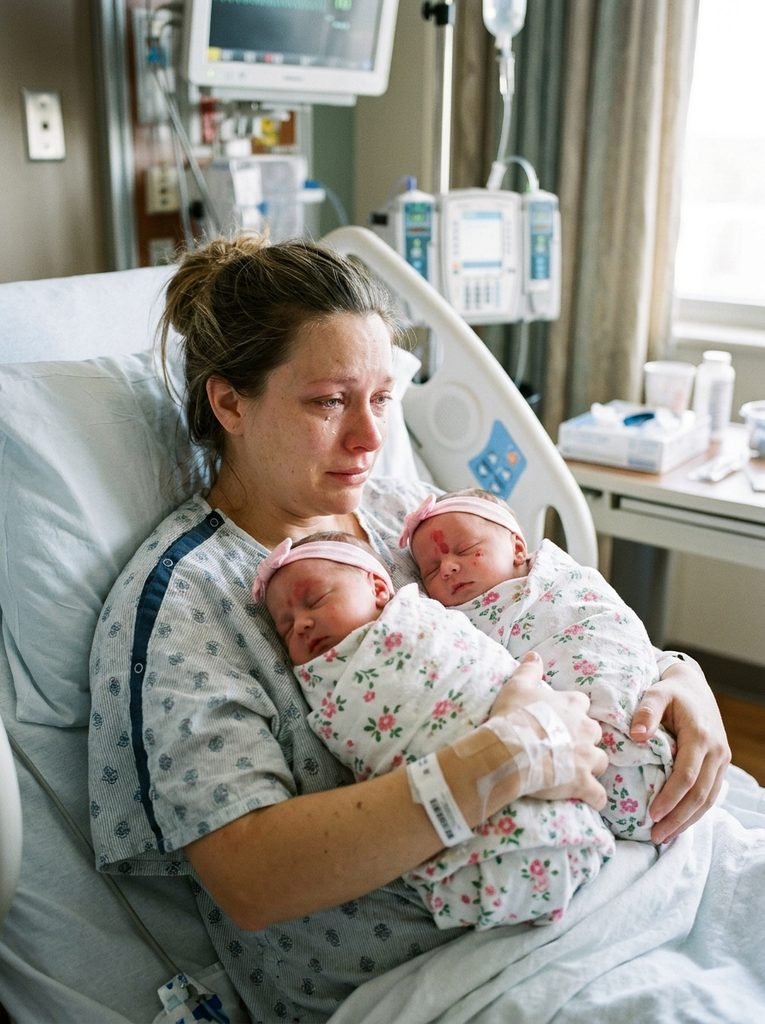
“There she is,” Deb said. “Congratulations, Mom. Two beautiful girls. Both doing great.”
I tried to say something. My throat felt like sandpaper.
“Take your time,” Deb said. “You’ve been out a while. Little sips.”
She held a cup of water to my lips. Then she disappeared for a second and came back with a clear plastic bassinet on wheels. There were two tiny bundles inside, one in a yellow hat and one in a green one. Andrew must have told them. Yellow for Ivy. Green for Nora.
She tucked them into my arms one at a time, keeping her hand steady under my elbow.
They were so small.
Ivy was five pounds two ounces, and Nora was four pounds eleven. They both had squashed red faces and swollen eyes and little dark wisps of hair poking out from under their hats. Nora had a crease in her forehead like she was worried about something already.
One of them, Ivy, wrapped her whole fist around my pinky.
I swear the whole world narrowed down to that grip.
All of it was in that grip. Ten years. The needles in my stomach every night. The waiting rooms with the out-of-date magazines. The phone calls. I’m sorry, the numbers just aren’t where we’d like them. The bathroom floor.
All of it, in one tiny fist.
Andrew has to see this, I thought.
I turned my head, ready to say look.
The chair by the window was empty.
Okay, I told myself.
Bathroom. Coffee. Calling his mother. Calling my mother. Moving the car out of the two-hour parking.
There were a hundred harmless reasons he might have broken his promise.
His sweater wasn’t on the chair. His phone charger wasn’t plugged into the wall. The hospital bag was sitting on the floor by the window, still zipped, the gold corner of my chocolate bar poking out of the top.
I fumbled for my phone on the nightstand. Deb had to help me. My arms were full of babies and my hands were shaking from the anesthesia.
I called Andrew.
It rang and rang.
Voicemail.
Hey, it’s Andrew. Leave a message.
“Hey, it’s me,” I said. I was still smiling. “I’m awake. Come see your daughters.”
I hung up.
I waited a minute.
Then I called again.
It rang and rang. Voicemail.
The smile got harder to hold.
He had promised. First face you’ll see.
Andrew didn’t break promises. He didn’t even break small ones. If he said he’d be home at six, he walked through the door at five fifty-eight. He’d assembled cribs on a schedule, for heaven’s sake.
I called again.
Voicemail.
“Excuse me,” I said to Deb. I tried to keep my voice light. “Have you seen my husband?”
Her smile slid right off her face.
It was only there and gone for half a second. Then she put it back on. But I’d seen it.
“I’ll get the doctor,” she said.
She left the room quickly.
I lay there with my daughters on my chest, staring at the door.
Nobody gets the doctor over a missing husband.
You get the doctor for a fever. You get the doctor for bleeding. You don’t get the doctor because somebody’s husband went to buy coffee.
My pulse started to climb. I could see it on the monitor beside the bed. Ninety-four. Ninety-eight. A hundred and three.
Nora made a small, squeaking sound against my collarbone.
“It’s okay,” I whispered to her. “It’s okay, baby. Daddy’s coming.”
Dr. Okafor came in with his hands folded in front of him.
He closed the door behind him. Then he looked at me strangely. It wasn’t worry, exactly. It was more like he was trying to work out a puzzle and I was one of the pieces.
“Is Andrew okay?” I said. “Did something happen? Is he hurt?”
“No, no. He’s not hurt.” Dr. Okafor hesitated. “Yes, your husband saw the babies. He held them both for quite a while, actually.”
“Then where is he?”
He paused.
“You really don’t know why he left?”
“Left?” My mouth was dry. “What are you talking about? Where is he?”
Dr. Okafor pulled a chair close to the bed. He sat down slowly.
“While you were still asleep after the surgery,” he said, “Andrew came to find me. At the nurses’ station. He asked to speak with me privately.” He rubbed his forehead. “He told me something I absolutely wasn’t expecting to hear.”
“What did he say?”
He exhaled slowly.
“He said his mother had called. She said she had proof the girls weren’t his.”
For a moment, I didn’t understand the words. It was like he’d said them in another language.
“What?” I stared at him. “That’s… that’s insane. He knows everything we went through. He was there for every single shot. He gave me half of them himself. He knows exactly how these babies were made.”
“I know,” Dr. Okafor said quietly. “I’ve seen your chart.”
“So what did he want from you?”
Dr. Okafor looked down at his folded hands.
“He asked me whether it was possible,” he said, “that you’d conceived naturally. Before the transfer. Or around the same time. Whether the IVF might not have been what actually worked.” He shook his head. “His mother had apparently pointed out that ten years of treatment had failed. And then, suddenly, twins.”
I felt like I’d been slapped.
“And he asked about a paternity test,” Dr. Okafor said. “Whether we could do one here. Today.”
Something hot rose in my chest and pushed the disbelief aside.
“What did you tell him?”
“I told him that this hospital doesn’t perform paternity testing on newborns without both parents’ consent,” he said. “And I told him that in my professional opinion, his wife had just had major surgery and he needed to be in this room when she woke up.” He paused. “He thanked me. Then he went down the hall and made a phone call. And then he left. I’m sorry. I thought maybe you knew something I didn’t.”
“I don’t know anything,” I said. “I don’t know anything at all.”
Dr. Okafor nodded slowly. He stood up.
“Your blood pressure is still high,” he said. “I need you to try to stay calm. I know how that sounds.”
“Yeah,” I said. “It sounds ridiculous.”
“It does,” he agreed. “I’ll check on you in an hour.”
He left.
Andrew hadn’t answered any of my calls.
So I scrolled to his mother’s name and hit call. My thumb was shaking so hard I almost missed the button.
She picked up on the second ring.
“Emma.” She didn’t sound surprised.
“What did you tell him?”
“Oh,” she said. “I think you know.”
“I really don’t. What did you say to my husband?”
“Don’t raise your voice, dear. It isn’t good for you. Not in your condition.”
“What did you tell him?”
There was a pause. When she spoke again, she sounded almost kind, which was worse.
“I’ll come and show you,” she said, “since you’re so confused. Stay right there.”
She hung up.
Stay right there.
As if I could go anywhere.
I tried Andrew again while I waited.
Voicemail.
I tried again.
Voicemail.
I texted him. Where are you? Please. Please call me. Whatever she said, it’s not true. Please come back.
The message said Delivered. Not Read. Just Delivered.
I stared at it.
“Enough!”
I said it out loud. Deb, who’d come back in to check my IV, jumped.
I pushed back the blanket. I put the girls carefully down in the bassinet beside the bed. I tried to swing my legs over the edge of the mattress. I was going to stand up. I was going to find my clothes. I was going to walk out of that hospital and find my husband and drag him back by his ear if I had to.
The pain hit like a hot wire through my belly.
I gasped and nearly folded in half.
“Whoa, whoa, easy.” Deb was at my side in a second. She lowered me back onto the pillows with one hand on my shoulder and the other under my knees. “You just had major surgery, honey. They cut through seven layers to get those girls out. You can’t go anywhere yet.”
I lay there breathing hard. Tears stung my eyes.
Was this what it came to?
Ten years of fighting. Ten years of needles and pills and hope and grief. And at the end of it, I couldn’t even chase my own husband down.
I couldn’t go find him and make him look at me. I couldn’t make him explain. I had two newborns who needed me and a body that wouldn’t obey.
This was the exact moment I’d planned to lean on Andrew. This was the moment I’d been saving him for.
And he was the one who had walked out.
One of the girls started to cry.
It was Nora, the little one. She was making a thin, furious wail, like a kitten caught in a door. Her face went bright red under the green hat. Her fists punched at the air.
I reached for her bassinet. My stomach screamed.
“Let me,” Deb said gently.
I hated how badly I wanted to say no. I hated it. She was my daughter. I was supposed to be the one who picked her up. I was supposed to be the one who knew how.
I said, “Thank you,” instead.
I watched a stranger lift my daughter out of the bassinet and settle her against my chest. Deb arranged her head in the crook of my neck and tucked the blanket around her. She showed me how to hold her so she wouldn’t press on the incision.
Nora stopped crying almost immediately. She made a little huffing sound and went still.
“See?” Deb said softly. “She knows you.”
I pressed my lips against the top of Nora’s head.
At least someone does, I thought.
Then I called my mother.
“Hi, sweetheart!” She picked up on the first ring. I could hear traffic in the background. She’d been on her way to our house to set up the air mattress. “Are they here? Are they…”
“Mom.”
I’d planned to sound calm. I’d practiced it in my head while the phone rang.
“Andrew left,” I said. “He got a call from his mother and he left, and he won’t pick up, and I can’t…”
My voice broke clean in half.
There was silence on the other end. Just traffic.
Then my mother said, “I’m coming. Don’t move. I’m getting my coat.”
“You’re in the car, Mom.”
“Then I’m turning the car around,” she said. “Twenty minutes. Don’t you move.”
She arrived in twenty minutes, her hair half pinned up.
She’d been in the middle of getting ready when she left the house that morning, and she’d never finished. One side of her hair was neatly twisted up and the other side was falling down her neck. She was wearing her gardening sneakers and her good wool coat.
She came through the door and stopped.
She looked at me in the bed, then the girls in the bassinet, then the empty chair by the window.
Her face did something I’d only seen once before, at my father’s funeral.
Then she crossed the room and kissed my forehead, hard.
“Oh, my girl,” she said.
Then she leaned over the bassinet.
“Oh,” she said again, softer. “Oh, look at them. Look at them, Emma.”
She touched Ivy’s cheek with one finger. She touched Nora’s fist. She started to cry, and she laughed at herself for crying, and she wiped her eyes with the sleeve of her good coat.
“Which one’s which?”
“Yellow’s Ivy. Green’s Nora.”
“Hello, Ivy,” my mother whispered. “Hello, Nora. I’m your grandma. I’ve been waiting for you for a very long time.”
She’d barely kissed the girls when the door swung open again.
My mother-in-law walked in.
She wore her good pearls and a camel-colored coat. Her silver hair was perfectly set. She carried a large manila envelope under her arm, the kind lawyers use.
She didn’t knock.
“Well,” she said, looking at me and not at the babies. “Here we are.”
My mother straightened up beside the bassinet. She didn’t say anything. She just folded her arms.
“Show me,” I said. “Whatever you told him.”
Carol set her handbag down on the chair by the window. Andrew’s chair.
She opened the envelope.
She laid out photographs on my blanket one by one, carefully, like she was dealing cards.
The first ones were of the newborns. Ivy and Nora in the nursery, still red and wet, under the warming lamp. Andrew must have taken them in the first hour and sent them to her. There was even one with his thumb in the corner of the frame.
He’d sent them to her before I’d even woken up.
She’d printed them out.
“Look at that nose,” Carol said. She held one photo up beside her phone, where she had another picture open. “Do you see it?”
“See what?”
She turned her phone toward me.
It was a picture of Daniel.
“Daniel’s nose,” she said. “Daniel’s chin.” She smiled triumphantly. “You’ve obviously been having an affair with him.”
Daniel.
Daniel Reyes, our friend of twelve years. He’d been Andrew’s college roommate first, then mine too, sort of, by marriage. He was the one who’d introduced us at a Halloween party when I was dressed as a lighthouse and Andrew was dressed as a sailor and Daniel said, “Well, this is obviously fate.”
Daniel had been the best man at our wedding. He’d cried during his toast so hard he had to stop and start again three times.
Daniel had a wife, Priya, and two little boys, Sam and Theo. I was Theo’s godmother.
Daniel had driven me to my egg retrieval three years before, when Andrew had the flu and couldn’t get off the couch. He’d sat in the waiting room for four hours doing crossword puzzles and texting Andrew updates.
That Daniel.
“They’re three hours old,” my mother said. Her voice could have frozen soup. “They look like potatoes.”
Carol ignored her.
“I’m not the only one who’s noticed,” she said to me. “Their coloring. Andrew is fair. You’re fair. Look at that hair.”
“Daniel is bald,” I said.
“He wasn’t always.”
“Carol, they’re newborns. They have hair like wet dandelions.”
She didn’t answer. Instead, she reached into the envelope and pulled out one more photograph.
She laid it down on my blanket very slowly, right on top of the baby pictures.
It was cropped tight around Daniel and me. Our heads were close together, and his arm was around my shoulders. My face was tipped up toward his, and I was laughing. My eyes were closed.
It looked intimate.
I stared at it.
“I found this last month,” Carol said. “On my phone. I’ve been sitting with it. Praying about it.” She sighed, a long, heavy, put-upon sigh. “I didn’t want to believe it. But I couldn’t stay quiet after seeing those babies this morning. Not with that nose. So I sent it to Andrew.”
She smoothed her pearls.
“He’s gone to speak with Daniel,” she said.
The room tilted.
“He’s what?”
“He wanted answers, dear,” Carol said. “Somebody had to give them to him.”
My husband was out there somewhere, discussing my faithfulness with another man, while I lay here cut open, begging his voicemail to love me.
I looked down at the photograph.
I made myself really look at it.
There was a gingham tablecloth behind us, red and white, and paper plates with blue and pink balloons printed on them. In the very corner of the frame, at the edge, was a blur of something bright. It looked like a sparkler.
I knew that tablecloth.
It was Andrew’s cousin Melissa’s birthday barbecue, last summer, in her backyard in Riverside. Everyone had been singing “Happy Birthday” and Daniel had grabbed me in a big side hug, the way he always did, and said something stupid in my ear. I couldn’t even remember what. Something about Melissa’s husband’s terrible singing.
I’d laughed.
That was all. I’d laughed.
I picked up the photograph and held it closer.
The edges were too clean. The crop was too tight. My right shoulder was cut off by the edge of the frame, and so was Daniel’s left elbow.
“Andrew was right beside us,” I said slowly. “You’ve cut him out.”
Carol’s mouth tightened, just slightly.
“And that makes the way you’re looking at Daniel all right?”
“It makes your proof a family photograph,” I said.
I turned to my mother.
“Mom,” I said. “Melissa posted all the pictures from her birthday in the family group chat. The cousins’ chat. You’re in it. Can you find the original? The whole picture?”
My mother already had her phone out.
She scrolled.
Carol stood at the end of the bed with her hand on the rail. Her face didn’t change. But I saw her fingers tighten.
My mother scrolled and scrolled. Past Christmas pictures. Past somebody’s new puppy. Past a long argument about who was bringing potato salad to Thanksgiving.
Then she stopped.
She turned the phone toward me without a word.
It was the same picture. The exact same one. The gingham tablecloth and the paper plates. Daniel’s arm was around my shoulders, my face was tipped up, and I was laughing.
But in this version, you could see the whole frame.
And there was Andrew, barely two feet to my right. He was holding a huge chocolate birthday cake with both hands and grinning at the camera. The sparklers on top of the cake were burning so bright they lit up his face.
He was laughing too, at the exact same thing.
I looked up at Carol.
She didn’t look at the phone.
I picked up my own phone and called Daniel.
It rang once.
“Em?” Daniel’s voice was strained. “Em, are you okay? Andrew’s here.”
“Where?”
“My house. He showed up half an hour ago. He’s… It’s bad, Em. He’s not making a lot of sense. He keeps asking me…” Daniel stopped. “Priya took the boys to her mom’s.”
“Daniel, listen to me,” I said. “Bring him back. Right now. His mother is here, and I have something he needs to see. She’s going to explain it. In front of both of us.”
There was a short silence.
“We’re on our way,” Daniel said. “Twenty minutes.”
I set the phone down on the blanket.
Carol’s smile had gone thin.
She looked at the photographs spread across my blanket. Then at my mother’s phone. Then back at me.
“Honey,” she said. Her voice had gone soft and soothing, like she was talking to a sick child. “You’ve had a terrible day. A terrible, exhausting day. Why don’t you rest first? We can sort this all out tomorrow. When everybody’s calmer.”
“No.”
“You’re exhausted, Emma.”
“I am,” I said. “And we’re doing it now.”
Carol didn’t leave.
I think she wanted to. I saw her glance at the door. But leaving would have looked like losing, and Carol had never lost anything gracefully in her life.
So she sat down in Andrew’s chair by the window. She crossed her ankles. She folded her hands in her lap over the manila envelope.
My mother pulled the other chair right up beside my bed and sat down in it like a guard dog.
For twenty minutes, nobody said a word.
The clock on the wall ticked. The monitor beside my bed beeped. Down the hall, somebody’s baby was crying.
Ivy woke up and started rooting against my chest. I’d never nursed before. I didn’t know how. My mother leaned over and helped me, guiding Ivy’s head with her hand, quietly murmuring instructions the way she must have murmured them to herself thirty-four years ago.
“There,” she whispered. “There you go. She’s got it.”
Ivy latched. I gasped. It hurt and it didn’t hurt, both at once.
Carol watched from the window. She didn’t say anything. For a second, just a second, something passed across her face. It looked almost like longing.
Then it was gone.
While Ivy nursed, I thought about Carol.
I’d always thought she just didn’t like me. That I was too loud, too messy, too much. That I’d stolen her son.
But sitting there, I remembered something Andrew told me once, years ago, very late at night.
His father had left when Andrew was nine. Not just left. He’d been having an affair for two years with a woman from his office. Carol found out from a photograph. Someone at a company Christmas party had taken a picture, and it had ended up on a bulletin board, and someone else had mailed a copy to Carol anonymously.
Carol had been the last to know, after everyone at his office. After half the neighborhood.
“She’s never gotten over it,” Andrew said. “She thinks everybody’s lying. All the time. About everything. She checks my receipts, Em. Still. I’m thirty-five, and she still asks where I’ve been.”
I’d felt sorry for her then.
Sitting in that hospital bed, with her cropped photograph spread across my blanket, I tried to feel sorry for her again.
I couldn’t quite do it.
But I understood her a little. I understood that she had spent twenty-six years waiting for the next photograph.
And then she’d made one.
Andrew came in first, with Daniel a step behind.
His eyes were red. His face was blotchy. His gray sweater had a coffee stain down the front. He looked like he’d been crying for hours.
He stopped in the doorway when he saw the photographs spread across my blanket.
My heart leaped. It actually leaped.
After hours of wanting him, there he was. Every cell in my body wanted to say you’re here, hold her, look at her. I wanted to hold out my arms. I wanted him to climb into the bed beside me and put his face in my neck and tell me it was all a terrible mistake.
Then I remembered why he hadn’t been there to begin with.
The feeling went sour.
“Look at what your mother sent you,” I said.
I held out the cropped photograph.
He took a step toward the bed. He looked at it. He’d seen it before. I could tell by the way his jaw clenched.
“And look at this,” I said.
I turned my mother’s phone toward him.
“You were right behind us,” I said. “Holding the birthday cake.”
He leaned in.
In the wider picture, he was grinning, with sparklers burning above the cake, barely two feet from Daniel and me. He was laughing at the exact same joke. You could see Melissa’s husband in the background with his mouth wide open, mid-song.
Andrew looked from the phone screen to the photograph on my blanket, then back at the phone, then at the photograph again.
Nobody spoke.
“The babies look like…” his mother started.
“Mom,” Andrew said.
She stopped.
“You told him you had proof,” I said to Carol. “You had a photograph with him cut out of it.”
Carol lifted her chin.
“I only wanted him to look closely,” she said. “He has a right to ask questions. He’s their father. Or he’s supposed to be.”
“There’s no affair,” Daniel said from the doorway. His voice was steady and plain. “I swear on my own kids. There never was. Not once. Not ever.”
He looked at Andrew when he said it. Not at Carol. At Andrew.
“I know,” I said quietly. “Thank you, Daniel. I don’t have anything else to ask you.”
Daniel nodded.
He looked at me. Then at the girls in the bassinet. Something in his face softened, just for a second.
“They’re beautiful, Em,” he said.
Then he gave Andrew a long, long look. It wasn’t angry. It was disappointed. It was the look you give somebody you’ve known for twelve years who just showed you a part of himself you’d never seen.
And then he slipped out.
Andrew faced his mother.
He was standing very straight. His hands were shaking at his sides.
“You told me you caught them alone,” he said.
Carol’s mouth opened. Then closed.
“You said you walked in on them,” Andrew said. “At Melissa’s. You said you came around the side of the house and they were alone, and he had his arms around her, and they jumped apart when they saw you. That’s what you said, Mom. That’s what you told me on the phone.”
“I was protecting you,” Carol said. “After everything you went through to have children. All those years. I couldn’t watch you raise another man’s…”
“Stop,” Andrew said.
She stopped.
“You used that,” I said. My voice was shaking now too. “All those years. The appointments. His numbers. You knew exactly where to put your finger. You used that to make him doubt them.” I took a breath. “And then you came here to make me defend myself. Two hours after surgery.”
I looked her in the eye.
“Leave,” I said.
Carol didn’t move.
She stood up out of the chair and walked over to the bed. She put one hand on the bed rail, on my side, right beside my leg.
“Andrew,” she said, without looking away from me. “Tell her. I’m your mother. I’m not being kept from my grandchildren over a photograph.”
“Let go of my bed,” I said.
Carol’s knuckles went white on the rail.
“You don’t get to decide who stays in this room,” I said. “Not anymore. Let go of my bed.”
For a long moment, nobody moved.
Then Andrew stepped toward the door and opened it.
“She asked you to leave, Mom.”
Carol turned and looked at him. She was waiting for him to change his mind, the way he always had. Every phone call. Every Sunday dinner. Every time she’d made a little comment about my cooking or my job or my family, and he’d rubbed the back of his neck and said, That’s just Mom being Mom.
She waited.
He held the door.
At last, she let go of the rail.
She gathered her photographs off my blanket one by one. She picked up the baby pictures too, the ones Andrew had sent her. She slid them all back into the manila envelope and tucked it under her arm. She picked up her handbag from the chair by the window.
At the door, she stopped beside her son.
“You’ll regret this,” she said quietly.
“I already do,” Andrew said. “Just not the part you think.”
She walked out.
He closed the door behind her. Then he turned back to me.
I kept my eyes on him.
There was still one question his mother couldn’t answer for him.
He stood by the door. He didn’t come any closer. He looked at the bassinet and then at me and then at the floor.
“I’m sorry, Em,” he said. His voice cracked. “I’m so sorry. She made it sound so convincing. She was crying on the phone. She said she’d been carrying it for a month, and she couldn’t stand it anymore, and she’d seen it with her own eyes. And then she sent the picture. And all I could think about was my numbers. How it was my fault we’d waited so long. How every single doctor said the chances were so low. And then suddenly it worked, and it was twins, and I just…” He pressed his palms against his eyes. “I thought maybe it was too good. Maybe that’s why it finally worked. Because it wasn’t me.”
“Why didn’t you answer my calls?” I asked.
He stared at the floor.
“I wanted to see Daniel first,” he said. “I thought I needed an answer I could trust.”
“An answer you could trust,” I repeated.
I let the words sit in the room for a moment.
“So you trusted your mother’s accusation enough to walk out on me,” I said. “But you didn’t trust your own wife enough to pick up the phone.”
He flinched like I’d hit him.
“I should have answered,” he said. “I saw your name. Every time. I saw your name on the screen. And I let it ring.”
“I woke up asking for you,” I said. “I turned my head to show you Ivy holding my finger, and the chair was empty. Our daughter was crying, and I couldn’t even lift her. The nurse had to help me.”
He glanced toward the bassinet. His face crumpled.
“You missed that,” I said. “You missed all of that because you decided I was the one person you couldn’t ask.”
He took one step toward the bed.
“I want to stay,” he said. “Please. Let me stay. Let me hold them. I’ll sleep in the chair. I’ll do the night feeds. I’ll do everything. Please, Em.”
Part of me wanted to say yes so badly it hurt.
That was the picture I’d carried all morning. All year, really. All ten years. Andrew in the chair by the window, the girls in his arms, the gold chocolate bar on the tray table, both of us crying and laughing at the same time.
I could still see it, golden and perfect.
He had come back.
That didn’t mean I trusted him again.
“I’m going to recover at my mom’s,” I said.
My mother didn’t say anything. She just reached over and put her hand on my ankle under the blanket.
“And I’ll decide about us when I’m ready,” I said. “Not when you are.”
Andrew stood very still.
I watched him take it in. I watched him want to argue. I watched him open his mouth and close it again.
Then he nodded, once.
He walked over to the bassinet.
He looked at the girls for a long moment. Ivy was asleep. Nora was awake, staring up at nothing with her dark, unfocused newborn eyes and the little worried crease in her forehead.
He reached down and touched one tiny foot with a trembling finger.
Nora’s toes curled.
He made a sound like something breaking inside him.
Then he turned and went to the door.
“I love you,” he said.
“I know,” I said.
It was true. And it wasn’t enough.
He left.
My mother stood up.
She didn’t say anything about Andrew. She didn’t say anything about Carol. She just moved the cup of water closer to my hand on the tray table.
Then she reached down into the hospital bag by the window, the one Andrew had packed so carefully. She pulled out the gold-wrapped caramel chocolate bar and set it on the tray beside the water, within reach.
Then she sat back down beside me.
One of the girls began to fuss. It was Ivy this time.
“Mom,” I said, “can you help me lift her?”
“Of course, sweetheart.”
She stood. She slid one hand beneath Ivy’s head and the other under her bottom. She lifted her out of the bassinet and brought her over to me, waiting until I had her settled before letting go.
Then she brought Nora too.
I held both girls against me. My mother tucked a pillow beneath my arm so I wouldn’t strain the incision.
This time, when Ivy reached out, her little fist closed around my finger.
And this time, I didn’t turn my head to look for anyone.
I stayed at my mother’s house for seven weeks.
It was the same house I grew up in, a small yellow two-story on a quiet street, with creaky floors and a kitchen that always smelled like toast. My old bedroom still had glow-in-the-dark stars on the ceiling. My mother pushed my childhood bed against the wall and borrowed two bassinets from a woman at her church.
The first two weeks were a blur.
I don’t remember much about them. I remember feeding. Feeding and changing and feeding again. I remember that twins never sleep at the same time, no matter what the books promise. I remember that my incision burned every time I laughed or coughed or sneezed, and that I sneezed a lot that October. I remember my mother standing at the stove at three in the morning making scrambled eggs, holding Nora in one arm and the spatula in the other, singing old Motown songs under her breath.
I remember crying in the shower so the water would cover the sound.
I remember the chocolate bar sitting on my nightstand, still wrapped.
I couldn’t eat it. I couldn’t throw it away either.
Andrew texted every day.
Not long texts. He didn’t beg. He didn’t make speeches. Just small things.
How are they today?
Did Nora gain any weight?
I put the car seats in your mom’s garage. Both bases installed. I checked them twice.
I’m sorry.
The first week, I didn’t answer at all.
The second week, I sent him pictures. Only of the girls, never of me. Ivy asleep with her arms thrown over her head like she was on a roller coaster. Nora frowning at a ceiling fan.
He wrote back every time, within a minute, no matter what time it was. Two in the afternoon. Four in the morning.
She looks like you when she sleeps.
She has your frown. That’s your exact frown.
On the tenth day, my mother answered the front door and found a cooler on the porch.
Inside, there were frozen meals. Lasagna. Chicken soup. My favorite curry from the Thai place on Fifth, frozen in individual portions, with the containers labeled in Andrew’s careful block capitals. EMMA — CURRY — 2 MIN THEN STIR.
There was a note taped to the lid.
For your mom, so she doesn’t have to cook. I won’t come in unless you want me to. — A.
My mother read the note. Then she looked at me over the top of it.
“Well,” she said. “He labels things.”
“He’s always labeled things.”
“Hmm.” She carried the cooler into the kitchen. “He’s not a terrible man, Emma. I want you to know I think that. He’s not a terrible man. He did a terrible thing.”
“I know.”
“Those are different.”
“I know, Mom.”
She started stacking the containers in the freezer.
“I’m not telling you what to do,” she said. “I’m just telling you that I know the difference. And so do you.”
Daniel called on day twelve.
I almost didn’t answer. I didn’t know what to say to him. I was so embarrassed, embarrassed for Andrew and for me, even though I hadn’t done anything.
“Hey, Em,” he said.
“Hey.”
“How are they?”
“Loud.”
He laughed. It sounded tired.
“Priya wants to bring dinner. And to meet them. If that’s okay.”
“Of course it’s okay.”
There was a pause.
“Em,” he said. “I’m not calling to tell you what to do about Andrew. That’s not my business. But I want to tell you what happened. At my house. Because I don’t think he’s told you.”
I sat down on the edge of my childhood bed.
“Okay.”
“He showed up at my door,” Daniel said. “Shaking. He didn’t even say hello. He just held up his phone with that picture on it and said, ‘Tell me the truth.’” Daniel’s voice went rough. “And I said, ‘Andrew, you were standing right there. You were holding the cake.’ And he just stared at me. He stared at me for a long time. Like he was trying to remember.”
“He didn’t remember?”
“I don’t think he’d let himself,” Daniel said. “His mother had told him a story. A really specific one. Come around the side of the house, caught you alone. And he’d been sitting in a hospital hallway for two hours with that story in his head. By the time he got to me, I think he couldn’t see anything else.”
I didn’t say anything.
“He sat down on my front steps and cried for twenty minutes,” Daniel said. “Then he looked up and said, ‘What have I done? I left her. She woke up and I wasn’t there.’ And then your call came. And I don’t think I’ve ever seen anyone get into a car that fast.”
He paused.
“I’m still angry with him,” Daniel said quietly. “I need you to know that too. I’ve been his friend for twelve years, and he looked me in the face and asked if I’d slept with his wife. I’m still angry. But I wanted you to know he figured it out before your call. Not after. He was already on his way back in his head.”
“Thank you, Daniel.”
“Bring the girls to meet Theo soon,” he said. “He’s been practicing. He keeps telling everyone he’s going to be the boss of them.”
On day fifteen, I said Andrew could come see the girls.
Just the girls. At my mother’s house. For one hour.
He came at two o’clock on a Saturday. He knocked instead of ringing the bell, like he was afraid of waking someone up. He was wearing a clean shirt. He’d gotten a haircut. He looked like he hadn’t slept in two weeks.
My mother let him in. She didn’t hug him. But she didn’t close the door in his face either.
He came into the living room where I was sitting on the couch with Nora on my chest and Ivy in the bassinet beside me.
He stopped in the middle of the room.
“Hi,” he said.
“Hi.”
“Can I…?” He gestured toward the bassinet.
“Wash your hands first.”
He went to the kitchen. I heard the water running for a long time, the full twenty seconds, the way the nurses taught us.
When he came back, I showed him how to pick up Ivy without putting pressure on her neck. He already knew. He’d held them in the nursery that first hour, before he left. He’d taken a class. He’d watched videos.
But he let me show him anyway.
He sat down in my mother’s armchair with Ivy in his arms.
He didn’t say anything for a long time. He just looked at her.
Then he started to cry. Not loudly. Just tears running down his face, silently, dripping off his chin onto Ivy’s blanket.
“She’s gotten so big,” he whispered.
“She’s gained almost a pound,” I said.
“I missed it.”
“Yeah,” I said. “You did.”
He nodded slowly. He didn’t argue. He didn’t say but.
He just held her and cried and let me watch him do it.
When his hour was up, he handed her back to me very carefully. He thanked my mother on the way out. At the front door, he turned around.
“Same time next week?” he asked. “If you’ll let me.”
“We’ll see,” I said.
He came the next Saturday. And the next.
The third Saturday, I let him stay for two hours. The fourth, he gave Nora her bottle while I took a nap upstairs. When I came down, he was asleep in the armchair with her on his chest, both of them snoring.
My mother was sitting at the kitchen table watching them through the doorway, drinking coffee.
“He hasn’t moved in forty minutes,” she said quietly. “He was afraid he’d wake her.”
That fourth Saturday, before he left, we sat on my mother’s back steps while the girls slept.
It was cold. November. The maple tree in the backyard had dropped all its leaves. Andrew sat a careful distance away from me on the concrete step.
“Can I tell you something?” he said.
“Only smart things allowed.”
He almost smiled. Then he didn’t.
“I told her,” he said. “Mom. I went to her house on Tuesday, and I sat down at her kitchen table. And I told her that she isn’t going to see the girls unless you say so. And even then, not alone. Not ever.” He looked at his hands. “She cried. She said I was choosing you over my own mother.”
“What did you say?”
“I said yes.” He swallowed. “I said, ‘Yes, Mom. I’m choosing my wife and my daughters. I should have done it eleven years ago. I’m sorry it took me this long.’”
I didn’t say anything.
“She said Dad would never have done that to his mother,” Andrew said. “And I said, ‘No. Dad did something much worse to you. And I almost did the same thing to Emma. Because you taught me to look for it everywhere.’”
He rubbed his face.
“She didn’t say anything after that,” he said. “She just sat there. I left.”
“And I’ve started seeing someone,” Andrew said. “A therapist. Dr. Hale. Twice a week.”
I turned to look at him.
“About the numbers,” he said. “About… all of it. Why I believed her. Why it was so easy for me to believe her.” He was quiet for a moment. “Dr. Hale asked me what I was actually afraid of. That day. In the hospital. And I said I was afraid they weren’t mine. And she kept asking. Why does that scare you so much? And I said, because then it would mean I couldn’t give you anything. That I’d failed at the one thing. And you’d have to find it somewhere else.”
He looked out at the bare maple tree.
“She said that wasn’t a fear about you,” he said. “It was a fear about me. And I made you pay for it.”
I sat there on the cold step for a long time.
Then I said the thing I’d been holding for four weeks.
“Do you know what the worst part was?”
“Me leaving.”
“No,” I said. “Well, yes. But no.” I pulled my sweater tighter. “The worst part was that I couldn’t stand up. I had two babies, and I’d just gotten everything we ever wanted, and I couldn’t stand up. And the one person I’d always been able to lean on was gone. And I had to let a stranger pick up my daughter.”
He closed his eyes.
“You remember the bathroom floor?” I said.
He nodded. He couldn’t speak.
“That’s the night I always think about,” I said. “When I wonder if I married the right person. You didn’t have an answer. You didn’t fix anything. You just sat down beside me and stayed.”
I looked at him.
“That’s all I wanted, Andrew. In that hospital bed. I didn’t need you to have answers. I just needed you to stay.”
He didn’t say anything for a long time.
Then he said, “I know. I know that’s what you needed. And I didn’t give it to you.” He wiped his eyes with the heel of his hand. “I can’t take it back. I’d give anything to take it back. But I can’t.”
“No,” I said. “You can’t.”
“I can only show up,” he said. “Every day. For as long as you’ll let me. I know that’s not the same thing. I know it doesn’t fix it.”
“No,” I said. “It doesn’t fix it.”
I looked out at the maple tree.
“But it’s a start,” I said.
I went home in the first week of December.
Not because everything was fixed. It wasn’t. I went home because the girls were seven weeks old and needed their own cribs, the ones their father had built on a schedule. I went home because my mother’s back was killing her from the air mattress. I went home because I’d watched Andrew show up every single Saturday for six weeks, on time, with his hands washed and his phone off and his head down, and I wanted to see if he could do it every day too.
We made rules before I came back.
It was my idea. I wrote them on a piece of paper at my mother’s kitchen table, and Andrew read them twice and signed his name at the bottom like it was a contract. He didn’t argue with a single one.
Couples counseling, every week, for at least six months.
Your mother doesn’t come to the house. If she sees the girls, it’s somewhere public, with both of us there, and only when I say so.
When I call, you answer. Every time. If you can’t talk, you pick up and say, “I can’t talk.” But you pick up.
If you ever doubt something about me again, you ask me first. Not her. Not anyone. Me.
The first few weeks at home were strange.
We were careful with each other. Too careful. We said “thank you” too much and “sorry” too much. We moved around each other in the kitchen like strangers in a hallway.
He slept in the guest room for the first two weeks. It was his idea. I didn’t stop him.
But every night, when one of the girls woke up crying, I heard his door open before I could even sit up. I heard his footsteps go down the hall to the nursery. I heard him murmuring to them in the dark, I’ve got you, I’ve got you, Daddy’s here.
Every single night. Usually twice. Sometimes three times.
Carol sent a card in December.
It came in the mail, addressed to both of us, in her perfect slanted handwriting. A Christmas card. On the front was a picture of an angel. Inside, she’d written:
I have been thinking a great deal. I would like to meet my granddaughters. I am willing to do so on whatever terms you feel are appropriate. — Carol.
It wasn’t an apology. Not really. It didn’t say she was sorry. It didn’t say she’d been wrong.
But it said whatever terms you feel are appropriate. It didn’t say I am the grandmother, after all.
I read it three times. Then I handed it to Andrew.
He read it. He looked at me.
“It’s up to you,” he said. “Whatever you decide.”
“I know.”
I put the card in the kitchen drawer with the takeout menus.
I didn’t answer it that month. Or the next.
In March, we met Carol at a coffee shop downtown, for forty-five minutes. Andrew and I sat on one side of the table with the girls in their car seats, and Carol sat on the other side. She held Ivy for ten minutes. She held Nora for ten minutes. Her hands shook the whole time.
She didn’t say anything about noses or chins.
When we left, she said, “Thank you, Emma.” She said it to me, not to Andrew.
It was the first time in eleven years she’d thanked me for anything.
It isn’t forgiveness. I don’t know if it ever will be. But it’s something.
Daniel and Andrew didn’t talk for almost three months.
Then one Sunday in January, Daniel showed up at our front door with Theo, who was five and holding a stuffed giraffe in each hand.
“He wanted to give the girls their presents,” Daniel said. “He’s been planning it since Halloween.”
Theo marched straight past us into the living room. He stood over the bassinets and solemnly placed one giraffe in each.
“I’m the boss of you,” he informed Ivy and Nora. “But I’ll be nice about it.”
Andrew stood in the hallway beside Daniel. Neither of them said anything for a long time.
“I’m sorry,” Andrew said finally. “I’m so sorry, Dan.”
“I know you are,” Daniel said.
“I don’t know how to make it up to you.”
Daniel watched his son leaning over the bassinets, explaining the rules of hide-and-seek to two babies who couldn’t hold their heads up yet.
“You could start,” he said, “by making coffee. I’ve been up since five.”
Andrew made coffee. They sat at the kitchen table and drank it and didn’t talk about anything important. Football. Work. Theo’s new obsession with volcanoes.
It wasn’t fixed. But it was coffee.
The night that changed it for me, the night I knew, wasn’t dramatic.
It was a Tuesday at the end of February. The girls were four months old. Nora had a cold, her first one, and she’d been crying for hours. That thin, furious wail. Nothing helped. Not feeding, not rocking, not the white noise machine, not the car ride around the block at midnight.
At two in the morning, I was so tired I couldn’t see straight. I’d been up with her since nine. I went into the bathroom and sat down on the closed lid of the toilet and put my face in my hands.
Then I slid down onto the floor.
The tile was cold against my back.
I wasn’t crying, exactly. I was just too tired to stay upright.
I heard Nora stop crying in the nursery. I heard Andrew’s voice, low and soft. Then his footsteps in the hallway.
The bathroom door opened.
He didn’t turn on the light.
He just stood there in the doorway for a moment, looking at me on the floor. Then he slid down the wall and sat beside me.
He didn’t say it would be okay.
He didn’t have an answer.
He just sat there, his shoulder pressed against mine.
After a while, he reached into the pocket of his robe and pulled something out. Gold wrapper. Crinkled.
It was the caramel chocolate bar.
I’d brought it home from my mother’s in December, still wrapped, and put it in my nightstand drawer. I’d forgotten it was there. Or I’d pretended to.
“I found it when I was looking for the thermometer,” he said quietly. “I didn’t know if you wanted it anymore. You never ate it.”
I stared at it.
“It was for afterward,” I said.
“I know.”
“I didn’t know when afterward was.”
He was quiet.
“I don’t know either,” he said. “But you’ve been up since nine, Em. Maybe it’s tonight.”
I took the chocolate bar from his hand.
I unwrapped it slowly. The gold foil crinkled loudly in the dark bathroom. I broke it in half. The caramel stretched between the two pieces in a long golden string.
I handed him half.
We sat there on the cold tile, eating chocolate in the dark, not saying anything.
Down the hall, both girls were asleep, finally, at the same time, for once.
After a while, I leaned my head on his shoulder.
He didn’t move. He didn’t say anything. He just stayed.
He moved back into our bedroom in March.
We still go to counseling every Thursday. We still fight sometimes, about real things, the way married people do. When we argue now, he doesn’t rub the back of his neck and change the subject. He says what he means, even when it’s hard.
He answers on the first ring, every single time. Even at work. Even in meetings. Even if all he says is, “Em, I can’t talk, I’m with a client. Are you okay?”
I am.
The girls are eight months old now.
Ivy is loud and fearless and has already tried to climb out of her crib twice. Nora is quiet and watchful, and she still has that little worried crease in her forehead when she’s thinking hard about something, like a ceiling fan, or a dog, or her father’s face.
They don’t look like Daniel. They never did.
They look like potatoes, mostly. Very cute potatoes. My mother says so every time she visits.
Last week, Andrew was sitting on the living room floor with Nora in his lap, reading her a board book about farm animals. He was doing all the voices. The cow, the pig, and a very unconvincing duck.
Nora wasn’t listening to the book. She was staring up at him with her serious dark eyes.
Then she reached up and wrapped her whole fist around his finger.
Andrew stopped reading.
He looked down at her tiny hand holding on to him. Then he looked up at me, standing in the kitchen doorway with a dish towel over my shoulder.
His eyes were wet.
“Em,” he whispered. “Look.”
He didn’t have to ask me to come see. I was already there.
And this time, he hadn’t missed it.