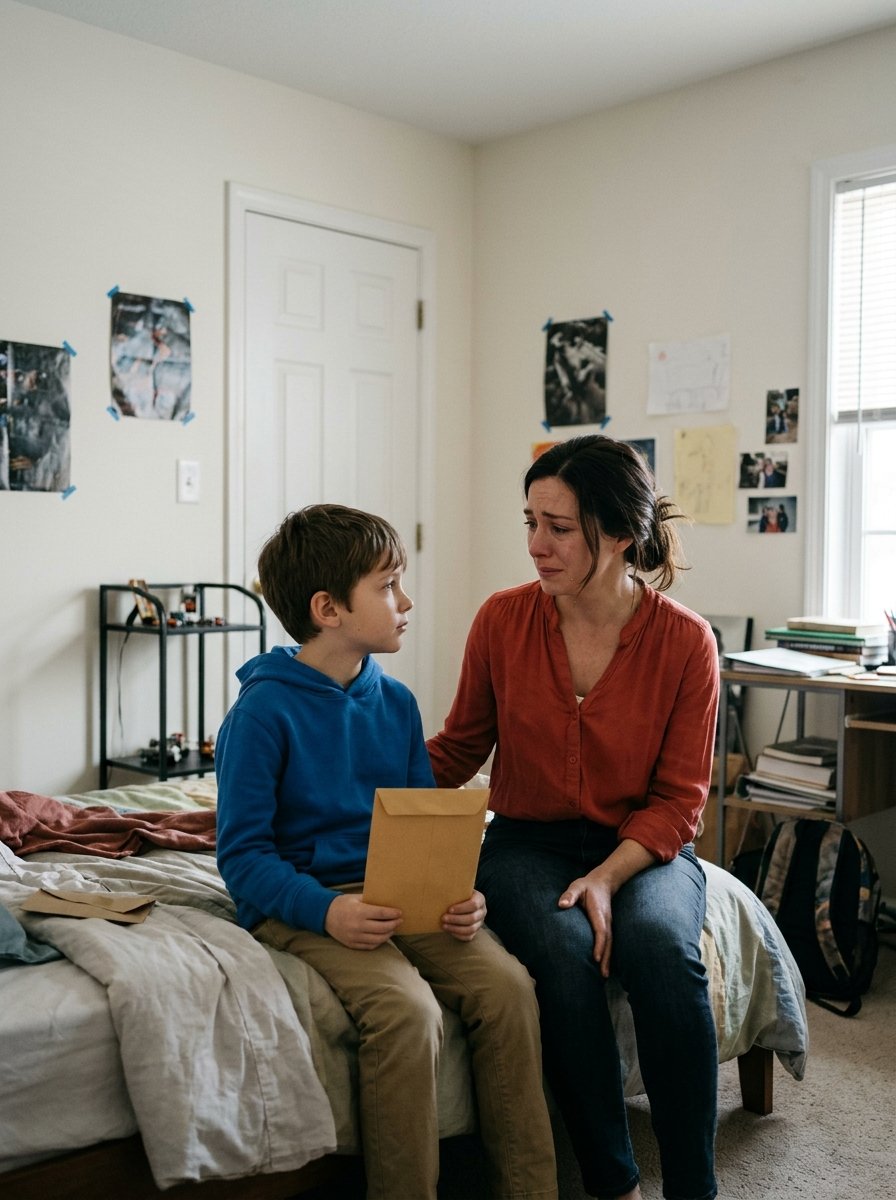
PART 1 — WHERE THE MUSIC USED TO BE
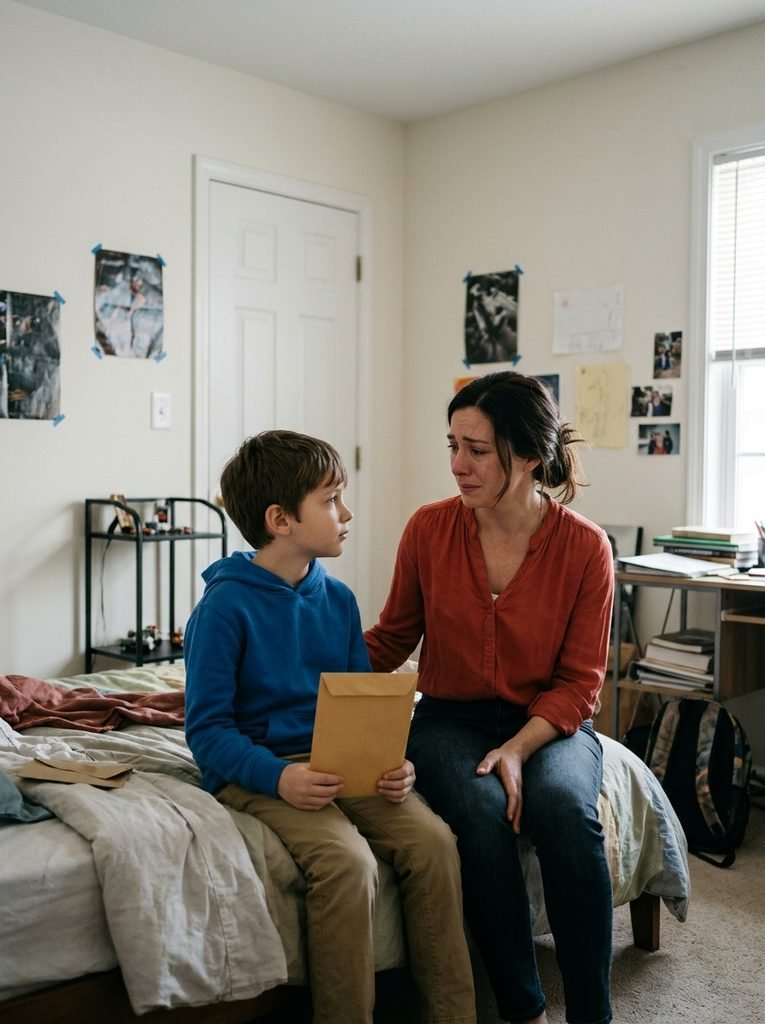
I knew something was wrong before I saw the empty guitar stand.
Our house was quiet.
At four-thirty on a Thursday afternoon, it was never quiet.
Usually, my thirteen-year-old son was upstairs working his way through the same difficult passage, stopping at the same place, then starting again. Some days I heard it so often that I could hum along while making dinner.
That afternoon, I heard the refrigerator.
I set my work bag on the kitchen table and went upstairs.
The amplifier was beside Alejandro’s desk.
The cable lay coiled on the floor.
His guitar was gone.
So was its case.
My name is Victoria Morales. I was thirty-nine, a single mother in Columbus, Ohio, and I had bought that guitar for my son’s eleventh birthday after saving for almost a year.
It cost fifteen hundred dollars.
There had been extra shifts, packed lunches, and a winter coat I decided could last another season.
I had never told Alejandro the details.
I only remembered how he had opened the case, stared at the instrument, and asked whether he was allowed to touch it.
For two years, he had touched it almost every day.
When he came home from school, I was waiting in the kitchen.
“Where’s your guitar?”
He stopped with one arm still inside his backpack strap.
“Mom, please let me explain.”
I pulled out a chair.
He sat.
“I sold it.”
For a moment, I couldn’t find anything to say.
“You sold it?”
He nodded.
“To whom?”
“Mr. Keller. From church.”
“For how much?”
His eyes dropped to the table.
“Eight hundred and fifty dollars.”
I pressed my fingers against my forehead.
“Alejandro, why?”
“Elena needs a new wheelchair.”
I knew Elena Miller. She was in his science class and had helped him build a model bridge that survived everything except being carried home on the bus.
She used a wheelchair, loved science fiction, and had once informed me that my son’s bridge design was “ambitious but structurally ridiculous.”
I liked her immediately.
“Her parents are working with a supplier,” Alejandro continued. “They’ve been trying to get everything sorted out. There’s still money they have to find.”
“And you decided to find it?”
He picked at a loose thread on his sleeve.
“Her chair got stuck outside the science room again. Everybody else went in.”
I waited.
“Some kids laughed. She laughed too, like it was funny.”
He looked up.
“It wasn’t.”
My anger shifted, but it didn’t disappear.
“Does Elena know you sold the guitar?”
“She knows now.”
“Do her parents have the money?”
He shook his head.
“Her mom said she had to talk to her dad first.”
He took an envelope from his backpack.
Inside were the bills Mr. Keller had given him.
I stared at them.
I had imagined a stolen instrument, a foolish purchase, some ordinary mistake I could be angry about without feeling my heart pulled in two directions.
“Why didn’t you come to me?”
His answer came immediately.
“Because you would’ve picked up another shift.”
I sat down across from him.
For a few seconds, neither of us spoke.
Then I reached for his hand.
“I’m glad you care about your friend. But selling something this valuable is a decision we talk about together.”
He nodded.
That night, I heard him tapping a rhythm against his desk.
There were no notes beneath it.
The next morning, someone knocked before we left for school.
A police officer stood on the porch.
Alejandro appeared behind me and went still.
The man noticed.
“You’re not in trouble,” he said immediately. “I’m Nathan Miller. Elena’s dad.”
He looked at the envelope on our kitchen table.
“Your son offered to do something very generous. But I don’t think we should accept that money without talking.”
PART 2 — THE THANK-YOU THAT DIDN’T FEEL SIMPLE
Nathan had called the evening before, but I had missed the unfamiliar number while getting dinner ready.
He apologized for stopping by without confirming.
“I was on my way in and thought I’d ask whether we could arrange a time.”
I invited him inside for a few minutes.
Alejandro remained close to me.
Nathan sat at the kitchen table.
“Elena told us about the guitar last night,” he said. “Before that, we thought you and Alejandro had discussed making a contribution.”
I looked at my son.
“What did you tell them?”
His ears turned red.
“I said I had the money.”
“You left out where it came from.”
He nodded.
Nathan leaned forward.
“We appreciate what you wanted to do. But we need to make sure everybody understands it.”
“Elena still needs the chair,” Alejandro said.
“She does. That doesn’t mean you have to solve the whole problem.”
My son looked at the envelope as though it might be taken away before it could become useful.
We arranged to meet the Millers the following afternoon.
After Nathan left, I called Mr. Keller.
He answered cheerfully, then grew quiet when I explained.
“He told me it was his guitar and that he was raising money for a friend,” he said.
“It was his guitar. He’s also thirteen.”
Mr. Keller exhaled.
“You’re right. I should have called you.”
He had admired the instrument before. Alejandro knew that, which was why he had approached him.
“I haven’t done anything with it,” he told me. “If you want to reverse the sale, we can. No problem.”
I thanked him.
Then I asked him to hold it while we talked.
I wasn’t ready to decide for everyone simply because I was the first adult who knew enough to be worried.
At the Millers’ house, Jillian greeted us wearing jeans and a sweater with a small hole at one cuff.
Their kitchen table held a stack of papers, two coffee mugs, and a half-finished model of a wind turbine.
Elena pointed at it.
“Don’t touch the blades. They finally work.”
Alejandro tucked his hands behind his back.
“That happened one time.”
“You said you were improving it.”
For a moment, they were just two kids arguing over a project.
Then Nathan sat down with us.
He and Jillian explained that Elena had outgrown parts of her current setup, and recurring mechanical problems had made using it increasingly difficult. They were already working with her equipment team on a replacement.
There had been delays, paperwork, and expenses they were still trying to cover.
The eight hundred and fifty dollars would help.
It would not make the entire process disappear.
“We knew the chair was becoming a problem,” Jillian said. “We didn’t understand how much Elena had started avoiding because of it.”
Elena folded her arms.
“I told you I didn’t want science club anymore.”
Her mother nodded.