Part 2
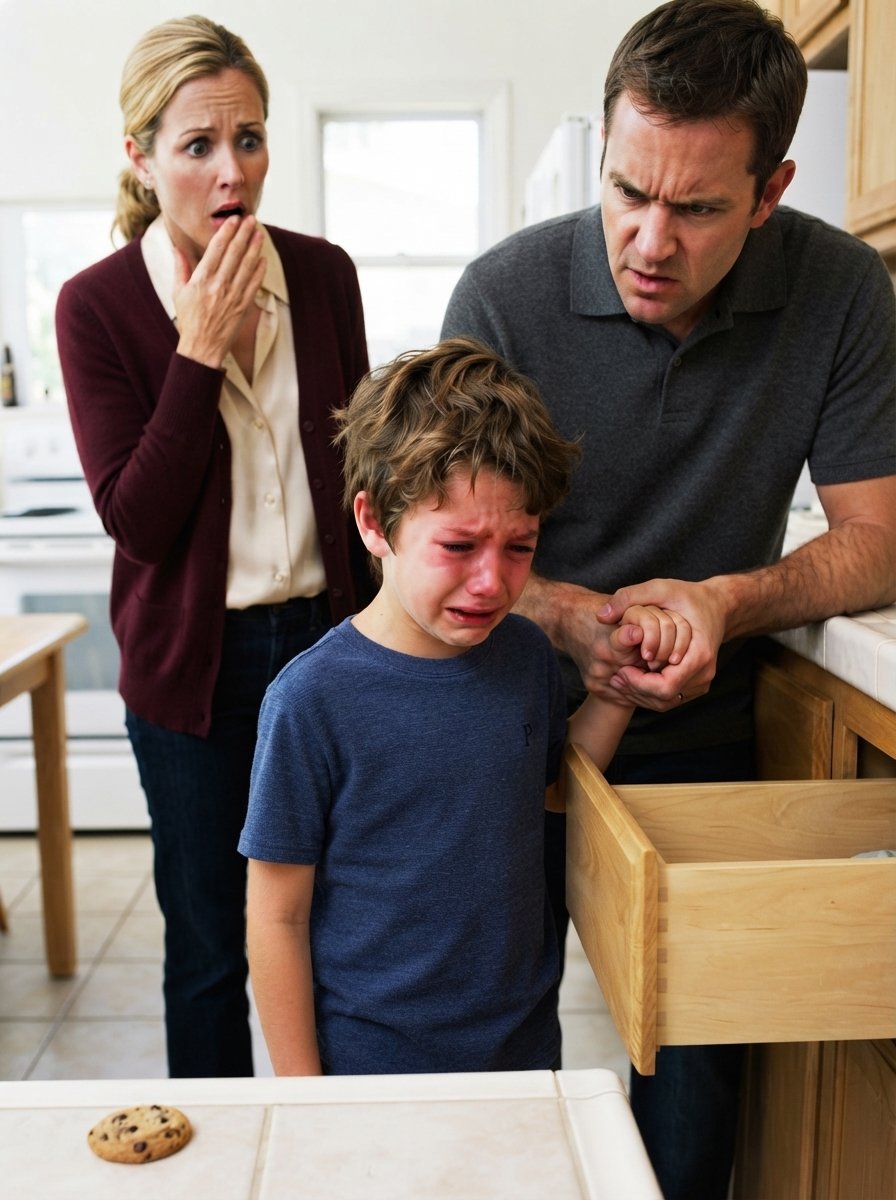
I spent the next twenty minutes at the kitchen table with my injured hand tucked between my knees. The refrigerator hummed behind me. Every time my stepfather crossed the room, the floorboards pressed cold against my bare feet and I kept my eyes on the table.
He told me twice to stop sulking.
I said nothing.
When Mom came in, he got to her first. He told her I had been sneaking food again and had thrown a tantrum when he corrected me. He sounded tired, almost amused, like I had created an exhausting little parenting problem for him.
Mom set her bag down and looked at me.
I kept my injured hand hidden.
She asked what happened. He answered for me:
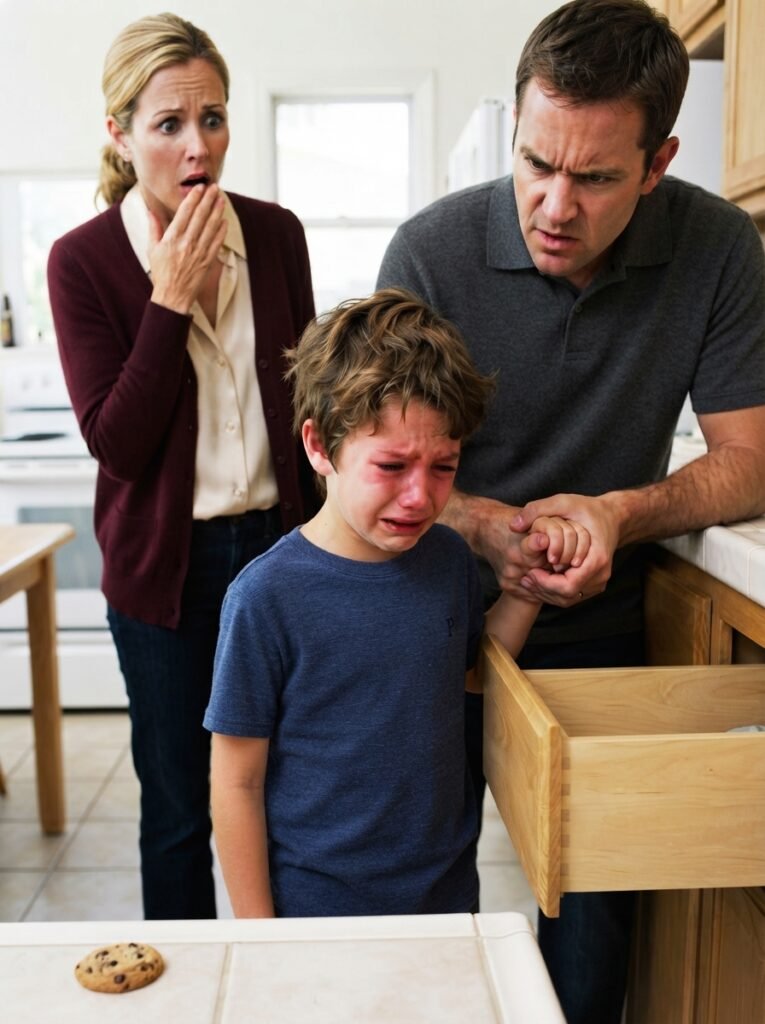
*“He caught his hand in the drawer.”*
I looked at him. He looked at Mom. He kept talking. He kept explaining. He kept making my silence sound like proof.
Then Mom bent to pick up something near the refrigerator.
It was the cookie.
There was a dark smear beside it.
She stayed crouched for a second, then looked underneath the table at my feet. Her eyes moved from the cookie to me and finally to the hand I was trying to hide.
“Show me.”
My stepfather sighed. “It looks worse than it is.”
Mom didn’t answer him.
I put my hand on the table.
Two fingers were swollen and deep purple. I couldn’t straighten them without pain. Mom’s mouth tightened, but she didn’t raise her voice.
“Which drawer?” she asked.
My stepfather pointed toward the counter. “That one. He yanked it shut on himself.”
Mom looked at me. “Did you?”
I shook my head.
He stepped closer. “Don’t start encouraging him to lie.”
That scared me more than the yelling had. I could already feel the story changing around me, becoming something adults might believe because he could say it louder.
Mom touched the edge of the cookie with one finger.
“Why was this under the refrigerator?”
My throat closed. I hadn’t planned what I would say if she actually found it. At nine, I only understood that the cookie was something he wouldn’t think to clean up because he believed I’d dropped it during the struggle.
So I told her the smallest truth I could manage:
“I kicked it there for you.”
Her eyes came back to mine. “For me?”
I nodded. “So you’d know where it happened.”
My stepfather gave a short laugh. “Listen to this. Now he’s making up clues?”
Mom didn’t look at him. She asked me one more question.
“Did he close the drawer on your hand by accident?”
“No.”
“Did he know your hand was there?”
“Yes.”
My stepfather started talking over me, but Mom raised one hand without turning around. For the first time that night, he stopped.
She asked whether I could put on my sneakers by myself. I said I could if I didn’t have to tie the right one. She told me to get them and my jacket.
My stepfather moved between her and the hallway.
“Where exactly do you think you’re taking him?”
Mom finally faced him. She didn’t make a speech. She didn’t argue about discipline. She didn’t tell him what kind of man he was. She simply held out her hand.
“The keys.”
He stared at her. She kept her palm open.
I stood there with one sneaker half on, watching the two of them while my fingers throbbed against my chest.
Then Mom reached past him, took the car keys from his hand, and closed them inside her fist.
Mom told me to finish putting on my shoes.
My stepfather didn’t move away from the hallway.
“You’re seriously leaving over a cookie?” he asked.
Mom looked down at my swollen fingers. **“This isn’t about a cookie.”**
His voice changed after that. Quieter. Controlled. He reminded her that it was late, that I was upset, that taking me out would only make everything look more dramatic than it was.
Mom zipped my jacket with one hand while keeping the keys in the other. Then she did something I had never seen her do before: she crouched until we were eye level and asked where I wanted to stand while the adults talked.
“By the door,” I whispered.
She moved me there immediately. That tiny choice mattered. Until then, every adult decision in that kitchen had happened around me.
My stepfather noticed too. He walked toward us slowly, still speaking in that careful voice. Mom put herself between him and me and reached for the back-door handle.
Before she could turn it, my stepfather stepped past her and slid the deadbolt shut.
The heavy click of the deadbolt felt louder than the yelling. It was a solid, metallic sound that seemed to lock the air out of the room.
My stepfather didn’t raise his fists. He didn’t scream. That was the thing about him that scared me the most—his violence was always quiet until it wasn’t. He just stood there with his arm resting against the wooden frame of the back door, towering over us, his shadow stretching long across the linoleum floor.
“We’re not doing this tonight, Sarah,” he said. His voice was smooth, completely devoid of the anger he had shown twenty minutes ago. “It’s eleven o’clock. Look at him. He’s tired, he’s confused, and you’re making a scene over a total misunderstanding.”
Mom didn’t step back. She stood inches away from him, her back straight. Her right hand was still tightly clamped around the car keys, the hard edges of the metal digging into her knuckles.
“Move, David,” she said. Her voice was flat, devoid of emotion, but I could see the slight tremor in her shoulder.
“I’m not letting you drive off in the middle of the night because the boy threw a fit,” David replied, leaning his weight slightly forward. “You’re emotionally unstable right now. What are you going to tell the doctor at the ER? That your kid dropped a cookie and threw a tantrum? You think they won’t call Child Protective Services on us for letting him run wild?”
That was his weapon. He knew how to twist reality until you started questioning your own memory. For a fraction of a second, I felt a terrible knot of panic in my stomach. What if he was right? What if I had pulled the drawer shut myself? What if the swelling in my hand was just my fault?
I looked down at my hand. My index and middle fingers were thick, dark purple, and pulsing with every beat of my heart. The pain was real. The blood on the floor was real.
Mom didn’t argue. She didn’t try to defend herself. Instead, she did something David didn’t expect.
She reached behind her back, grabbed the heavy iron skillet sitting on the stove, and slammed it down onto the glass top of the dining table.
CRACK.
The sound was like a gunshot. A long, jagged fracture spider-webbed across the tempered glass. David flinched, taking a sudden step back, his composure instantly shattering.
In that split second of surprise, Mom grabbed my left wrist—careful not to touch my injured right hand—and yanked the back door unlock button with her thumb. She threw the door open, pulled me out into the freezing night air, and slammed it behind us.
“Run!” she whispered.
We didn’t have our coats fully zipped. My right shoe was barely on, the laces dragging through the wet grass. The chilly autumn air stung my face as we sprinted toward her sedan parked in the driveway.
Behind us, I heard the back door burst open.
“Sarah! Get back in here!” David’s voice lost its smooth composure. It was sharp, wild, and furious now.
Mom unlocked the car with the remote, shoved me into the passenger seat, and leaped into the driver’s seat. Her hands were shaking so violently she missed the ignition twice before the key finally turned. The engine roared to life just as David reached the driver’s side window, pounding his palm against the glass.
“Open the damn door, Sarah!” he roared, his face contorted in the harsh amber light of the streetlamp.
Mom didn’t look at him. She threw the car into reverse. The tires shrieked against the asphalt as she backed out of the driveway, clipping the edge of the trash cans, and slammed the gear into drive.
We shot down the street, leaving the house, the kitchen, and David standing alone in the dark driveway.
I turned around in my seat, watching through the rear window until his silhouette shrank into nothingness. My chest was heaving. I could barely breathe.
Mom drove fast. Too fast. Her knuckles were white against the steering wheel, her eyes locked straight ahead on the dark, empty road.
“Mom?” I squeaked out, the pain in my fingers radiating all the way up to my elbow.
She didn’t answer immediately. She pulled the car onto the shoulder of the highway, threw it into park, and buried her face in her hands.
For a long moment, the only sound in the car was the hum of the engine and the rhythmic click of the hazard lights. Then, I heard a quiet, ragged sob.
She wasn’t crying like a child; she was gasping for air, her shoulders violently shaking. I had never seen my mother cry before. She was always the one who fixed things, the one who cooked dinner, the one who smoothed everything over when David got quiet and cold.
“I’m sorry,” she whispered, her voice choking. She reached over and gently, so gently, cupped the side of my face with her hand. “I’m so sorry, sweetie. I didn’t see. I should have seen.”
“It’s okay,” I said, even though my hand hurt so much tears were spilling down my own cheeks. “I kicked the cookie under the fridge.”
She let out a watery, broken laugh, pulling me into a tight embrace, careful to avoid my right arm. “You were so smart. My brave boy. You were so smart.”
She sat back up, wiped her eyes with the back of her sleeve, and put the car back in drive. The softness in her eyes was gone, replaced by a cold, hardened determination.
“We’re going to the hospital,” she said quietly. “And then we’re never coming back.”
Part 3
The emergency room was bright, sterile, and smelled of antiseptic and old coffee.
The doctor who examined me was a quiet woman named Dr. Aris. She didn’t ask leading questions in front of Mom, but when she gently examined my hand, her face darkened. She ordered X-rays immediately.
The results showed two clean fractures in my fingers. The crushing force of the heavy oak drawer had snapped the small bones.
While the nurse was wrapping my hand in a rigid fiberglass splint, two police officers walked into the curtained area. Someone at the hospital had made a call.
David had tried to call Mom’s phone fourteen times while we were in the waiting room. He sent texts ranging from desperate apologies (“I lost my temper, please come home, let’s talk about this like adults”) to subtle threats (“If you take him to a hospital, they’re going to think you did it. You know how nervous you get”).
Mom didn’t delete a single one. When the officers stepped up to her, she unlocked her phone, handed it to the head officer, and pointed to my cast.
“My husband broke my son’s hand in a kitchen drawer tonight,” she said clearly, her voice devoid of hesitation. “He locked us in the house when I tried to leave. I want to file a report, and I need a restraining order.”
The younger officer took notes, his expression solemn, while the older officer spoke softly into his radio.
We didn’t go home that night. We stayed at a small, cheap motel near the highway. The room smelled like faded detergent and smoke, but to me, it felt like the safest place on earth. Mom dragged a chair in front of the front door and jammed it under the handle, just in case. She slept on top of the covers next to me, her arm wrapped securely around my shoulders.
Over the next few weeks, the world we knew crumbled and reformed.
David tried everything. He hired a lawyer, claimed it was an accident, and even tried to turn my grandmother against Mom, saying she was having a mental breakdown. But the physical evidence—the crushed fingers, the dark smear of blood under the refrigerator, the cracked glass table, and the flurry of frantic, controlling text messages—was undeniable.
A temporary protective order was granted. Mom filed for divorce three days later.
Two months after that dark night in the kitchen, Mom and I rented a small, second-floor apartment three towns over. It didn’t have a big yard or fancy granite countertops like David’s house. The floorboards creaked, and the neighbors played loud music on weekends.
But there was no heavy silence hanging in the air. No walking on eggshells. No waiting for the storm to break.
One evening, while the plaster cast was finally off and my fingers were in a soft support splint, Mom was preparing dinner. I was sitting at the small wooden kitchen table, drawing with my left hand.
She accidentally dropped a ceramic mug. It shattered into pieces across the tile floor.
Instantly, my body stiffened. I pulled my arms close to my chest and squeezed my eyes shut, bracing for the inevitable yelling, the sudden wave of tension that always followed a mistake in our old life.
Silence filled the room.
When I opened my eyes, Mom wasn’t angry. She wasn’t yelling. She was kneeling on the floor, looking at the broken pieces of the mug, and then she looked up at me.
She saw my posture—the defensive, terrified curl of my body—and her expression softened with deep sorrow and understanding.
She didn’t pick up the pieces right away. Instead, she walked over to me, pulled out a chair, and sat down at eye level.
“Hey,” she said softly, reaching out to gently touch my uninjured hand. “It’s just a cup.”
I swallowed hard, my chest relaxing slightly. “Just a cup?”
“Just a cup,” she repeated, giving me a warm, genuine smile. “Things break. Mistakes happen. Nobody is going to hurt you for dropping something here. Ever again.”
She stood up, picked up a broom, and swept the shards into a dustpan.
I looked at my right hand. The fingers were still a bit stiff, and the scars near the knuckles were a pale pink reminder of that night. But as I watched Mom toss the broken pieces into the trash and come back to sit beside me with a fresh plate of food, the tightness in my chest finally evaporated.
The cookie under the refrigerator had saved us. It was the small, ugly truth that tore down a big, comfortable lie. And as I picked up my fork with my healing hand, I knew that for the first time in my life, we were finally safe.