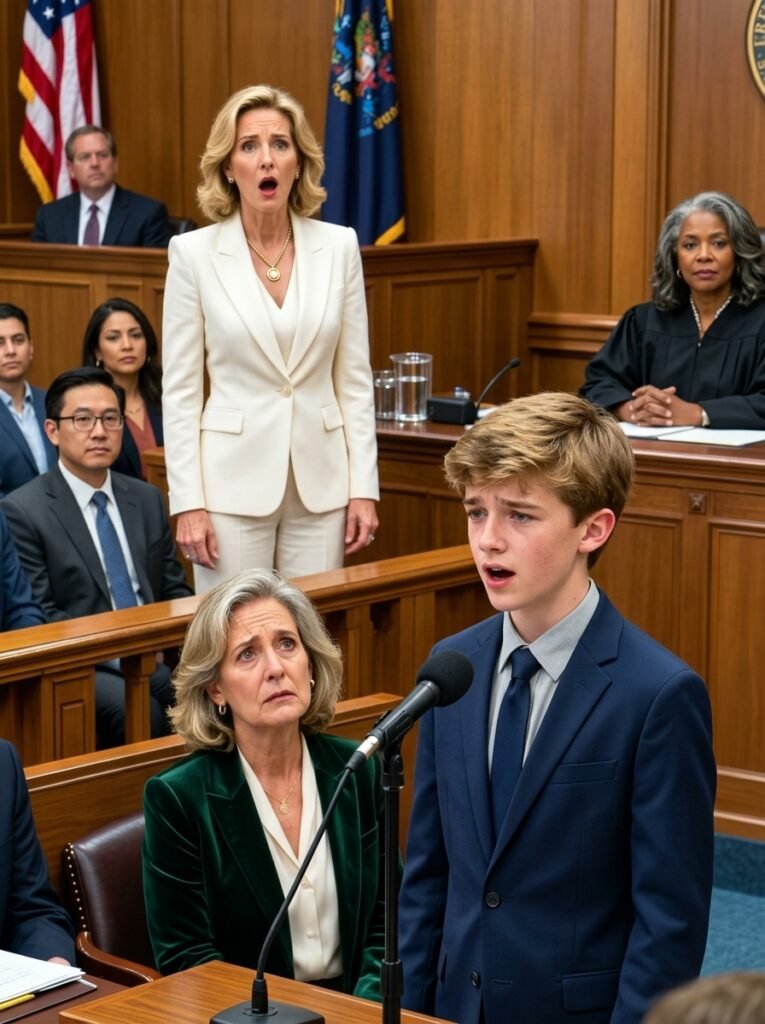
Noah rested both hands on the table in front of him.
For a moment, he said nothing.
The courtroom remained so quiet that I could hear the faint ticking of the clock above the judge’s bench. Charlotte sat across the aisle with her attorney beside her. Her shoulders were straight, her expression carefully controlled, but her eyes never left Noah’s face.
My son drew a slow breath.
“I understand that Charlotte gave birth to me,” he began. “And I understand that she may have reasons for what happened.”
Charlotte’s lips parted slightly.
“But I’m not a life that was put on hold for seventeen years,” Noah continued. “I’m not something that can be returned to the person who had me first.”
His voice trembled, but he did not look away.
“I already have a mother.”
He turned toward me.
“She is the person who sat beside my bed when I had pneumonia. She worked weekends so I could go on school trips. She taught me how to drive even though I nearly took out three mailboxes. She stayed awake with me when I was afraid I wouldn’t get into college, and she pretended not to cry when I did.”
A quiet ripple of laughter moved through the courtroom, gentle and brief.
My eyes burned.
Noah looked back at the judge.
“I’m willing to learn where I came from. I’m willing to listen to Charlotte. But I will not leave my mother.”
He paused.
“And I don’t think anyone should ask me to prove that I love one of them by rejecting the other.”
The silence that followed felt different from the silence before.
It was no longer the heavy stillness of people waiting for a verdict. It was the silence of people who had heard something they had not expected and needed time to understand it.
Judge Mallory removed her glasses.
She studied Noah for several seconds before speaking.
“Thank you, Mr. Carter.”
Noah sat down.
Under the table, his hand found mine.
I held it tightly.
Across the aisle, Charlotte lowered her eyes.
Her attorney leaned toward her and whispered something, but she barely reacted. For the first time since she had entered the courtroom, she did not look like a wealthy woman accustomed to having rooms rearrange themselves around her.
She looked like someone who had arrived too late.
Judge Mallory turned to the attorneys.
“This court is not deciding which woman can offer the young man a more impressive future,” she said. “Nor is this an ordinary custody dispute.”
Charlotte’s attorney rose.
“Your Honor—”
“I am aware of your petition, Mr. Hale.”
He sat down again.
Judge Mallory continued. “The adoption decree has been final for more than sixteen years. It cannot be undone simply because a biological parent has reappeared. The petitioner alleges that her parental rights were never knowingly surrendered and that records may have been falsified. Those allegations require investigation.”
My attorney, Rebecca Sloan, nodded.
“The court will therefore maintain the current placement. Noah will remain with Ms. Carter. There will be no change in guardianship while this matter is reviewed.”
Air rushed back into my lungs.
I had not realized how shallowly I had been breathing until then.
Beside me, Noah’s shoulders loosened.
Judge Mallory ordered a court-supervised DNA test, the release of sealed hospital records, and the appointment of a family counselor who would meet separately with Noah, Charlotte, and me.
Then she looked directly at Charlotte.
“Ms. Whitman, any contact with Noah will occur only with his agreement.”
Charlotte nodded.
“Yes, Your Honor.”
Her voice was barely audible.
The judge adjourned the hearing.
People began gathering files and pushing back chairs, but I remained seated for a moment, still holding Noah’s hand. My knees felt weak, as though I had run a great distance without moving.
“You okay?” he whispered.
I managed a nod.
“You?”
“I don’t know yet.”
That was the first completely honest thing either of us had said since the legal papers arrived.
We left through a private corridor to avoid the handful of reporters gathered near the courthouse entrance. Rebecca walked ahead of us, speaking quietly with a court officer.
Charlotte caught up with us before we reached the elevator.
“Please,” she said.
Noah stopped.
I did too.
Charlotte stood several feet away. Without the courtroom table separating us, she seemed less imposing. She was still elegant in a charcoal suit and pearl earrings, but there were fine lines around her eyes that I had not noticed before.
Her attorney hovered behind her.
Charlotte looked at Noah.
“I didn’t know they were going to argue that you should be removed from Emily’s home immediately.”
Her attorney stiffened.
“Charlotte, I advised you—”
“You advised me to let you handle everything.”
Mr. Hale closed his mouth.
Noah’s expression remained guarded.
“You signed the petition,” he said.
“Yes.”
“Then you must have read it.”
“I did. But I thought—”
She stopped.
“What?” Noah asked.
Charlotte’s composure faltered.
“I thought the court had to recognize me as your mother before I would be allowed to know you.”
I could see Noah trying to decide whether to believe her.
“And if the judge had told me to go with you today?” he asked.
Charlotte glanced at me.
The answer took too long.
“I would not have forced you,” she finally said.
“But you were willing to let a judge force me.”
The words were not cruel. Noah spoke quietly, which made them land with even more weight.
Charlotte’s face tightened.
“You’re right.”
Her attorney stepped closer. “We should leave.”
She ignored him.
“I have made many decisions in my life by asking what can be accomplished instead of what should be done,” she said. “I’m beginning to understand that this may have been another one.”
Noah watched her.
Then the elevator arrived with a soft chime.
He stepped inside with me.
Charlotte remained in the hallway.
Just before the doors closed, she said, “You have every right to be angry.”
Noah looked at her through the narrowing space.
“I’m not angry yet,” he replied. “I’m still trying to figure out what’s true.”
The doors slid shut.
Neither of us spoke on the drive home.
Pittsburgh passed beyond the windows in shades of gray and silver. Rain had begun falling, tapping lightly against the windshield. Noah watched the city without seeming to see it.
When we reached our apartment, he went directly to his room.
I stood in the kitchen, listening to the quiet.
Normally, Noah filled the apartment with sound. Music drifted beneath his door while he studied. He called out questions from one room to another. He opened the refrigerator repeatedly as if new food might appear every six minutes.
That afternoon, there was nothing.
I made tea and forgot to drink it.
An hour later, Noah came into the living room carrying the old blue blanket.
I had kept it in a cedar box with his adoption papers, hospital bracelet, first photograph, and every document the police had given me after the investigation was closed.
He sat across from me.
“Why did you keep this?”
The blanket looked smaller than I remembered. Its edges were frayed, and one corner had been repaired with uneven white stitches.
“Because it was the first thing that belonged to you.”
He ran his thumb across the faded fabric.
“Did the police examine it?”
“Yes.”
“Did they find anything?”
“Nothing useful. No label. No hair samples they could identify. No fingerprints clear enough to trace.”
He turned the corner of the blanket over.
A tiny embroidered bird had once decorated the fabric. Most of the thread had disappeared, leaving only the outline of a wing.
“Did you ever wonder why someone left me outside your apartment?”
“Every day for the first few years.”
“And then?”
“I realized the question could take up all the space where our life was supposed to be.”
He looked at me.
“That sounds like something you practiced saying.”
“It is.”
A faint smile touched his face, but it vanished quickly.
“Do you think Charlotte is lying?”
“I think she believes some of what she said.”
“That isn’t the same thing.”
“No.”
He folded the blanket carefully.
“What didn’t she say in court?”
I thought about Charlotte’s testimony. She had described being nineteen, frightened, unmarried, and controlled by a powerful father who considered her pregnancy a threat to the family’s reputation.
She said she had been taken to a private maternity clinic outside the city during the final weeks of her pregnancy. She remembered labor, medication, bright lights, and a nurse telling her to rest.
When she woke, her father informed her that the baby had not survived.
According to Charlotte, she believed him for nearly seventeen years.
Only after her husband’s death had she found documents suggesting that her son had lived.
“I think she left parts out,” I said.
“Important parts?”
“I don’t know.”
Noah leaned back.
“What if she’s telling the truth?”
The question carried more than curiosity.
It carried guilt.
I moved to the sofa beside him.
“Then she was robbed of something precious.”
“And you gained something.”
“Yes.”
“Does that make you feel guilty?”
I answered honestly.
“Sometimes.”
His head turned sharply.
I took his hand.
“But guilt isn’t the same as regret. I will never regret becoming your mother.”
“What if she didn’t abandon me?”
“Then we will learn to live with a more complicated truth.”
His eyes glistened.
“What if I want to know her?”
My heart tightened so quickly that it almost hurt.
Still, I said, “Then you should.”
“And what if that hurts you?”
“It probably will.”
He looked down.
I squeezed his hand.
“But pain doesn’t always mean something is wrong, Noah. Sometimes it means something is changing.”
Two days later, he agreed to meet Charlotte.
The meeting took place in the office of Dr. Miriam Lang, the family counselor appointed by the court. Her office occupied the second floor of a converted brick house, with soft lamps, crowded bookshelves, and a bowl of wrapped peppermints on the table.
Noah asked me to join him.
Charlotte arrived alone.
She wore a navy sweater and plain trousers instead of a business suit. Without her attorney, her confidence seemed thinner.
Dr. Lang invited us to sit in a loose circle.
“No one is required to make a decision today,” she said. “The purpose of this meeting is simply to speak honestly and listen carefully.”
Charlotte folded her hands in her lap.
Noah sat beside me, his knee bouncing.
Dr. Lang looked at him.
“You may begin wherever you wish.”
Noah faced Charlotte.
“When did you first know I might be alive?”
Charlotte swallowed.
“Four months ago.”
“How?”
“My husband, Richard, passed away last winter. While settling his estate, I found a storage key in his desk. It opened a private records room at our home in Connecticut.”
She paused.
“There were files inside. Files concerning my father’s business dealings, family matters, and people he had paid to remain silent.”
“What did you find about me?”
“A copy of a clinic ledger. It listed my name, the date you were born, and a payment made three days later to a private investigator in Pittsburgh.”
Noah frowned.
“Why would your husband have my father’s files?”
“They became his files after my father died.”
“And he never told you?”
“No.”
Charlotte’s voice tightened.
“Richard believed secrets could be managed if they were kept in the right hands.”
The words suggested a marriage far more complicated than the polished photographs I had seen in news articles.
“What happened after you found the ledger?” Noah asked.
“I hired another investigator. He located a sealed police reference connected to an abandoned infant found on the same date. From there, my attorneys petitioned the court for access.”
“You didn’t come to us first.”
“I was advised not to.”
“But it was your decision.”
“Yes.”
She did not offer an excuse.
Noah’s knee stopped bouncing.
“Did you hold me?”
Charlotte stared at him.
“After I was born,” he clarified. “Did you ever hold me?”
Her eyes filled.
“I don’t know.”
Noah’s expression changed.
“What do you mean?”
“I remember hearing a baby cry. I remember asking to see you. Someone placed something warm against my chest, but I had been given medication. My memories come in pieces.”
She pressed her fingers together.
“My father stood near the bed. There was also a woman wearing a pale green uniform. I remember trying to touch your face.”
A tear slipped down her cheek.
“Then I woke in another room, and my father told me you were gone.”
“Did you ask for proof?”
“For years.”
“What did he say?”
“That there had been complications. That I had nearly died. That he had arranged a private burial.”
Noah’s voice softened.
“And you believed him?”
“I was nineteen. I had no money of my own, no telephone he did not monitor, and no one around me who would contradict him.”
Charlotte wiped her cheek.
“I eventually stopped asking because every question ended with someone telling me grief had made me unstable.”
Dr. Lang let the silence settle.
I studied Charlotte’s face.
For the first time, I could imagine her at nineteen—not as the woman whose name appeared on financial magazines, but as a frightened girl waking in an unfamiliar room and being told that the sound she remembered had never meant what she thought it did.
Noah picked up a peppermint from the bowl and turned it between his fingers.
“Why do you want me now?”
Charlotte took a slow breath.
“At first, I thought I wanted to correct what had been done.”
“That sounds like something your attorney wrote.”
A sad smile appeared on her face.
“It does.”
She looked directly at him.
“The truth is less impressive. I saw a photograph of you outside your school. You were carrying a stack of library books, and one of your shoelaces was untied.”
Noah glanced down instinctively at his shoes.
Charlotte continued.
“You looked ordinary. You looked real. And I understood that while I had spent seventeen years mourning a baby, an entire person had been growing up somewhere without me.”
Her gaze shifted to me.
“I became jealous of every year Emily had with you.”
I appreciated the honesty even though it hurt.
“I told myself that I was fighting for my rights,” Charlotte said. “But some part of me was trying to reclaim time. That was unfair to both of you.”
Noah placed the peppermint back in the bowl.
“Do you still want custody?”
Charlotte’s eyes moved between us.
“No.”
I had not expected the answer.
Neither had Noah.
“I want the court to recognize the truth,” she said. “But I don’t want to take you from your home.”
“Then why hasn’t your attorney withdrawn the petition?”
“Because if the records were falsified, withdrawing now could prevent us from discovering who did it.”
Noah considered that.
“So you’re staying in the case to get the sealed files.”
“Yes.”
“And afterward?”
“I would like the chance to know you.”
“As what?”
Charlotte’s voice became unsteady.
“I don’t know yet.”
It was the most believable answer she could have given.
Over the next two weeks, our lives entered an uneasy new rhythm.
Noah returned to school. I returned to the hospital. Charlotte returned to New York but attended counseling sessions by video call.
The court supervised the DNA testing.
Noah pretended the result did not matter.
I pretended I believed him.
Meanwhile, he began exchanging messages with Charlotte through a secure account arranged by Dr. Lang. At first, the questions were practical.
What allergies do you have?
Did anyone in your family have heart problems?
Were you good at math?
Charlotte answered each one carefully.
She was allergic to shellfish. Her mother had suffered from migraines. She had hated mathematics until college, when a patient professor taught her that numbers could describe human behavior.
Then her questions became more personal.
What music do you listen to?
What do you want to study?
What was your favorite book when you were little?
Noah did not always answer immediately.
But he answered.
One evening, I found him laughing at his phone.
“What?” I asked.
“Charlotte sent me a picture of herself at seventeen.”
He handed me the phone.
The girl in the photograph had Noah’s dark eyes and serious expression. Her hair was windblown, and she was sitting on the hood of an old station wagon.
“She looks like you,” I said.
“I look like her.”
The correction was gentle, but it struck something tender inside me.
Noah noticed.
“Sorry.”
“You don’t have to apologize.”
“I’m not replacing you.”
“I know.”
But fear did not always listen to reason.
That night, I lay awake remembering Noah’s childhood in fragments.
His first day of kindergarten, when he clung to my coat.
The time he broke his wrist falling from a swing and apologized to me for the emergency room bill.
The evening he asked why other children had baby pictures taken in hospitals while his first photograph showed him sleeping in a police station bassinet.
Love had made our family, but now biology had entered the room, and biology carried evidence in Noah’s eyes, his smile, the shape of his hands.
I worried that Charlotte could give him something I never could—the experience of looking at another face and seeing where his own had begun.
The next morning, Noah found me drinking coffee in the dark.
“You’re doing that thing,” he said.
“What thing?”
“The thing where you act fine so quietly that everyone knows you aren’t fine.”
I turned on the kitchen light.
He sat across from me.
“I looked her up,” I admitted.
“Charlotte?”
“I read interviews. Watched speeches. Found pictures of her homes.”
“She has more than one.”
“I noticed.”
He waited.
“I’m afraid you’ll discover that your life should have been bigger,” I said.
Noah frowned.
“What does that mean?”
“Better schools. More travel. People who understand things I don’t. Opportunities I couldn’t give you.”
He stared at me for a moment.
Then he reached across the table.
“When I was nine, we took a bus to Washington because we couldn’t afford plane tickets.”
“I remember.”
“You packed twelve sandwiches.”
“You were always hungry.”
“We stayed in a hotel where the bathroom door didn’t close.”
“That was not mentioned on the website.”
He smiled.
“It was one of the best trips of my life.”
“Noah—”
“My life isn’t small because we didn’t have a lot of money.”
His expression grew serious.
“It would be small if I thought money was the only thing that made a life matter.”
I looked away before the tears reached my eyes.
He squeezed my hand.
“You taught me better than that.”
The DNA results arrived the following Monday.
Rebecca called while I was at work and asked Noah and me to come to her office.
Charlotte joined by video.
A white envelope rested on Rebecca’s desk.
“I’ll begin with the clearest finding,” she said. “The laboratory confirms a biological parent-child relationship between Charlotte Whitman and Noah Carter.”
Charlotte closed her eyes.
Noah sat very still.
I felt relief and sadness at the same time—relief because one question had been answered, sadness because certainty made Charlotte’s loss more real.
Rebecca continued.
“The hospital documents are more complicated.”
She opened a second folder.
“The clinic where Charlotte gave birth closed fourteen years ago. Its director, Dr. Martin Vale, died before investigators could question him. Most records were reportedly destroyed in a flood.”
“Reportedly?” Noah asked.
“Several boxes survived. They were transferred to a private archive owned by the Whitman family.”
Charlotte’s face hardened.
“My father kept them.”
“It appears so.”
Rebecca removed a photocopied page.
“This is the delivery log. Charlotte’s admission was recorded under the name Caroline West.”
Charlotte nodded slowly.
“My father used that name when he wanted to keep me out of public records.”
“The log confirms a live birth at 2:14 in the morning.”
Noah leaned forward.
“And then?”
“The infant was listed as transferred.”
“To where?”
“The destination field was left blank.”
I felt Noah’s hand close around the edge of his chair.
Rebecca turned another page.
“However, we also obtained the statement of a former clinic employee named Margaret Bell. She was interviewed by the police seventeen years ago but asked that her identity remain confidential.”
“Why?” I asked.
“She claimed she feared losing her license. According to her statement, Charlotte’s father ordered the staff to tell Charlotte that her child had died.”
Charlotte’s face drained of color.
“He knew.”
“Yes.”
She looked away from the screen.
For several seconds, no one spoke.
Then Noah asked, “Who took me from the clinic?”
Rebecca hesitated.
“A young woman signed the transfer form.”
“What young woman?”
“The signature is difficult to read, but the archive identifies her as Grace Whitman.”
Charlotte’s head snapped toward the camera.
“No.”
“Do you know that name?”
“She was my younger sister.”
Noah looked at Charlotte’s image on the screen.
“Your sister took me?”
Charlotte appeared unable to answer.
Rebecca said, “That is what the surviving record suggests.”
“Where is she now?” Noah asked.
Charlotte’s voice was distant.
“Grace disappeared from my family when I was twenty-one. We were told she had moved abroad.”
“You were told?”
Charlotte pressed a hand against her mouth.
“My father said she wanted nothing more to do with us. Richard later told me she had died in an accident in Europe.”
Rebecca exchanged a glance with me.
“We have been unable to locate any official record of her death.”
Charlotte lowered her hand.
“You think she might be alive?”
“We don’t know.”
The uncertainty followed us home.
Noah spent the evening studying the old blanket again.
He examined each stitch as though the fabric might remember the hands that had wrapped him.
“Grace could have left me outside our door,” he said.
“She could have.”
“But why your apartment?”
“I don’t know.”
“Did you ever meet her?”
“Not by that name.”
He looked toward the cedar box.
“Can we go through everything again?”
We spread the contents across the dining table.
Police reports. Medical records. Adoption documents. Photographs. Letters from social workers. Receipts for formula and diapers that I had inexplicably saved.
Near midnight, Noah opened a thin envelope marked PROPERTY RELEASE.
Inside was the original list of items found with him.
One blue blanket.
One white infant shirt.
One plastic hospital identification band, damaged.
I remembered the band. Most of the writing had been blurred by moisture, and the police had been unable to read it.
Noah held it beneath the kitchen light.
Only a few faded marks remained.
C. WEST.
“That was Charlotte’s false name,” he said.
“Yes.”
He turned the band over.
On the reverse side was a sequence of handwritten numbers.
2:14.
The time recorded in the clinic ledger.
Beneath it was another time.
2:22.
Noah stared at the numbers.
“Why are there two times?”
The next court hearing took place three days later.
Judge Mallory reviewed the DNA report and the newly released documents. Charlotte’s attorney formally withdrew the request for immediate custody but asked that the investigation into the falsified records continue.
My attorney agreed.
For the first time, the two sides were not arguing about who should possess Noah.
We were asking the same question.
What had happened inside that clinic?
At the end of the hearing, a court clerk approached Rebecca with a sealed envelope.
“This was delivered from the Whitman archive this morning,” she said. “It was found inside the back cover of the clinic’s delivery ledger.”
Rebecca opened it with the judge’s permission.
Inside was a single page, yellowed around the edges.
The handwriting slanted sharply to the right.
Charlotte stood as Rebecca began reading.
“Charlotte, I am sorry. Father said he would make sure the children disappeared into institutions where no one would connect them to us. I could not let that happen.”
Charlotte gripped the back of her chair.
“Children?” Noah whispered.
Rebecca stopped reading.
Judge Mallory leaned forward.
“Continue.”
Rebecca’s voice became quieter.
“I took the boy because he was strong enough to travel. I left him with the nurse who once helped me when no one else would. Her name is Emily Carter. I believed she would protect him.”
Every face in the courtroom turned toward me.
My chest tightened.
A memory rose from seventeen years earlier—a frightened young woman in the emergency department, using the name Anna, refusing to explain the bruises on her arm and asking me whether a person could begin again without anyone’s permission.
I had sat with her until dawn.
Before leaving, she had written my address on the back of a hospital appointment card because she said she wanted to send a thank-you note.
The note had never arrived.
Or so I had believed.
Rebecca looked down at the final lines of the letter.
“My greatest regret is that I could not take them both. By the time I returned for the girl, Father had already sent her away.”
Noah slowly rose.
Charlotte’s face had gone completely still.
Rebecca turned over the copied delivery record, revealing a second entry hidden beneath the folded edge.
The first line read:
MALE INFANT—LIVE BIRTH—2:14 A.M.
The second read:
FEMALE INFANT—LIVE BIRTH—2:22 A.M.
Noah looked at Charlotte.
Neither of them seemed able to speak.
Judge Mallory removed her glasses.
“What was the name of the female child?” she asked.
Rebecca studied the faded entry.
“There is no name, Your Honor.”
She glanced at the final column.
“But according to this record, she was discharged from the clinic alive.”
My son had spent seventeen years wondering why someone had abandoned him outside my door.
Now, for the first time, he had an even greater question.
Somewhere in the world, Noah might have a twin sister who had no idea that any of us existed.