One was navy. The other was green, the color Abigail once told me made me look younger.
I put the green one back on the bed.
“Cancel what?”
There was a pause.
“Dinner.”
I sat down.
“Why?”
“Barbara invited us somewhere else.”
Barbara was Owen’s mother.
She had expensive taste, a spotless house, and a habit of organizing things nobody had asked her to organize.
“Somewhere else?”
“There’s a new steakhouse downtown. She made a reservation.”
I waited.
Abigail lowered her voice.
“She said it would be nicer.”
That word landed harder than it should have.
My little Italian restaurant had red-checkered napkins and a waiter named Marco who’d known me for 15 years.
It wasn’t fashionable.
But it was mine.
“So you’re all going there instead?”
“Mom, I’m sorry.”
“What about the kids?”
“They’re coming too.”
I looked at the cake on my kitchen counter. I’d bought it myself that morning.
Nothing fancy. White frosting, and strawberries around the edge.
A little chocolate plaque that said “HAPPY 60TH.”
I had laughed when the bakery clerk asked what I wanted written on it.
Now I couldn’t look at it.
“It’s okay,” I said.
Abigail exhaled.
That was the worst part.
The relief.
“I’ll make it up to you.”
“Of course.”
“I love you, Mom.”
“I love you too.”
After we hung up, I called the restaurant.
Marco answered.
When I told him I needed to cancel, he went quiet.
“Tonight?”
“Yes.”
“But it’s your birthday.”
“I know.”
“We can move it to next week.”
“No, thank you.”
I didn’t want my 60th birthday next week.
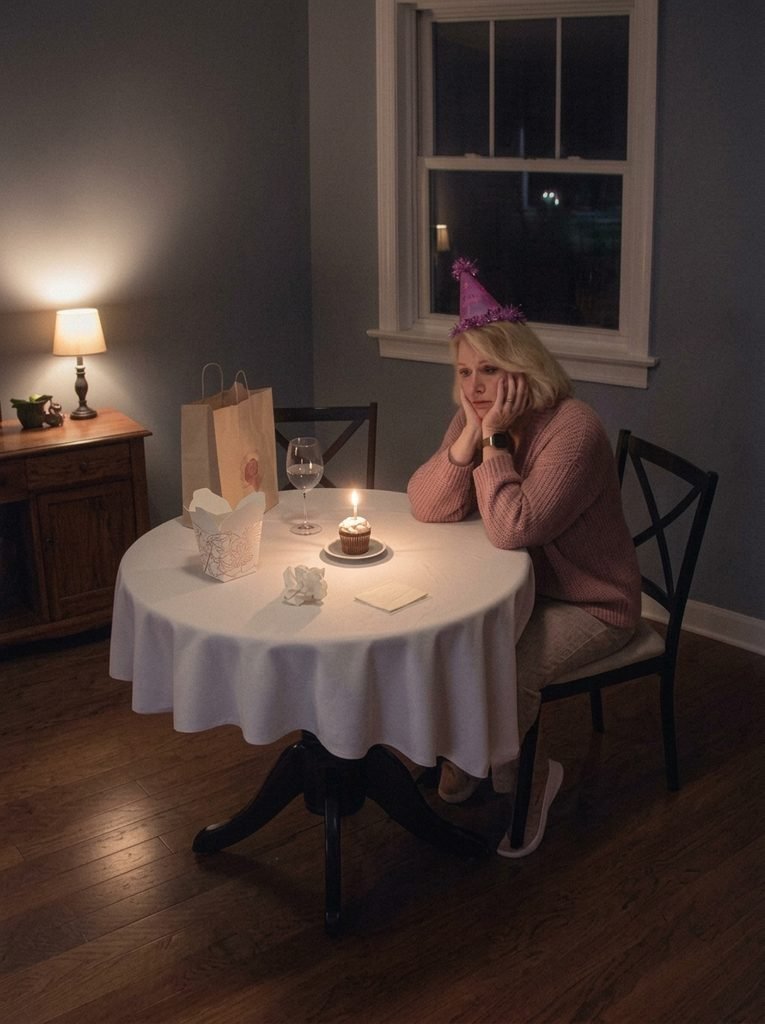
At 6:00 p.m., I ordered Chinese food.
At 6:30 p.m., I opened a bottle of wine.
At 7:00 p.m., I put the birthday cake in the refrigerator without cutting it.
Happy birthday to me.
At 9:05 p.m., someone pounded on my front door.
Not knocked.
Pounded.
I nearly dropped my glass.
When I opened the door, Abigail stood on the porch.
Her mascara had streaked beneath both eyes.
“Mom, can I come in?”
“What happened?”
She stepped inside quickly and locked the door behind her.
I stared at her.
“Abigail?”
She pressed both hands against her face.
“Barbara lied.”
“About what?”
“There was no family dinner.”
My stomach tightened.
“What do you mean?”
“When we got to the steakhouse, there was one table.”
She swallowed. “For three people.”
“Who?”
“Barbara. Owen. Me.”
“What about the kids?”
“Barbara had told us to bring them. When we got there, she had a sitter waiting in the lobby to take them back to our house.”
I stared at her.
“So what was it?”
Abigail looked toward the kitchen as if she needed somewhere else to focus. “She put a folder on the table.”
“A folder?”
“She said tonight wasn’t about dinner.”
I pulled out a chair.
“Sit down.”
Abigail didn’t.
Her hands were trembling.
“What was in it?”
“Pictures of a house.”
I frowned.
“A house?”
“Six bedrooms. Big backyard. Good school district.”
“That sounds nice.”
“It has an in-law suite.”
I understood.
“For Barbara.”
Abigail nodded.
“She wants to sell her house and put most of the money toward this one.”
I stared at her.
“She wants to buy you a house?”
“No.”
Abigail gave a humorless laugh.
“She wants to buy herself a place in ours.”
The folder contained everything.
Mortgage estimates.
School information.
A floor plan.
Photos of bedrooms Barbara had already decided would belong to the children.
A list of nearby activities.
She’d even marked which room she would use.
“Did you know about this?”
“No.”
“Owen?”
Abigail hesitated.
That was enough.
“He knew?”
“Not all of it.”
“What does that mean?”
“He knew she’d been looking.”
I leaned back.
“How long?”
“A few weeks.”
“Why?”
“Because we’ve been struggling.”
That surprised me.
“Owen’s doing well.”
“Not as well as you think.”
She finally sat down.
“Childcare went up again. We had the roof repaired. Owen’s bonus was smaller than expected. We’ve been using Barbara more.”
“For money?”
“For everything.”
Barbara picked up the children three afternoons a week.
She covered last-minute babysitting.
She took them when one was sick.
She’d paid for a summer program when Abigail and Owen couldn’t manage it.
She’d covered part of a car repair.
“She helps us constantly,” Abigail said.
“And tonight she decided to collect?”
“I don’t know.”
“Did she ask you to repay her?”
“No.”
“What did she ask?”
Abigail looked at me.
“To move in with us.”
“That’s not what I asked.”
She looked away.
“She said if she was going to keep helping this much, it made sense for us to be one household.”
“And?”
“She talked about school pickups. Meals. The kids. Holidays.”
I stared at her.
“Holidays?”
Abigail rubbed her forehead.
“Like everything was already decided.”
Before I could answer, headlights swept across my living room wall.
Abigail froze.
The color drained from her face.
“No.”
She rushed to the window and pulled the curtain back half an inch.
Then she stepped away.
“No, not tonight.”
“Who is it?”
She didn’t answer.
I went to the window.
A dark SUV had stopped outside.
Owen climbed out.
Abigail grabbed my arm.
“Mom, please.”
“What?”
“I don’t want another argument.”
“Then don’t have one.”
There was a knock.
Owen didn’t pound.
He knocked once and waited.
I opened the door.
He looked exhausted.
He was still wearing the jacket he’d worn to the steakhouse.
In one hand was Barbara’s folder.
“I figured Abigail would come here.”
Abigail stood behind me.
“Did your mother send you?”
“No.”
“Then why are you here?”
“Because I left too.”
That stopped her.
Owen stepped inside.
“I didn’t agree to anything.”
Abigail laughed bitterly.
“Congratulations.”
“I’m not asking for congratulations.”
He set the folder on my table.
“I should’ve stopped this weeks ago.”
“So you did know.”
“I knew she was looking at houses.”
“You knew enough.”
“Yes.”
He didn’t argue.
That helped more than an excuse would have.
Owen admitted the truth slowly.
His mother had become their solution to almost every problem.
Childcare.
Money.
Emergencies.
School pickups.
Dinner when they worked late.
Whenever Barbara crossed a line, Owen told himself they needed her too much to risk a fight.
“And who usually handled those fights?” I asked.
He looked at Abigail.
She laughed once.
“Me.”
Owen lowered his head.
“Yes.”
That was when I became angry for her.
“Your mother has been putting her in impossible positions for months.”
Abigail went quiet.
I turned toward her.
“She keeps making you choose.”
“Mom.”
“And tonight she made you cancel your own mother’s birthday so she could corner you at a restaurant.”
“Mom.”
“What?”
Abigail looked down at her hands.
“She didn’t make me cancel your birthday.”
The room went still.
“What?”
“She asked me to come.”
“Abigail.”
“She said it was important.”
“And you canceled my dinner.”
“Yes.”
“Because she told you to?”
“No.”
Her voice cracked.
“Because I said yes.”
I stared at my daughter.
Something shifted inside me.
Not anger exactly.
Something sadder.
“Has this happened before?”
Abigail started crying again.
Owen looked away.
That told me enough.
“How many times?”
“Mom, please.”
“How many?”
“Not many.”
“That’s not a number.”
She wiped her eyes.
“That Sunday lunch in March.”
I remembered.
She’d canceled because one of the children supposedly had a stomachache.
“And the weekend I was supposed to take the kids to the lake?”
Abigail closed her eyes.
“Barbara wanted them for a family thing.”
“Did she know they were supposed to be with me?”
Abigail didn’t answer.
“Abigail.”
“Yes.”
I felt my throat tighten.
“And she asked anyway.”
“Yes.”
“You told me they were sick.”
“I’m sorry.”
“Why?”
She didn’t answer.
“Why was disappointing me easier?”
Abigail looked at me then.
“Because when Barbara gets upset, everyone pays for it.”
I said nothing.
“She calls Owen. She texts. She goes quiet for days. She tells us after everything she’s done, we don’t appreciate her.”
“And when I get upset?”
Abigail’s mouth opened.
Nothing came out.
I understood before she said it.
“You knew I’d forgive you.”
Her face crumpled.
“Yes.”
That hurt more than the steakhouse.
More than “nicer.”
More than sitting alone with takeout on my 60th birthday.
I had spent years making sure my daughter never felt trapped by me.
And somewhere along the way, she’d learned that I was the safest person to disappoint.
“I did forgive you,” I said.
She cried harder.
“Every time.”
I swallowed.
“That doesn’t mean it didn’t hurt.”
“I’m sorry.”
Then something occurred to me.
“Did Barbara actually say the steakhouse was nicer?”
Abigail stopped crying.
Owen looked at her.
That was my answer.
“Abigail?”
“No.”
“What did she say?”
“She said she needed us there. That it was important.”
“So where did ‘nicer’ come from?”
Abigail looked ashamed. “I said it.”
“Why?”
“Because I didn’t want to tell you I was canceling your birthday because Barbara said she needed us at some private meeting.”
I stared at her.
“So she didn’t insult my dinner.”
“No.”
“You did.”
Her eyes filled again.
“Yes.”
Headlights crossed the curtains a second time.
This time Owen sighed.
“That’s her.”
Abigail looked at him.
“How does she know we’re here?”
“She probably guessed the same thing I did.”
Barbara knocked before anyone moved.
Abigail looked at Owen.
He nodded once.
She opened the door.
Her gaze moved past Abigail and landed on me.
“Of course.”
Her mouth tightened.
“You came running to her.”
“No,” Abigail said. “You don’t get to make this about her.”
Barbara entered without being invited.
“I have spent the last year helping you two hold everything together, and now I’m being treated like some kind of criminal.”
“No one called you a criminal,” Owen said.
“You walked out.”
“Because you ambushed us.”
“I made you an offer.”
“You made plans for our lives without asking.”
Barbara looked at Abigail.
“You need the help.”
“That’s not the point.”
“I’ve picked up those children hundreds of times. I’ve canceled appointments. I’ve paid for things you couldn’t afford. I’ve cooked. I’ve babysat. I’ve rearranged my entire life.”
Her voice cracked.
And suddenly, beneath all the anger, I heard something else.
Fear.
“My husband died 18 months ago,” she said. “Do any of you understand what that house feels like now?”
No one answered.
Barbara’s face changed.
“I come home and there’s nobody there.”
Abigail softened slightly.
“Barbara…”
“No. You all have each other.”
She looked at me.
“She has you.”
Then back at Owen.
“You have her and the children.”
Her hand pressed against her chest.
“I have an empty house.”
There it was.
Not generosity.
Not entirely.
Need.
Barbara had made herself indispensable because being needed felt safer than wondering whether anyone would choose her.
“I’ve spent all this time making sure you could depend on me,” she said.
I looked at her.
“That’s not the same as making sure they love you.”
She flinched.
“You don’t understand.”
“I understand more than you think.”
She laughed bitterly.
“You have the easy position.”
“What does that mean?”
“You get to be Grandma.”
I stared at her.
Barbara’s voice sharpened.
“I pick them up from school. I take them when they’re sick. I cancel my plans when they need me. I pay for things. I cook. I babysit.”
“And?”
“And they still ask for you.”
The words hung between us.
Barbara looked away.
“You don’t have to do any of it. You just show up, and they love you.”
For a moment, neither of us spoke.
Then I understood.
This wasn’t only about an empty house.
Barbara thought love was something you earned by being useful.
And somewhere along the way, she’d started resenting me for being loved without paying for it.
That nearly made me laugh.
“You could’ve had a place in this family without taking mine.”
“I never took yours.”
Abigail spoke before I could.
“Yes, you did.”
Barbara stared at her.
“And I let you.”
That mattered.
Abigail wiped her face.
“I’m not taking the house.”
Barbara’s expression hardened.
“Think about what you’re giving up.”
“I am.”
“What about childcare?”
“We’ll figure it out.”
“The money?”
“We’ll figure it out.”
Barbara looked at Owen.
He nodded.
“We will.”
Then Abigail said the thing I needed her to say.
“And I’m not choosing between you and my mother anymore.”
Barbara folded her arms.
Abigail shook her head.
“Actually, that’s wrong. I should never have let either of you think there was a competition.”
Barbara looked at her.
“And what am I supposed to do? Sit in that house and wait until somebody remembers me?”
Abigail’s face softened.
“No.”
She reached for Barbara’s hand.
“You don’t have to buy a room in our house to have a place in our family.”
Barbara looked down.
“But you do have to stop making us prove we love you by saying yes.”
Barbara left 20 minutes later.
Not happily.
Not forgiven.
Not defeated.
Just quieter.
Owen drove her home.
Abigail stayed.
For a while, neither of us spoke.
Then she noticed the takeout containers.
“You ate Chinese food?”
“I tried.”
Her eyes moved to the refrigerator.
“Did you have cake?”
“No.”
“Why not?”
I shrugged.
“I didn’t feel like celebrating alone.”
Abigail covered her face.
“Mom.”
I waited.
She lowered her hands.
“I’m sorry I ruined your birthday.”
Not Barbara.
Not Owen.
Not circumstances.
I ruined your birthday.
That was the apology I needed.
“I kept telling myself you understood,” she said.
“I did understand.”
She looked at me.
I held her gaze.
“It still hurt every time.”
Abigail nodded.
“I know.”
A few minutes later, another car pulled up.
This time nobody flinched.
Owen came back after picking up the children from their house.
My grandson burst through the door holding a folded card covered in marker.
“Grandma!”
My granddaughter ran behind him.
“We made this at school!”
Inside, beneath a crooked purple heart, my granddaughter had written, “60 THINGS WE LOVE ABOUT GRANDMA.”
They’d made it to 17 before running out of room.
They climbed all over me.
Then my granddaughter saw the cake.
“Grandma, you didn’t have your cake?”
I looked at Abigail.
“No.”
“Why?”
I smiled. “I was waiting.”
Abigail’s eyes filled again.
We found an old number six candle in the back of a drawer and a crooked zero from another birthday.
It didn’t matter.
Owen reheated the Chinese food.
The children fought over who got to light the candles.
Abigail sat beside me.
Before I blew them out, she reached for my hand.
“Next time,” I said quietly, “don’t assume ‘it’s okay’ means it doesn’t hurt.”
She squeezed my fingers. “Next time I’ll ask.”
I looked around my small kitchen.
No steakhouse.
No expensive house.
No perfect plan.
Just my daughter, my grandchildren, cartons of lo mein, melting frosting, and a birthday card written in purple marker.
I’d spent years trying to make loving me easy.
Somewhere along the way, Abigail had started believing hurting me was easy too.
That night, for the first time, we both understood the difference.
If your child admitted they kept choosing someone else because they knew you’d forgive them, would their honesty make it easier to forgive, or hurt even more?