PART 2
Sophie’s lips moved, but no sound came out at first.
She looked down at the hospital bracelet on her wrist as though the white plastic strip carried a truth she was terrified to release.
I followed her gaze.
Her name was there.
Sophie Carter.
Her birth date.
A string of numbers.
And beneath them, an abbreviation for a hospital department I didn’t understand.
When she finally spoke, her voice was barely louder than the hum of the fluorescent lights above us.
“Ethan,” she whispered, “you weren’t supposed to find out like this.”
The hallway seemed to narrow around us.
A nurse passed behind me pushing a cart, its wheels squeaking softly against the polished floor, but the sound felt impossibly far away.
All I could hear was Sophie’s uneven breathing.
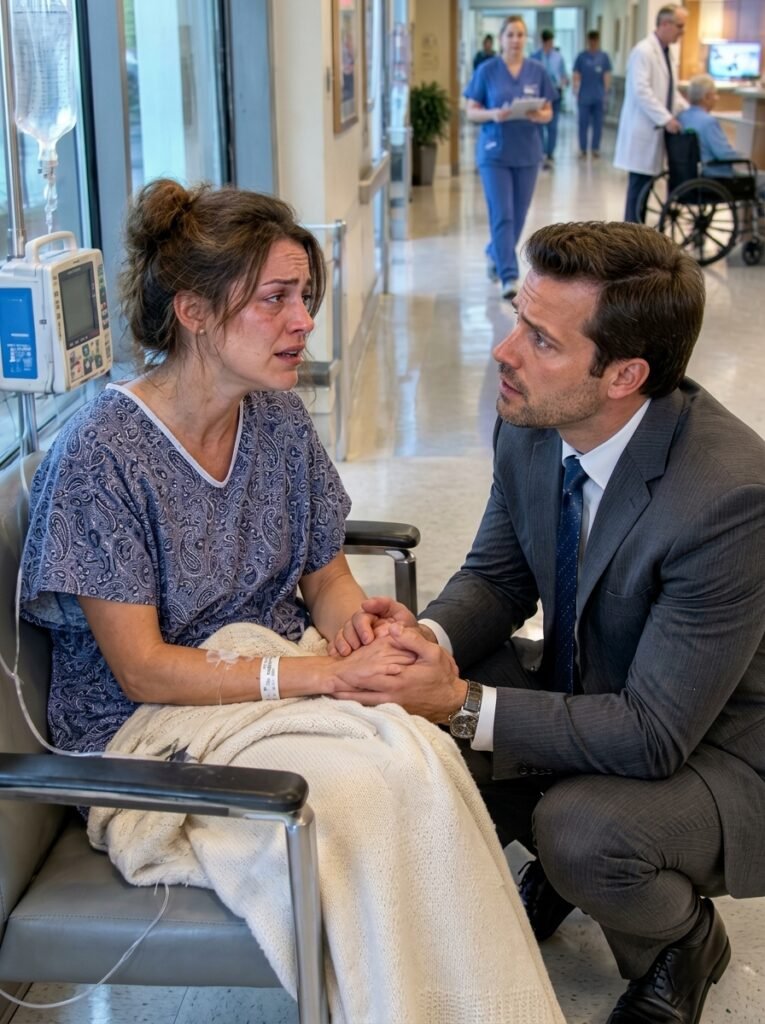
I knelt in front of her because standing over her felt wrong.
Because standing felt too much like leaving.
“Find out what?” I asked.
Sophie’s eyes flicked toward the nurses’ station, then back to me.
There was fear in her expression, but not fear of me.
It was something deeper.
Something she had been carrying alone for far too long.
“Please don’t make a scene,” she said.
“I’m not making a scene.”
My voice cracked despite my effort to keep it steady.
“Sophie, are you sick?”
She swallowed hard.
Her fingers curled around the edge of the plastic hospital chair.
“They found a mass,” she said quietly.
For a second, I did not understand the sentence.
It landed too gently for something so terrifying.
“A mass?” I repeated.
She nodded.
“They don’t think it’s cancer, but it was dangerous enough that they wanted to operate. I had surgery yesterday.”
Yesterday.
The word struck me harder than anything else.
Surgery yesterday.
And she had been alone.
“Why didn’t you call me?” I asked.
The moment the question left my mouth, I hated how wounded I sounded.
As though I had been the one abandoned.
Sophie looked at me for a long moment.
Then she gave a small, tired smile that vanished almost immediately.
“You divorced me, Ethan.”
There was no anger in her voice.
No accusation.
Only fact.
And somehow that made it hurt worse.
I looked down at my hands.
Two months ago, those hands had signed papers that turned my wife into someone I was no longer entitled to protect.
No longer entitled to know.
No longer entitled to hold.
“I didn’t know,” I said.
“I know.”
“Why didn’t anyone tell me?”
“Who would have?”
I opened my mouth, but no answer came.
Her parents had never liked me much.
Her older sister, Lena, barely spoke to me.
Most of our mutual friends had chosen silence after the divorce because silence was easier than taking sides.
And Sophie herself had always been painfully good at enduring things quietly.
Before I could say anything else, a doctor in blue scrubs stepped out from a nearby doorway and paused when he saw us.
“Mrs. Carter?”
Hearing him call her by my last name made something twist sharply in my chest.
Sophie straightened a little.
“Yes?”
The doctor glanced at me politely.
“I’m Dr. Patel,” he said. “Are you family?”
The question hollowed me out.
Family.
Once, the answer had been simple.
I was her husband.
Her emergency contact.
The person who knew how she took her coffee, which side of the bed she preferred, and what song made her cry every Christmas.
Now I was standing in a hospital hallway with no clear right to be there.
Sophie started to speak, but I answered first.
“I was her husband.”
Dr. Patel nodded carefully, as though he had heard many complicated answers in hospital hallways.
“She needs rest,” he said. “We were about to review her discharge plan, but I would prefer someone stay with her for at least forty-eight hours.”
Sophie’s face tightened.
“I have arrangements,” she said.
The doctor’s expression softened.
“Your neighbor called this morning. She said she can’t come until tomorrow evening.”
Sophie looked down.
Dr. Patel continued gently, “I’m not comfortable releasing you to an empty apartment tonight.”
I turned to Sophie.
“I can take you.”
Her head lifted immediately.
“No.”
“Sophie—”
“No, Ethan.”
“Just for tonight,” I said. “Not to decide anything. Not to erase anything. Just so you’re not alone.”
She looked away.
Her jaw trembled once before she pressed her lips together.
Dr. Patel cleared his throat softly.
“I’ll give you a few minutes.”
He walked away, leaving us beneath the bright hospital lights and the weight of everything unsaid.
Sophie kept her gaze fixed on the window at the end of the hallway.
“You don’t owe me this,” she said.
“Maybe not.”
I lowered myself into the chair beside her.
“But I owe you more than disappearing.”
Her eyes shimmered, but she blinked the tears away.
“You made it clear you wanted a life without me.”
“I thought I did.”
“That isn’t an answer.”
“No,” I said. “It’s the beginning of one.”
For a while, neither of us spoke.
Outside the window, Chicago moved on without us.
Cars slid through late afternoon traffic.
People crossed the street carrying coffee cups and grocery bags.
Somewhere beyond the glass, life continued with impossible normalcy.
But in that hallway, everything I had convinced myself was finished suddenly felt unfinished.
A nurse named Marisol arrived with discharge papers, medication instructions, and a cloth bag containing Sophie’s phone, cardigan, and shoes.
Sophie signed each form slowly.
The pen trembled between her fingers.
I remembered her handwriting from birthday cards and grocery lists.
Soft loops.
Careful spacing.
Little hearts sometimes drawn over the letter i when she was trying to make me laugh.
After the divorce, I had found a stack of her old notes in my desk drawer.
I couldn’t throw them away.
So I placed them in a shoebox under my bed, where they waited like evidence.
When Marisol asked for Sophie’s address, shame tightened around my throat.
I did not know where she lived now.
For five years, I had known everything about her daily life.
Now I did not even know the street that held her bed.
“Ravenswood,” Sophie said quietly.
The neighborhood was only twenty minutes from my apartment.
Twenty minutes.
All this time, she had been close enough for us to pass each other in a grocery store aisle or stand on the same train platform without knowing.
Yet I had imagined her life as distant because distance made my guilt easier to carry.
The elevator ride downstairs felt longer than the divorce hearing.
Sophie leaned against the rail, eyes closed, the cloth bag pressed against her chest.
I wanted to ask a hundred questions.
When did the symptoms start?
Who had driven her to surgery?
How long had she been afraid?
Had she cried when they wheeled her into the operating room?
Had she wished I was there?
But her exhaustion answered enough.
Outside, the October wind moved dry leaves along the curb.
I helped her into my car carefully.
She murmured thank you without looking at me.
For a moment, we sat in silence.
Two people in a parked car.
Two people surrounded by everything they had failed to say.
Halfway to Ravenswood, Sophie asked me to stop at a pharmacy.
“The hospital gave me enough for tonight,” she said, “but I need soup, crackers, and lemon drops.”
The words lemon drops caught me off guard.
During her first pregnancy, nausea had turned lemon drops into a household necessity.
She used to keep them in every coat pocket, every purse, every drawer.
She must have seen the memory cross my face, because her expression closed.
“Sorry,” she said. “Habit.”
“Don’t apologize for remembering your own life.”
The sentence surprised both of us.
She turned her head and looked at me through the dim light inside the car.
For one brief second, something unguarded passed across her face.
Then it was gone.
At the pharmacy, I moved through the aisles beneath harsh fluorescent lights and gathered everything she had asked for.
Chicken soup.
Crackers.
Lemon drops.
Bottled water.
Gauze pads.
A heating pad.
I almost bought flowers.
Then I stopped.
Flowers were too easy.
Flowers were what guilty men bought when they wanted grief to look beautiful.
Sophie did not need beauty arranged in a vase.
She needed someone to remember her medication schedule.
Someone to make sure she ate.
Someone to stay awake if her fever rose.
At the register, an older cashier looked at the items and asked, “Taking care of somebody?”
I looked through the glass doors at Sophie waiting in the car.
“Trying to,” I said.
And for the first time in months, I meant it without excuse.
Her apartment building was an old brick walk-up with browned ivy clinging to the walls.
The lobby smelled faintly of detergent, dust, and someone’s dinner.
Sophie insisted she could manage the stairs.
By the second landing, her face had gone pale.
I offered my arm without speaking.
For a stubborn second, she ignored it.
Then she took it.
Her hand was light on my sleeve.
That small touch carried more trust than I deserved.
At her door, she fumbled with the keys.
One key still had the little house-shaped keychain we bought years ago at a street fair.
We had laughed when we bought it because we did not own a house yet.
We only had a dream of one.
A dream with a porch.
A tiny garden.
A yellow nursery neither of us dared mention after the second loss.
The apartment was small but unmistakably hers.
A blue scarf hung over the back of a chair.
Books rose in careful stacks beside the couch.
A chipped daisy mug sat near the sink.
There were watercolor prints on the walls, all quiet landscapes.
A lake at dawn.
A path through birch trees.
A porch facing rain.
There were no photographs of us.
No wedding picture.
No vacation snapshot.
No visible proof that I had ever belonged to her life.
I set the bags on the kitchen counter.
“Where do you keep bowls?”
She pointed toward a cabinet, then eased herself onto the couch with a sigh she tried to hide.
While soup warmed on the stove, I noticed a folder on her kitchen table labeled St. Vincent.
Beside it were bills, appointment cards, and a folded letter with a university logo.
I looked away before curiosity became invasion.
Sophie noticed anyway.
“You can ask,” she said.
“I don’t know what I’m allowed to ask.”
“That never stopped you during tax season.”
It was the first hint of humor between us in months.
I smiled, and it hurt.
“Medical folder?”
She nodded.
“Mostly test results. Insurance forms. A few things I haven’t decided what to do with.”
I carried the soup to her on a tray.
She took it with both hands and blew gently across the surface.
The motion nearly undid me.
We had built years of marriage from moments like this.
Soup.
Tea.
Folded blankets.
Quiet evenings.
Then we had convinced ourselves those small things were not enough to save anything.
“When did you get sick?” I asked.
Sophie stirred the soup without eating.
“Before the divorce was final.”
My hand tightened around the back of the chair.
“You knew then?”
“I knew something was wrong. I didn’t know how wrong.”
“And you didn’t tell me?”
She looked up at me.
“I didn’t want another reason for you to stay out of obligation.”
“Sophie…”
“You were tired, Ethan.”
“So were you.”
“Yes,” she said softly. “But I was used to hiding it.”
That sentence settled between us like a stone.
After dinner, I organized her medications on the coffee table.
She corrected me twice, gently but firmly.
For a moment, the rhythm between us felt familiar enough to be dangerous.
At nine, I made tea while she dozed on the couch.
Her phone buzzed.
Once.
Twice.
Then again.
I glanced only because the sound kept repeating.
Three missed calls from Lena.
Then a message appeared on the screen.
Please tell me Ethan isn’t there. You promised you’d be careful.
I set the phone down quickly.
Sophie opened her eyes.
“That was Lena,” she said.
“I know.”
“She’s my sister.”
“I remember.”
A faint sadness crossed her face.
“You remember the name. Not much else.”
She was right.
In five years of marriage, Sophie had spoken of Lena only in fragments.
An older sister.
Ten years older.
Protective.
Difficult.
Always followed by a change of subject.
“She doesn’t like me,” I said.
“She doesn’t know you.”
“She knows enough to send that message.”
Sophie pulled the blanket closer.
“She knows the version of you I described when I was hurt.”
“Was that version accurate?”
She looked down at her tea.
“Sometimes.”
Then she added, “Not completely.”
Honesty entered the room quietly, but it changed the air.
Sophie told me Lena had practically raised her after their mother died.
Their father remarried and moved away, leaving the two sisters to become a family by necessity.
“Lena believes love should protect people from pain,” Sophie said. “When it doesn’t, she blames whoever is closest.”
“Me.”
“And me.”
She closed her eyes.
“Mostly me. But she hides that behind worrying.”
“Did she know about the surgery?”
“Yes.”
“And she couldn’t come?”
Sophie hesitated.
“She wouldn’t.”
That answer carried more history than I knew how to enter.
So I let it rest.
She was tired.
Her eyelids kept lowering.
“You should sleep,” I said.
“You can take the couch.”
“I can leave once Lena calls back.”
“No.”
Her voice sharpened, then softened.
“Please stay. I don’t want to explain tonight to anyone else.”
It was the closest she had come to asking for help.
I nodded.
She rose slowly.
I walked beside her to the bedroom door but stopped at the threshold.
Inside, her room was small and neat.
A narrow bed.
A green-shaded lamp.
Curtains patterned with tiny birds.
On the dresser stood one framed photograph.
At first, I did not recognize it.
Then I did.
It was not from our wedding.
Not from a vacation.
Not from any smiling occasion people usually frame.
It was a picture of our hands wrapped around two paper cups of hospital coffee.
The first pregnancy.
The first scare.
The first time we thought fear was temporary because hope was still stronger.
My thumb was pressed against hers in the photo.
She noticed me looking.
“I meant to put it away,” she said.
“I kept forgetting.”
“Or you didn’t want to.”
She did not answer.
I returned to the living room and made the couch into a bed.
The blanket smelled of lavender.
For a long time, I lay awake beneath the glow of the streetlamp outside.
Around midnight, I heard Sophie crying.
Not loudly.
Not dramatically.
Only enough for someone listening carefully to hear.
Every instinct told me to go to her.
But every lesson from our failure told me not to confuse my guilt with comfort she had not requested.
So I stayed where I was.
And I listened.
In the morning, she found me in the kitchen reading the medication schedule for the fourth time.
Her hair was flattened on one side, making her look younger and more fragile than she would have liked.
“You always read instructions like they’re riddles,” she said.
“They usually are.”
She smiled faintly, then winced as she sat down.
I poured tea and pretended not to notice her pain.
She looked at me over the mug.
“You can notice,” she said. “Ignoring it doesn’t make me feel stronger.”
I set the kettle down.
“All right. Does it hurt?”
“Yes.”
“How much?”
“Enough that I’m glad you stayed last night.”
Those words stayed with me through breakfast.
They stayed with me during the slow walk down the block her doctor had recommended.
Ravenswood was bright with autumn color.
Children in knit hats kicked leaves near a school fence.
A dog barked from behind a gate.
Sophie moved slowly, one hand against her side, but her eyes followed everything with quiet hunger.
As if the world had become precious while she had been trapped in hospital sheets and machine sounds.
“I forgot how loud morning is,” she said.
“Cars?”
“Life.”
We stopped beneath a maple tree.
A red leaf landed on her sleeve.
She stared at it for a moment.
Then she smiled.
A real smile.
Small, tired, but real.
On the way back, Lena called.
Sophie put the phone on speaker because her hands were shaking too much to hold it.
“Are you safe?” Lena demanded.
Sophie closed her eyes.
“Good morning to you too.”
“Is he there?”
Sophie looked at me.
Then she looked at the red door of her building.
“Yes.”
There was a tight silence.
“Sophie, after everything—”
“After everything,” Sophie interrupted, “I had surgery and needed help. Ethan helped.”
“Help is easy when someone wants forgiveness,” Lena said.
I expected Sophie to defend me.
Instead, she said, “Maybe.”
That maybe followed us upstairs.
Back in the apartment, Sophie sat at the kitchen table, pale from the walk and the phone call.
“She isn’t wrong,” I said.
Sophie unwrapped a lemon drop slowly.
“Neither are you.”
“What does that mean?”
“It means people can do the right thing for complicated reasons.”
She placed the candy on her tongue.
“I don’t need you to become a hero, Ethan. I need you to be honest.”
I thought about all the months I had spent calling avoidance peace.
“I was relieved when you didn’t fight the divorce,” I admitted.
Sophie went very still.
I forced myself to continue.
“Because if you had asked me to stay, I might have. And I was terrified that staying would mean failing again.”
Her fingers tightened around the candy wrapper.
“I didn’t fight because I thought you had finally said what both of us were too tired to admit.”
“That we didn’t love each other?”
Her eyes lifted quickly.
“No.”
The answer came so sharply it startled me.
Then her voice softened.
“That love had stopped being enough by itself.”
The distinction opened something in me.
Not hope exactly.
Something quieter.
Something like a door unlocking, though neither of us had touched the handle yet.
“I never stopped loving you,” I said.
Sophie looked down so quickly I wished I could pull the sentence back.
“That isn’t fair,” she whispered.
“I know.”
“No, I don’t think you do.”
She pressed her hand flat against the table.
“Love after leaving can sound beautiful to the person saying it. But to the person left behind, it can sound like a key arriving after the house has burned.”
I closed my eyes.
“You’re right.”
When I opened them, she was crying silently.
I reached across the table, then stopped halfway.
She looked at my hand.
After a long moment, she placed hers over it.
The contact was warm.
Uncertain.
Devastatingly familiar.
That afternoon, while Sophie slept, I washed dishes, folded laundry, and found the practical shape of remorse.
Apologies mattered.
But clean mugs and fresh towels had their own language.
While putting away a stack of sweaters, I noticed a cardboard box on the closet shelf.
My handwriting was on the side.
Ethan’s winter things.
I had forgotten the box existed.
Inside were gloves, a scarf, and the navy sweater Sophie used to borrow on cold Sundays.
Beneath them lay an envelope.
The handwriting was hers.
For Ethan, only if I lose courage.
My hands went cold.
I stood there holding it while rain began tapping the window.
Every decent part of me knew I should put it back.
Every frightened part wanted answers before Sophie could decide I had forfeited the right to hear them.
In the end, I carried the envelope to the kitchen and set it beside her medical folder.
Unopened.
Then I sat beside it like both a guard and a thief.
When Sophie woke near dusk, she noticed it immediately.
Color rose in her face.
“Where did you find that?”
“Closet shelf.”
“Did you open it?”
“No.”
Her shoulders lowered with relief.
And dread.
She sat across from me, turning the envelope until the corners aligned with the edge of the table.
“I wrote it before the surgery,” she said.
“In case I woke up and lost my nerve.”
“Lost your nerve about what?”
Rain blurred the windows behind her.
The city outside turned into streaks of amber and gray.
Sophie pressed her thumb against the sealed flap.
“About telling you the whole truth.”
My stomach tightened.
“About being sick?”
“Partly.”
The word was too small for the weight it carried.
“There’s something else,” she said. “Something I should have told you before I signed those papers.”
I thought of money.
Another diagnosis.
A betrayal.
Some secret she had hidden because we were already too broken.
My mind reached for ordinary fears because ordinary fears were easier than the look in her eyes.
“Tell me now,” I said.
She shook her head.
“Not like this.”
“Sophie—”
“Not while I’m dizzy and you’re here because I scared you.”
“I’m here because I chose to be.”
“Today,” she said softly.
Then she looked directly at me.
“Choice is only real when it lasts past the emergency.”
I had no defense against that.
She slid the envelope toward me.
Then stopped before letting go.
“Come to my appointment tomorrow morning.”
“I’ll be there.”
She studied me carefully.
Searching for hesitation.
Searching for escape.
Searching for the old version of me who softened disappointment with careful words.
Whatever she saw made her nod.
“Then I’ll tell you after.”
She tucked the envelope beneath the medical folder.
But one corner remained visible.
A white triangle with my name on it.
That night, we ate toast and soup while rain stitched silver lines down the glass.
We did not talk about love again.
Instead, we discussed small things.
The leaky faucet.
Her stubborn fern.
My terrible apartment.
Burnt coffee.
The neighbors upstairs who apparently argued every Thursday about recycling.
It was the kind of conversation married people have when they believe there will be endless evenings to say the bigger things later.
Only this time, we knew better.
Near midnight, after Sophie had fallen asleep, her phone lit up again on the coffee table.
I glanced over.
This time, the message was not from Lena.
It was from Dr. Patel.
The preview made my breath catch before I could look away.
Sophie, the lab repeated the test. The markers match the archived sample from three years ago. Please bring Ethan if you decide to tell him.
I stared at the glowing screen, unable to move.
Because three years ago was when we had lost our first baby.
PART 3
For a long time, I did nothing.
The apartment was dark except for the soft blue glow of Sophie’s phone on the coffee table. Outside, rain whispered against the windows, turning the city into a blur of streetlights and wet pavement. Inside, the room felt perfectly still, as though even the old radiator beneath the window had stopped breathing.
Sophie, the lab repeated the test. The markers match the archived sample from three years ago. Please bring Ethan if you decide to tell him.
Three years ago.
Our first baby.
I stared at the message until the letters began to lose shape.
Markers.
Archived sample.
Bring Ethan.
There are moments when fear does not arrive loudly. It does not slam through the door or knock the air from your lungs. Sometimes it enters quietly and sits beside you, polite and patient, waiting for you to understand that your life has just changed.
I wanted to wake Sophie immediately.
I wanted to ask what it meant, why Dr. Patel had written my name, why anything from three years ago could matter now. But she was sleeping in the next room after surgery, pale and exhausted, and the one thing I had promised myself was that I would not make my panic her burden again.
So I turned the phone face down.
Then I sat in the dark until morning.
When dawn finally came, it did not feel like morning. The sky outside remained heavy and gray, and the apartment smelled faintly of rain, tea, and the soup we had reheated the night before. I made coffee and then remembered Sophie could not have any before the appointment. I poured mine down the sink.
It felt like the smallest form of loyalty.
She came out of the bedroom wearing a loose sweater over leggings, moving carefully with one hand at her side. Her short hair was tucked behind one ear, and for a moment I saw the woman I had first met in a bookstore eight years ago—the same quiet focus, the same softness around her eyes, the same way she seemed to notice everything without asking for attention.
Then she saw my face.
“You saw the message,” she said.
There was no accusation in it.
Only recognition.
I turned from the sink slowly. “I didn’t mean to.”
“I know.”
“I only saw the preview.”
She nodded and lowered herself into the kitchen chair. “That was enough, wasn’t it?”
I sat across from her. The envelope with my name on it still lay beneath the medical folder, one corner visible like a warning.
“Sophie,” I said carefully, “what happened three years ago?”
Her fingers folded together on the table.
“You remember the first miscarriage.”
I almost answered too quickly.
Of course I remembered.
I remembered the hospital hallway, the vending machine coffee, the way she kept apologizing though she had done nothing wrong. I remembered holding her hand while a doctor explained things in gentle language that somehow made every sentence hurt more. I remembered going home afterward and finding the little yellow blanket she had bought tucked beneath our bed.
But remembering was not the same as understanding.
“I remember pieces,” I admitted. “Maybe not all of it. Maybe not the way you do.”
Sophie looked at me then, and something in her expression softened.
“That’s the most honest thing you’ve said in a long time.”
I deserved that.
She opened the folder and pulled out a folded sheet of paper. It was not the envelope. Not yet.
“After the first loss, they ran tests. Not many. Just routine things. I was told everything was inconclusive.” She paused. “But a few months ago, when I started getting sick, Dr. Patel requested my older records. He found something strange.”
“What kind of strange?”
“One of the samples taken during the miscarriage had markers that didn’t match what they expected.”
I tried to follow her words, but they felt like stepping stones across deep water.
“Markers for what?”
“For a rare condition,” she said. “Something that can affect pregnancy and then show up later as abnormal tissue growth. It’s treatable. That’s what the surgery was for.”
The first solid breath I had taken all morning shuddered out of me.
“Treatable?”
“Yes.”
I closed my eyes for a second.
Relief came, but it did not arrive cleanly. It came tangled with dread, guilt, confusion, and a question I could not stop hearing.
“Then why did Dr. Patel mention me?”
Sophie’s hand moved to the envelope.
“Because the records from three years ago weren’t complete.”
I looked at the envelope, then at her.
“They weren’t complete because I didn’t let them be.”
The room seemed to tilt.
“What does that mean?”
Sophie stared down at her hands. “I got a call after the first miscarriage. Not from my doctor. From another office. They said there had been an issue with one of the records. They needed both parents to come in for follow-up testing.”
I was silent.
She continued, voice thin but steady.
“I was going to tell you. I really was. But that was the same week you started sleeping at the office almost every night. You were barely eating. Every time I looked at you, I could see how trapped you felt.”
“I was grieving,” I said, though it sounded weak even to me.
“I know. But back then, I didn’t know how to reach you without feeling like I was dragging you underwater with me.”
“So you went alone?”
She nodded.
“They told me the sample suggested the pregnancy may not have failed for the reason we were first given. They wanted more information. Genetic history. Family history. Bloodwork from both of us.”
My throat tightened.
“And you didn’t tell me.”
“I didn’t.”
“Why?”
Her eyes filled, but she held herself still.
“Because I was scared of what the results might say. I was scared something was wrong with me. I was scared something was wrong with you. I was scared we would start blaming each other without meaning to.” A tear slipped down her cheek. “And then, when I went back for the next appointment, the file had been marked closed.”
“Closed by who?”
“That’s what I don’t know.”
The radiator clicked on beneath the window.
Somewhere upstairs, a floorboard creaked.
My mind was moving too fast. “A medical file can’t just close itself.”
“No.”
“You’re saying someone stopped the follow-up?”
“I’m saying Dr. Patel thinks someone did.”
That was when I understood why she had not wanted to tell me the night before. Not while dizzy. Not while weak. Not while I might respond like a man who wanted answers more than he wanted to protect the person giving them.
I leaned back and pressed both hands over my face.
For years, I had believed our marriage broke because grief changed us and neither of us knew how to find our way back. That was still true. But now there was something else beneath it, hidden in the foundation like a crack no one had shown us.
“Sophie,” I said, lowering my hands, “who would have had access to those records?”
She did not answer right away.
That silence told me she had wondered the same thing.
“My sister helped with paperwork after the miscarriage,” she said. “Lena was there when I couldn’t think clearly. She called insurance. She picked up prescriptions. She handled things I couldn’t look at.”
“You think Lena closed the file?”
“No.” Her voice firmed. “I don’t know. And I’m not accusing her without understanding what happened.”
“But you’re afraid.”
Sophie’s gaze moved toward the phone on the table.
“I’m afraid there’s a version of my life other people made decisions about while I was too broken to ask questions.”
The words stayed between us.
I wanted to take her hand, but this time she reached for mine first.
“We have the appointment in an hour,” she said. “I need you to come with me. Not as my ex-husband trying to fix everything. Not as someone who feels guilty.”
“Then as what?”
She looked at me, tired and brave.
“As the only other person who lost that baby with me.”
I nodded because I could not speak.
St. Vincent Medical Center looked different in daylight.
The lobby was busy with families, nurses, wheelchairs, coffee cups, balloons, flowers, and the strange mixture of fear and hope that every hospital seems to hold. Sophie moved slowly beside me, her hand resting lightly on my arm. This time she did not resist the help.
At the elevator, an elderly man in a Cubs cap smiled at her.
“Long morning?” he asked kindly.
Sophie gave a small smile. “Feels like it.”
He nodded as if he understood everything. “They usually are. But mornings end.”
It was such a simple thing to say, yet Sophie’s fingers tightened around my sleeve.
On the fourth floor, Dr. Patel met us outside an office instead of an exam room. He looked kind but serious, with tired eyes that suggested he had learned not to speak too quickly around frightened people.
“Sophie,” he said, “how are you feeling?”
“Like I had surgery two days ago.”
“That is, unfortunately, medically accurate.”
She laughed softly, and the sound eased something in the hallway.
Then Dr. Patel looked at me.
“Ethan?”
“Yes.”
“Thank you for coming.”
We followed him into his office. There were no harsh exam lights, only a desk, three chairs, and a window overlooking the hospital courtyard. A maple tree below had turned bright orange, its leaves shining against the gray morning.
Dr. Patel sat and folded his hands.
“I want to begin with reassurance,” he said. “The surgery went well. The mass we removed appears consistent with the condition we discussed. We are still waiting for final pathology, but nothing we’ve seen so far suggests the worst-case scenario.”
Sophie exhaled quietly.
I realized I had been holding my breath too.
“That’s good,” I said.
“It is good.” Dr. Patel nodded. “But the reason I asked Sophie to consider bringing you concerns the earlier pregnancy record.”
He opened a file.
“After Sophie’s recent tests, we compared tissue markers with an archived sample from the pregnancy loss three years ago. The match suggests the same condition may have been present then. If properly identified, it likely would have led to follow-up monitoring.”
“And it wasn’t identified?” I asked.
“It was identified enough to trigger a follow-up request.”
Sophie’s face went pale.
Dr. Patel continued carefully. “That request appears to have been canceled.”
“By who?” I asked.
“That is the part we are trying to determine. The cancellation was entered using an administrative login. Not a physician’s note. Not Sophie’s written refusal. Not your consent. Just a system entry.”
Sophie stared at him.
“So someone clicked a button and my care stopped?”
“I’m saying the record shows a cancellation without adequate documentation.”
The professional wording could not hide what it meant.
I felt anger rise, but Sophie’s hand found mine under the edge of the desk. Not to comfort me. To steady me.
I held on.
Dr. Patel turned a page. “There is one more issue. At the time, a note was added indicating that the patient was transferring care to an outside clinic.”
“I never did,” Sophie said.
“I know.”
“Which clinic?” I asked.
Dr. Patel hesitated.
“North Shore Women’s Family Center.”
Sophie’s eyes snapped toward me.
I knew that name.
Not well. Not from our marriage.
From Lena.
“She worked there,” I said.
Sophie’s face changed.
“Lena worked there?”
“You told me once. Years ago. She left after some disagreement with management.”
Sophie shook her head slowly. “No. She told me she worked in billing at a pediatric practice.”
Dr. Patel’s expression remained neutral, but his silence carried weight.
Sophie withdrew her hand from mine and pressed it against her mouth.
“No,” she whispered. “No, that doesn’t make sense.”
“We don’t know that Lena did anything,” I said quickly.
“I know.” Her eyes were bright with tears. “But why would she lie about where she worked?”
Dr. Patel gave her a moment before speaking.
“I’ve requested a formal audit of the record. That will take time. In the meantime, your health is our priority. We’ll monitor your recovery closely, repeat labs, and discuss next steps once pathology is final.”
Sophie nodded mechanically.
But I could tell she was no longer in that office. She was three years in the past, standing in a hallway with a file someone else had closed.
When the appointment ended, we walked to the courtyard instead of the parking garage.
The rain had stopped, and the air smelled clean, sharp, and cold. Sophie sat on a bench beneath the maple tree. Leaves moved above us like small orange flames.
I sat beside her, leaving space between us.
She looked at her hands.
“Lena was there for everything after my mom died,” she said. “When Dad checked out, she made lunches. She signed school forms. She learned how to braid my hair by watching videos because Mom wasn’t there to teach us. She was twenty-two and raising a twelve-year-old.”
I listened.
“She can be controlling. I know that. She decides what’s best and then pushes until people agree. But she loved me.”
“I believe that.”
Sophie looked at me. “Do you?”
“Yes. Love and fear can get tangled. That doesn’t mean the love was fake.”
She turned away, blinking hard.
“I don’t want to discover that my sister hurt me while trying to protect me.”
I thought of our marriage. Of how often I had called avoidance kindness.
“Sometimes people hurt others while trying not to,” I said.
She gave a sad little smile. “You would know.”
“Yes,” I said. “I would.”
For the first time, the words did not feel like defeat. They felt like the beginning of an apology that was no longer asking for anything.
I reached into my coat pocket and pulled out the envelope she had given me before we left. She had asked me to carry it, then said nothing more.
“Do you want this back?” I asked.
Sophie stared at it.
“No. I want you to read it.”
“Now?”
She nodded.
My hands were careful as I opened it.
The letter was written in her soft, familiar handwriting.
Ethan,
If you are reading this, it means I found courage too late or almost too late. I don’t know which is worse.
I wanted to tell you so many things before the divorce, but every time I tried, you looked so tired that I convinced myself silence was mercy.
It wasn’t.
I was sick before we signed the papers. Not just sad. Not just grieving. Sick. I knew something was wrong, and I was scared. I didn’t tell you because I didn’t want you to stay with me out of guilt, and I didn’t want to learn that you wouldn’t stay even if you knew.
That was unfair to both of us.
There is something else. After the first miscarriage, someone from the hospital called about follow-up testing. I went alone. I didn’t understand everything they said, but I understood enough to know there were questions about why we lost the baby.
Then the calls stopped.
I thought maybe the doctors had decided it didn’t matter. Or maybe I wanted to think that because I couldn’t survive another answer.
I have been carrying that fear for three years.
If I wake up from surgery and lose my nerve, please know this: I never stopped loving you. But I stopped trusting that we knew how to love each other without disappearing.
If there is still any kindness between us, help me find the truth.
Not for our marriage.
For the child we lost.
And for the people we used to be before grief taught us how to hide.
Sophie.
By the time I finished, the courtyard had blurred.
I folded the letter slowly.
“I’m sorry,” I said.
She shook her head. “Don’t use it as a wall.”
“What?”
“Sorry can become a place to hide. You say it, I accept it, and then we don’t have to do anything harder.”
I looked at her through the orange leaves and pale hospital light.
“Then tell me what’s harder.”
She took a breath.
“Stay honest after today. Even if the truth makes me angry. Even if it makes you look bad. Even if it doesn’t bring us back together.”
I nodded.
“I can do that.”
She studied my face.
“I need more than the version of you who shows up during emergencies.”
“I know.”
“I need to know you won’t vanish when things become ordinary again.”
The words struck deep because ordinary was where I had failed her most. Not in dramatic moments. Not in one terrible decision. In quiet evenings. In unanswered questions. In rooms where she sat beside me and still felt alone.
“I don’t know what happens to us,” I said. “I don’t know if we rebuild anything or just learn how to stop hurting each other. But I know this: I’m not leaving you alone with this.”
Her chin trembled.
“You can’t promise that because you feel guilty.”
“I’m not.”
“Then why?”
I looked at the hospital windows above us, at all the rooms full of people waiting for news.
“Because I loved our child too,” I said. “And because I love you enough now to stop pretending silence is peace.”
Sophie covered her face with one hand.
I did not reach for her.
I waited.
After a moment, she leaned sideways until her shoulder rested against mine.
It was not forgiveness.
Not exactly.
It was something smaller and more fragile.
A beginning that knew better than to call itself new.
That afternoon, we went back to her apartment and called Lena.
Sophie insisted on doing it herself.
She sat at the kitchen table with the phone between us, Dr. Patel’s notes beside her, the envelope folded neatly near her elbow. I made tea neither of us drank.
Lena answered on the second ring.
“Sophie? Are you okay?”
“I’m home.”
“Is he still there?”
“Yes.”
A pause.
Then Lena said, “I don’t like this.”
“I know.”
“You had surgery. You’re vulnerable. This is exactly when people confuse fear with love.”
Sophie closed her eyes briefly. “Lena, I need to ask you something.”
The line went quiet.
“Did you ever work at North Shore Women’s Family Center?”
The silence that followed was different from the others.
It was not irritation.
It was not protectiveness.
It was recognition.
“Why are you asking that?” Lena said.
Sophie’s face tightened.
“Because my medical record says my follow-up after the first miscarriage was canceled when my care supposedly transferred there.”
“Sophie—”
“Did you work there?”
Another pause.
“Yes.”
The word was small.
Sophie gripped the edge of the table.
“You told me you worked at a pediatric billing office.”
“I did billing for several clinics.”
“Did you cancel my follow-up?”
“No.”
The answer came quickly. Too quickly.
Lena seemed to realize it too, because her voice softened.
“No, Sophie. I didn’t cancel anything.”
“Then why does that clinic appear in my file?”
“I don’t know.”
“Lena.”
“I said I don’t know.”
Sophie looked at me, pain widening her eyes.
I wanted to take the phone and demand answers, but this was not my sister. Not my history. Not my place unless Sophie asked.
She didn’t.
Instead, she leaned closer to the phone.
“You promised after Mom died that you would never lie to me about important things.”
Lena made a quiet sound, almost like a breath breaking.
“I was trying to protect you.”
The room seemed to stop.
Sophie whispered, “From what?”
Lena did not answer.
“From what?” Sophie repeated.
“When you lost the baby, you were disappearing,” Lena said. “You wouldn’t eat. You wouldn’t sleep. Ethan was gone all the time, and you kept telling everyone you were fine when you looked like you were made of paper.”
I flinched but stayed silent.
“I called the clinic because I knew someone there,” Lena continued. “I asked what the follow-up could mean. I shouldn’t have. I know that. But I was scared.”
Sophie’s voice became very soft.
“What did they tell you?”
“They said the results were complicated. That more testing might reveal inherited issues. That it could affect future pregnancies.”
“That was my information to receive.”
“I know.”
“Did you stop them from calling me?”
“No,” Lena said, but her voice cracked. “I told them you needed time. I asked them not to overwhelm you until I could convince you to come in with me.”
“And then?”
“I never convinced you.” Lena was crying now. “And then your marriage got worse. You started talking about trying again, then not trying, then divorce. I thought maybe if you didn’t know, you could survive one grief at a time.”
Sophie’s tears fell silently.
“That wasn’t your choice.”
“I know.”
“Did you change my record?”
“No. I swear I didn’t. I asked questions I had no right to ask. I made calls I shouldn’t have made. But I didn’t enter anything into your file.”
“Then who did?”
Lena’s breath trembled through the speaker.
“There was a woman at the clinic. She handled archived transfers. I only spoke to her twice.”
“What was her name?”
Lena hesitated.
Sophie’s voice sharpened. “Lena.”
“Marianne Vale.”
I looked up.
The name meant nothing to Sophie. I could see that immediately.
But it meant something to me.
Not much.
A memory. A business card. A voice in our old apartment.
Sophie saw my expression change.
“Ethan?”
I swallowed.
“Marianne Vale was my father’s assistant.”
Lena went silent.
Sophie stared at me.
“My father?” she whispered. “Why would someone connected to your father touch my medical file?”
I had no answer.
My father, Richard Carter, had never been warm, but he had always been efficient, respectable, careful with appearances. He was a retired hospital administrator who still donated to medical boards and attended charity dinners in suits that looked more expensive than my monthly rent.
He had not approved of Sophie when we married.
Not openly.
Never cruelly.
Just through small silences, delayed replies, polite questions that made her feel examined.
Are you sure you’re ready for children so soon?
Has Sophie considered going back to work full-time?
Grief can make people dependent, Ethan. Be careful.
At the time, I had dismissed his comments as awkward concern.
Now I felt those memories rearranging themselves into something colder.
Sophie ended the call with Lena after promising to speak again when she had more strength. Then she sat very still.
“You didn’t tell me your father knew someone at that clinic,” she said.
“I didn’t know she worked there. I knew her as his assistant years ago.”
“Would he have known about the miscarriage records?”
“No,” I said automatically.
But Sophie only looked at me.
And the truth was, I didn’t know.
My father knew people everywhere. Hospitals. insurance boards. private practices. He had built his career on connections and called them community. He believed problems were best handled quietly, preferably before anyone outside the family noticed.
The family.
His favorite word.
A word that had never included Sophie easily.
My phone buzzed in my coat pocket.
I pulled it out.
Dad.
For a moment, I simply stared at the screen.
My father rarely called without scheduling it first. He preferred messages, calendars, predictable conversations over Sunday lunch. Yet there was his name, glowing in my hand, as though summoned by suspicion.
Sophie saw it too.
“Answer it,” she said.
I accepted the call and put it on speaker.
“Ethan,” my father said. His voice was calm, familiar, controlled. “I heard Sophie has been unwell.”
Sophie went pale.
I looked at the phone on the table.
“How did you hear that?”
A slight pause.
Then my father said, “We should talk in person.”
“About what?”
Another pause.
This one longer.
“When you come,” he said, “bring the letter Sophie wrote you. And do not involve Dr. Patel again until you understand what your mother did.”
My mother had been dead for six years.
Sophie’s hand flew to her mouth.
And before I could ask a single question, the line went dead.