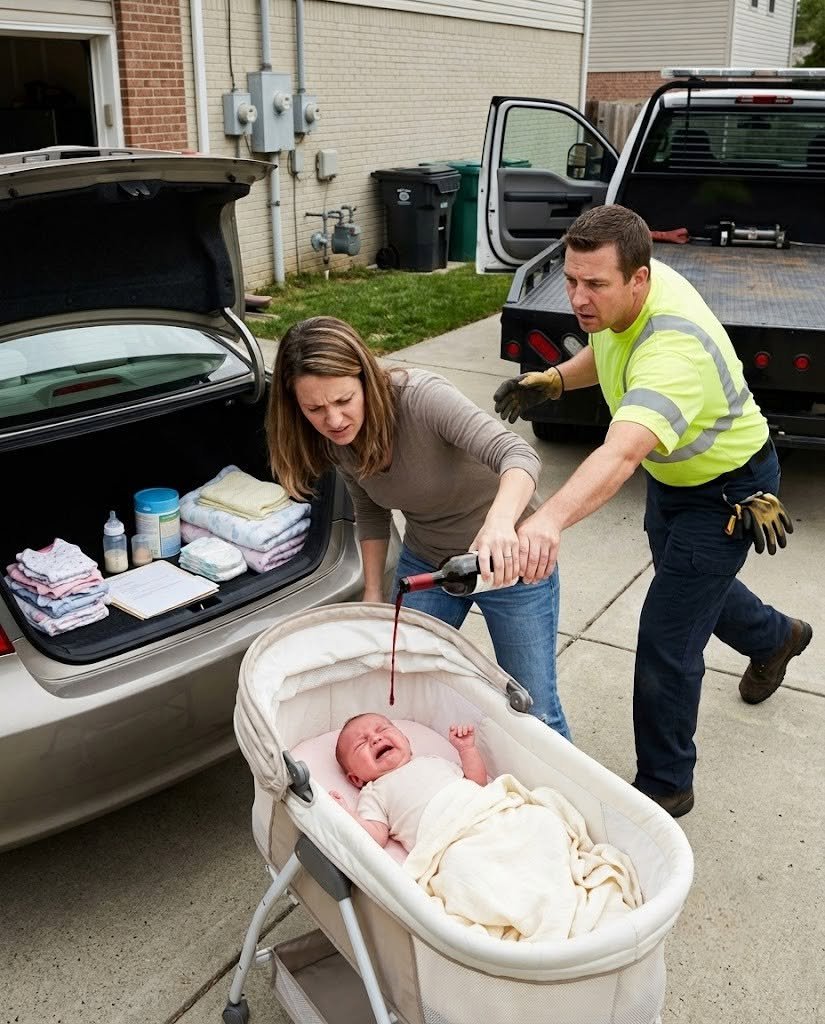
I turned instinctively, keeping my body angled between the newborn and whatever was happening behind me. A woman I didn’t recognize stepped out of a second car parked further down the street, one I hadn’t even noticed pulling up during the chaos, dressed in a blazer that looked deliberately professional for a quiet residential driveway.
“Is there a problem?” she called out, her voice carrying an edge of forced calm that immediately put me on alert.
The mother’s face went white. “Get back in the car,” she hissed. “This isn’t the time.”
But the father had already turned toward the stranger, the copied documents still clutched in his hand. “Who are you? Why is your name on this paperwork?”
The woman’s composure cracked slightly. “I don’t know what you’re talking about.”
“This form,” he said, holding it up even from a distance. “It has your name listed as the receiving party. Receiving what, exactly? My daughter?”
The woman didn’t answer. Instead, she moved quickly back toward her car, but the father was faster, sprinting across the lawn to block her path the same way he’d blocked his wife moments earlier.
“You’re not leaving until someone explains what’s happening here,” he said.
I stayed where I was, rocking the newborn gently, feeling her cries finally begin to quiet against my chest now that she was warm and dry inside my jacket. I had no intention of getting closer to whatever was unfolding, my only priority the small, fragile life I was holding, but I also weighed my phone in my free hand, already dialing.
“911, what’s your emergency?”
“I need police and an ambulance,” I said, keeping my voice as steady as I could manage. “There’s a newborn baby who was left in wine-soaked bedding in a driveway, and I think I just walked into some kind of attempt to take her somewhere without her father’s knowledge. There’s a confrontation happening right now.”
The dispatcher took the address quickly, promising units were on the way, and I stayed on the line, narrating what I could see without approaching any closer to the argument now escalating in the driveway.
The mother had rushed back toward the woman in the blazer, speaking low and fast, something that sounded like pleading rather than explanation. The father stood between them still, documents in hand, his expression shifting from confusion into something far colder as pieces clicked together that none of us standing there wanted to be true.
“You were selling her,” he said, his voice cracking. “You were actually going to sell our daughter.”
“It’s not like that,” the mother said, though her voice had lost all its earlier authority. “It’s an arrangement. A private one. She would have gone to a good family, better than anything we could—”
“She has a family,” the father said. “She has me.”
Sirens finally cut through the tension, distant but growing louder, and the woman in the blazer bolted for her car the moment she heard them, though she barely made it to the driver’s door before the father grabbed the handle, refusing to let her leave.
“You’re not going anywhere,” he said. “Not until the police get here and you explain exactly who you are and what this arrangement was supposed to be.”
The mother sank down onto the edge of the open trunk, the documents scattered at her feet, the fight visibly draining out of her now that the truth was standing exposed in broad daylight.
I held the newborn a little tighter, murmuring softly to her, feeling her tiny fingers curl instinctively against the fabric of my sleeve, utterly unaware of how close she’d come, in the space of one ordinary afternoon, to being taken from the one parent who had actually come running to protect her.
Two patrol cars arrived within four minutes, followed shortly by an ambulance and a plainclothes detective who introduced himself as Detective Marsh. He took one look at the scene, the abandoned bassinet still dripping wine onto the driveway, the scattered documents, the woman in the blazer now sitting handcuffed on the curb, and immediately radioed for additional units.
Paramedics moved toward me first, gently taking the newborn to check her over while I stood by, reluctant to let her out of my sight even now that she was clearly in capable hands.
“She’s stable,” one of the paramedics told me a few minutes later. “A little cold, a little dehydrated, but nothing that won’t resolve with monitoring at the hospital. You got her out in time.”
The father, whose name I learned was Daniel Ruiz, stood off to the side answering the detective’s questions, still gripping the copied documents like they might disappear if he loosened his hold. The mother, identified in the police report as Vanessa Ruiz, sat silently in the back of a patrol car, refusing to answer any questions without an attorney present.
Detective Marsh walked me through what he could share once the immediate scene was secured. “The woman in the blazer, Renata Colt, isn’t a stranger to us. She’s been under quiet investigation for months, suspected of running a private, unlicensed adoption arrangement scheme. Preys on financially desperate parents, convinces them a ‘private placement’ is legal and above-board, then charges the adoptive family enormous fees while cutting corners that would never survive an actual legal adoption process.”
“So this wasn’t a legitimate adoption,” I said.
“Not remotely,” Marsh said. “No court oversight. No home study on the receiving family. And based on what we’re seeing in that trunk, it looks like Vanessa Ruiz forged her husband’s signature on paperwork designed to make it look like a legal, mutual decision, when in reality, Daniel had no idea any of this was happening.”
Daniel, overhearing this from a few feet away, looked like he might be sick. “She told me she was taking the baby to get her hearing screening done,” he said. “This morning. That’s the last thing she told me before I left for work.”
“Based on the timeline we’re piecing together,” Marsh said gently, “it looks like she planned to complete the handoff while you were at your job, using the forged consent forms to make the transaction appear legitimate if anyone ever asked questions later.”
Daniel sat down hard on the porch steps, his head in his hands, the reality of how close he’d come to losing his daughter without even understanding what had happened settling over him all at once.
I gave my own statement to Marsh, walking him through exactly what I’d seen when I pulled my truck around back to drop off a delivery for the neighboring property, the sound of a baby crying pulling me toward the driveway before I even understood what I was looking at.
“You did the right thing,” Marsh told me. “If you hadn’t intervened when you did, this could have played out very differently before anyone realized what Renata Colt actually was.”
The baby, whose name I learned was Isabella, was taken to the hospital for observation, Daniel riding along in the ambulance despite Marsh’s initial hesitation, quickly overruled once it became clear Daniel was the only parent in this situation who’d had no knowledge of, let alone participation in, what nearly happened.
Renata Colt was arrested on the spot, charges pending further investigation into what detectives suspected was a pattern extending well beyond the Ruiz family. Vanessa was arrested as well, facing charges related to forgery, attempted illegal adoption placement, and child endangerment, the scattered documents in that trunk providing more than enough evidence to build a serious case against both women.
As the scene finally began to clear, Detective Marsh found me one last time before I left.
“You’re going to want to stick around this case,” he said. “Given what we found in Renata Colt’s records today, this isn’t just about one baby. There are other names in that paperwork. Other families. This might be bigger than any of us expected walking into this driveway an hour ago.”
I looked toward the ambulance pulling away, Daniel’s face pressed close to his daughter’s through the small window, and thought about how close that ordinary Tuesday delivery had come to ending in something far worse than wine-stained bedding and a confrontation in a driveway.
The investigation into Renata Colt expanded faster than even Detective Marsh had anticipated. Within seventy-two hours of Isabella’s rescue, a joint task force involving local police, the Department of Family and Children’s Services, and the state Attorney General’s office had been assembled specifically to unravel what turned out to be a scheme far more extensive than a single desperate mother and a predatory broker operating out of a sedan on a residential street.
Marsh called me four days after the incident, his voice carrying the particular weariness of someone who had spent the better part of a week combing through evidence that kept getting worse the deeper they dug.
“We executed a warrant on Renata Colt’s residence and storage unit yesterday,” he said. “We found records going back almost six years. Financial documents, forged consent forms nearly identical to what we found in that trunk, and a client list with names we’re still working through. Conservative estimate right now is at least fourteen infants placed through her network over that period, though we suspect the real number is higher.”
“Fourteen,” I repeated, the number landing heavier than I expected. “Were any of them like Isabella? Taken without a parent’s knowledge?”
“At least three others that we’ve confirmed so far,” Marsh said. “Colt had a particular method. She’d identify financially vulnerable mothers, usually through a network of contacts at pawn shops, payday loan offices, and a couple of sympathetic-seeming ‘crisis pregnancy’ storefronts that turned out to be entirely fake. She’d offer them a lump sum, convince them the other parent’s consent was a mere formality she could handle with paperwork, and then forge whatever signatures she needed to make the transaction look legitimate to the adoptive families on the other end, families who genuinely believed they were going through a legal, if unconventional, private adoption.”
“And the adoptive families?” I asked. “Did they know?”
“That’s the part we’re still sorting out,” Marsh admitted. “Some may have suspected something was off given how quickly and quietly everything moved, but proving criminal knowledge versus willful blindness is going to be a long legal fight. A few, based on initial interviews, appear to have been genuinely deceived themselves, believing they were paying legitimate adoption facilitation fees rather than participating in what amounts to trafficking.”
The word landed hard, even though some part of me had already understood, standing in that driveway with wine-soaked bedding at my feet, that what I’d interrupted was something far darker than a simple custody dispute.
Vanessa Ruiz’s case moved through the legal system over the following months, her attorney initially attempting to frame her actions as a mother in financial and emotional crisis making a desperate, ill-considered decision rather than a calculated act of fraud and endangerment. That defense crumbled once prosecutors presented evidence recovered from her phone: months of text exchanges with Renata Colt, negotiating a price, discussing exactly how to forge Daniel’s signature convincingly, and detailing a plan to complete the handoff while he was safely occupied at work, believing his daughter was simply getting a routine hearing test.
“There’s premeditation documented here going back nearly two months before the incident,” the prosecutor told the court during Vanessa’s sentencing hearing. “This wasn’t a single desperate moment. This was a sustained, deliberate plan to sell a newborn without her father’s knowledge or consent, using forged legal documents to disguise a criminal transaction as a legitimate one.”
Vanessa was ultimately convicted of forgery, attempted sale of a child, and child endangerment, receiving a twelve-year sentence, the judge noting during sentencing the particular cruelty of exploiting Daniel’s trust and absence to nearly complete an irreversible harm against both him and their daughter.
Renata Colt’s case, given the scope of her operation, drew significant media attention once investigators confirmed the broader trafficking network. She was ultimately charged federally, given that her scheme had crossed state lines in several instances, adoptive families located as far away as three different states. Her trial, when it finally concluded nearly a year and a half later, resulted in a twenty-five-year federal sentence, along with restitution orders that, while unlikely to ever be fully collected, at least formally acknowledged the financial and emotional damage inflicted on every family caught in her network.
The three other infants investigators identified as taken without a parent’s knowledge were, thankfully, all recovered and returned to their biological families, though the legal process for unwinding fraudulent adoption paperwork proved lengthy and emotionally exhausting for everyone involved. I learned, through occasional updates from Marsh, that one of those cases involved a father in a neighboring county who hadn’t even known his ex-partner was pregnant, having been deliberately kept in the dark specifically so Colt’s network could complete a placement without any risk of him objecting.
Daniel Ruiz, meanwhile, spent those same months rebuilding a life for himself and Isabella that looked nothing like what he’d imagined even six months earlier. He was granted full custody almost immediately, given Vanessa’s incarceration and the overwhelming evidence of her role in the scheme, and he threw himself into fatherhood with the kind of ferocious, grateful dedication that only comes from truly understanding how close you came to losing everything.
I visited them a handful of times over that first year, initially at Daniel’s insistence, since he’d made it clear early on that he considered me family in every way that mattered, regardless of the fact that our entire relationship had begun with me sprinting across his backyard clutching his daughter against my chest.
“She’s going to know your name someday,” he told me, the first time I visited them in their new apartment, Isabella asleep in a bassinet that, this time, held nothing but a clean blanket and a small stuffed elephant. “I’m going to make sure of that. She’s going to know that a stranger delivering packages saw something wrong and didn’t just keep driving.”
“Anyone would have done the same thing,” I said, though we both knew that wasn’t entirely true. Plenty of people might have hesitated, uncertain whether to intervene in what looked, from a distance, like a private family matter rather than an active crime in progress.
“Not anyone,” Daniel said. “You did. That’s what matters.”
Isabella grew steadily over that first year, no lasting physical harm from the ordeal that had marked her earliest hours, though Daniel remained understandably vigilant, working with a family therapist himself to process the trauma of nearly losing his daughter to a scheme he’d had no idea was unfolding in his own home. He eventually remarried, two years after the incident, to a woman named Priya who Isabella, by then a chattering, curious toddler, adored instantly and completely.
I attended their wedding, an invitation I hadn’t expected but accepted without hesitation, watching from a folding chair in a modest backyard ceremony as Daniel promised, in his vows, to build Isabella a home built on honesty rather than the kind of hidden, calculated deception that had once nearly stolen her away in her first day of life.
Detective Marsh, who I’d stayed in occasional contact with throughout the investigation, retired from the force eighteen months after Isabella’s case closed, though not before helping establish a new interagency protocol specifically designed to flag suspicious private adoption arrangements before they could be completed, a protocol that, according to a brief mention in a local news article I stumbled across a year later, had already prevented at least two other attempted illegal placements in the time since its implementation.
“You should feel good about that,” Marsh told me, during one of our last conversations before his retirement. “That protocol exists because of what happened in that driveway. Because you didn’t just drive past a crying baby and assume it wasn’t your business.”
I thought about that a lot in the months and years that followed, the strange, unplanned nature of how an ordinary delivery route had turned into the moment I’d unknowingly prevented a trafficking scheme from claiming its fifteenth victim. I hadn’t set out to be anyone’s hero that afternoon. I’d simply heard a baby crying somewhere it shouldn’t have been, and something in me had refused to keep driving.
Three years after the incident, Daniel invited me to Isabella’s birthday party, a small, joyful gathering in a backyard strung with balloons and paper lanterns, Isabella herself running around in a princess dress, entirely, blessedly unaware of how differently her life might have unfolded if a delivery truck hadn’t happened to round that driveway at exactly the right moment.
“Do you ever think about what would have happened if you’d been running late that day?” Daniel asked me quietly, watching Isabella chase bubbles across the lawn with Priya close behind her.
“Sometimes,” I admitted. “I try not to dwell on it too long. It doesn’t do anyone any good to relive the version of events that didn’t happen.”
“I think about it more than I probably should,” Daniel said. “But then I look at her, and I remind myself that it didn’t happen that way. You were there. She’s here. That’s the only version that actually matters.”
Isabella, catching sight of us watching her, abandoned her bubble chase entirely and ran over, throwing her small arms around my legs in the uncomplicated, instinctive way small children greet the people their parents clearly trust.
“Are you my angel truck man?” she asked, tilting her head up at me with wide, curious eyes, clearly having absorbed some simplified version of the story from Daniel over the years.
I laughed, crouching down to her level. “I don’t know about an angel. Just someone who happened to be in the right place at the right time.”
“Daddy says you saved my life,” she said matter-of-factly, the way children state things they’ve heard repeated often enough to accept as simple, unremarkable fact.
“Your daddy saved you too,” I told her. “He came running the second he realized something was wrong. That’s what matters most, kiddo. You’ve got a dad who will always come running for you.”
She considered this with the particular seriousness only a three-year-old can bring to an idea slightly beyond her years, then grinned and ran back toward her bubbles, entirely satisfied with the answer, already moving on to the next joyful, ordinary moment of an ordinary childhood, the kind she’d very nearly been denied entirely.
I stayed at that party longer than I’d planned, watching Daniel and Priya chase Isabella around the yard, watching a family that had been built, deliberately and carefully, on the wreckage of what almost happened instead. I thought about wine-stained bedding and forged signatures, about fourteen infants and a broker who’d treated newborns like inventory, about how close the whole terrible scheme had come to succeeding simply because no one happened to be looking at the right moment.
But someone had been looking. And sometimes, that’s all it takes, one person willing to stop the truck, walk toward the sound of crying, and refuse to keep driving until they understood exactly what they were hearing.
Isabella would grow up never remembering any of it herself, the earliest, most dangerous hours of her life destined to exist only in the careful, protective retelling her father would choose to share with her over the years. But she would grow up safe, loved, and entirely, permanently home, and for everyone who had stood in that driveway on the worst afternoon of Daniel Ruiz’s life, that outcome was worth every complicated, exhausting month it had taken to secure.