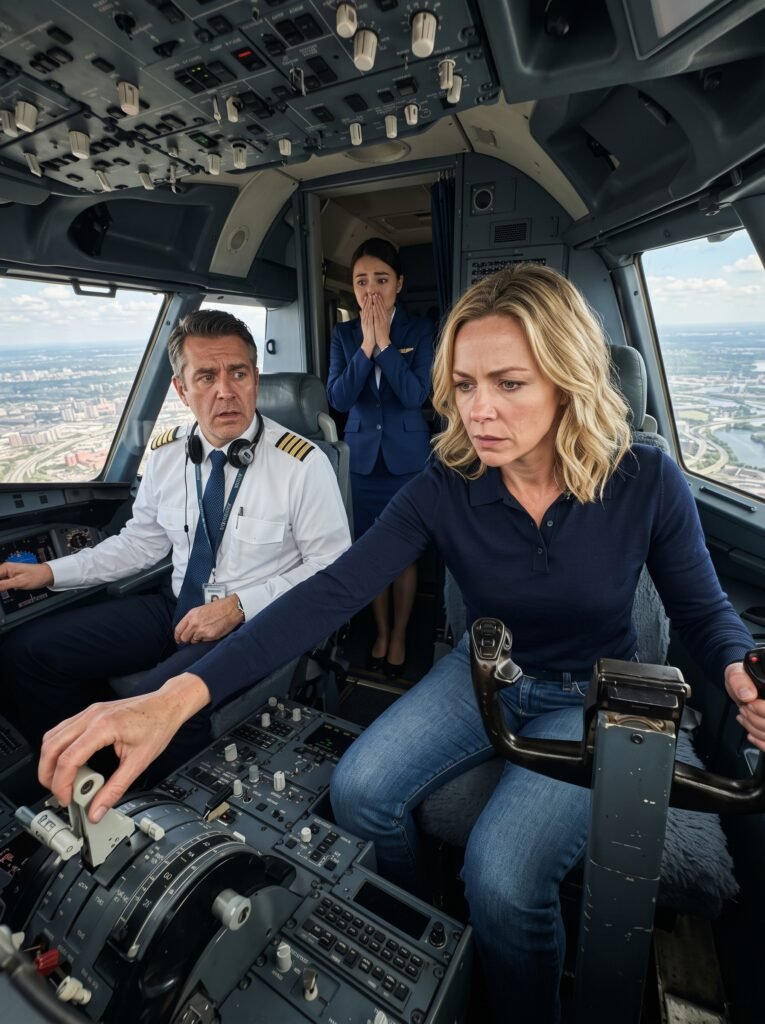
The explosion rocked the cabin, orange light flashing briefly across the windscreen before Reed silenced every alarm he could reach with practiced, desperate efficiency. The left engine, our only remaining source of differential thrust, spooled down into silence, leaving nothing but the right engine’s uneven roar and the sickening, unstoppable pull of gravity.
“Left engine’s gone,” Jennifer said, her voice flat with the particular calm that comes right before panic, if you let it.
“Then we steer with what’s left,” I said, already running the numbers in my head, thirty-two years old but still burned into muscle memory that had never fully faded, no matter how many years I’d spent telling myself I’d never need it again. “Reed, cut right engine thrust to sixty percent. Now.”
He obeyed instantly, no hesitation left in him, whatever authority a name and a scarred pair of hands had bought me in the last four minutes now fully, completely trusted.
The nose dipped, the wings leveling by a fraction, not nearly enough, but enough to matter.
“Altitude?” I asked.
“Four thousand two hundred,” Jennifer said. “We’re not going to make the river cleanly. We’re coming down short, over the trees on the east bank.”
I stared out at the terrain rushing toward us, forested hills giving way to a wide bend in the Columbia, one long, straight stretch of water our only real hope.
“Then we’re going to skip it in,” I said. “Like a rock. Shallow angle, wings as level as we can hold them, gear up.”
“Gear up in a water landing,” Reed said, “that’s—”
“Standard for ditching,” I said. “You know that, Reed. You trained for it. You just never thought you’d actually need it.”
He nodded once, sharp, and I saw something steady itself behind his eyes, the fear still there, but folded now beneath something more useful.
“Sarah,” Jennifer said, glancing again at the diagnostic screen still glowing faintly on the console, “that file. Wraith-92. That’s not just some coincidence. Someone flagged this exact aircraft’s maintenance history against a thirty-two-year-old classified test program. Someone did this to you. Again.”
“We don’t have time for that right now,” I said, though something cold and furious had already lodged itself behind my ribs. “Twelve hundred feet. Reed, ease the right throttle back, five percent.”
The aircraft shuddered, wings rocking, correcting.
“Nine hundred feet.”
Behind us, through the thin cockpit door, I could hear Linda’s voice, steady and clear despite everything, walking passengers through brace positions, her calm a small miracle in itself given what she must have understood was coming.
“Six hundred feet.”
The river spread wide and gray beneath us now, the tree line falling away, one last stretch of open water our entire world reduced to a single approach angle and a prayer.
“Three hundred feet. Reed, level her out, everything you’ve got.”
He pulled back with both hands on a yoke that barely answered him anymore, more instinct than input at this point, and I called the throttle adjustments in short, clipped bursts, feeling the aircraft respond in that same delayed, wounded-animal way it had responded for the last twenty minutes, always a beat too slow, always fighting us for every degree.
“One hundred feet.”
“Sarah,” Jennifer said, “if this doesn’t work—”
“It’s going to work,” I said, though I had no real way of knowing that, only the same stubborn, unbending will that had once brought a broken fighter home on nothing but engine thrust and refusal to accept any other outcome. “Brace.”
The water rushed up to meet us.
The belly of the aircraft struck the water at an angle just shallow enough to matter, a violent, grinding impact that threw everyone forward against their restraints as a wall of spray exploded up over the windscreen, blinding white for one endless second before the plane skipped, lifted slightly, and came down again harder, the fuselage groaning under the strain.
Then, impossibly, it began to slow.
The Boeing plowed through the river in a long, churning wake, water hammering against the hull, the right engine finally sputtering out as the aircraft’s momentum bled away into the current. For three full seconds after it stopped moving, no one in the cockpit spoke, the only sound the frantic hiss of settling systems and, somewhere behind us, the muffled, disbelieving sobs of passengers realizing they were still alive.
“We’re down,” Reed said, his voice barely a whisper. “We’re actually down.”
“We’re floating,” I corrected, already unbuckling. “Which means we don’t have long. Get the evacuation started, now, before this thing starts taking on water faster than it can be managed.”
Jennifer was already moving, and within ninety seconds, Linda and the rest of the cabin crew had the emergency slides deployed into the river, passengers filing out in the ordered, terrified rush of people who’d spent the last twenty minutes believing they wouldn’t survive to do it. Local water rescue, already staged along the riverbank thanks to Portland Approach’s early warnings, moved in with boats faster than I would have thought possible, pulling survivors from the slides and the water alike.
By the time I finally stepped out onto the wing myself, the last of 187 passengers, I counted them, every single one, already accounted for on the rescue boats, I allowed myself exactly one breath of something that wasn’t pure adrenaline.
Then Jennifer’s voice cut through it. “Sarah. The diagnostic file.”
She’d printed it before we evacuated, some instinct telling her it mattered more than anything else on that aircraft besides the passengers themselves, and now, sitting in a rescue boat wrapped in a blanket someone had thrown over my shoulders, I finally read it in full.
WRAITH-92 TEST PROGRAM REFERENCE: HYDRAULIC ACTUATOR BATCH 7-C.
CROSS-REFERENCE FLAG: AIRCRAFT N7891K, INSTALLED COMPONENT SERIAL 7C-4471.
MANUFACTURER: DYNECORE AEROSYSTEMS (FORMERLY VANTAGE DYNAMICS).
My stomach turned over. Vantage Dynamics. The same contractor whose experimental hydraulic system had failed on the Wraith thirty-two years earlier, the same system that had cost two people their lives and my entire career in the same catastrophic afternoon.
“They’re the same company,” I said slowly. “Vantage Dynamics rebranded as Dynecore sometime in the last few decades. And this,” I tapped the batch number, “this means the actuator that failed on this plane today came from the exact same manufacturing lineage that failed on the Wraith.”
“That can’t be coincidence,” Jennifer said. “Sarah, that’s a defective part line that’s apparently been in circulation for thirty-two years, and somebody, somewhere, knew it.”
Reed, still soaked and shaking slightly from the adrenaline crash, looked between us. “You’re saying this company knew about a defect three decades ago and kept selling components built the same way?”
“I’m saying,” I said, my voice hardening into something I hadn’t used in thirty-two years, the same tone I’d once used demanding answers from engineers who’d sent me up in a plane they knew was flawed, “that I think it’s time somebody finally investigated what actually happened to me in 1992, and what almost happened to everyone on this flight today.”
Detective work, it turned out, moved fast when 187 survivors and a viral cockpit recording were involved. Within hours, NTSB investigators had secured the recovered diagnostic file, along with the aircraft’s black boxes, and by that evening, a federal aviation attorney named Diane Osei had already reached out to me directly, having watched footage of my daughter, tracked down through news coverage of the landing, crying with relief on a Portland dock.
“Ms. Mitchell,” Diane said over the phone that night, “I’ve spent six years litigating aviation component fraud. If what you’re telling me about Wraith-92 is accurate, and this diagnostic file suggests it is, you may be sitting on the key to reopening a case that was buried for over three decades.”
I looked across the hospital room where I’d finally, after thirty-two years, been reunited with Emily, her hand gripping mine so tightly it ached, her wedding forgotten entirely in the chaos of nearly losing her mother a second time before she’d even had the chance to fully get her back.
“Then let’s reopen it,” I said. “Because I think it’s long past time the truth about what happened to Peter, and the Wraith, and everyone almost hurt today, finally came out.”
PART 4 (FINALE)
The investigation into Dynecore Aerosystems moved with a speed that surprised even Diane Osei, who had spent six years watching aviation fraud cases crawl through federal bureaucracy at a pace that tested every ounce of her patience. Within a week of the Columbia River landing, NTSB investigators had cross-referenced the recovered diagnostic file against thirty-two years of manufacturing records, uncovering a paper trail that painted a far darker picture than any of us had initially suspected.
The hydraulic actuator batch responsible for Flight 2891’s failure, designated 7C in the recovered file, traced back to a manufacturing process Vantage Dynamics had developed in the early 1990s specifically to win the Wraith contract, a $12 billion Air Force program that had demanded impossibly tight deadlines and impossibly light components. Engineers at the time, according to internal memos investigators recovered from an archived server Vantage Dynamics had apparently forgotten still existed after their corporate rebrand, had flagged the actuator design as prone to catastrophic failure under sustained pressure, exactly the kind of failure that had brought down the Wraith in 1992, and exactly the kind of failure that had nearly killed 187 people over Oregon three decades later.
Instead of redesigning the component after the Wraith crash, the internal memos showed, Vantage Dynamics had quietly settled with the Air Force, sealed the investigation under a national security classification that conveniently buried my name alongside the truth, and continued manufacturing the same flawed actuator design under slightly modified part numbers for the commercial aviation market, where oversight was less rigorous and profit margins were considerably better.
“They knew,” Diane told me during our third meeting, sliding a thick folder of recovered documents across her office desk. “Not suspected. Knew, with documented internal warnings, and chose the settlement and the cover story over a redesign that would have cost them the contract.”
“And they let it fall on me,” I said, my voice steadier than I expected, thirty-two years of buried anger finally finding somewhere productive to go. “They let me eject from a plane they knew was flawed, let two people die in that viewing area, and then buried the truth so thoroughly that even my own daughter believed I’d been reckless.”
“Not anymore,” Diane said. “The recovered files, combined with the diagnostic data from Flight 2891, are more than enough to reopen the original Wraith investigation. I’ve already been in contact with the Air Force Judge Advocate General’s office. They’re taking this seriously, Sarah. Very seriously.”
The reopened investigation moved through the following months with the same relentless momentum, congressional hearings following closely behind the NTSB’s preliminary findings once news outlets connected the dots between “Miracle Landing on the Columbia” and a thirty-two-year-old classified Air Force crash investigators had quietly, without public announcement, agreed needed a full second look.
I testified before a joint congressional aviation safety committee eleven weeks after the landing, the same scarred hands that had once adjusted throttles at six hundred feet now steady on a witness table microphone as I laid out, methodically, everything I remembered about the Wraith program, the warnings I’d received before that flight, the warnings I now knew had been deliberately incomplete, and the thirty-two years of silence that had followed.
“I was told the aircraft had passed every safety check,” I said, my voice carrying clearly through the hearing room. “I was not told that engineers on the program had flagged the hydraulic actuator design as prone to failure under sustained high-pressure conditions. I was not told that the same design would go on to be manufactured, under a different name, for commercial aircraft over the following three decades. I ejected from that aircraft because the system failed exactly the way those engineers had warned it would. Two people died that day because of a decision made in a boardroom, not a cockpit. And I spent thirty-two years being blamed for it.”
The committee’s response was, for once, exactly what it needed to be. Within a month, the Air Force formally reopened and reversed the findings of the original 1992 investigation, restoring my rank, my pension, and, most importantly to me, my name. Dynecore Aerosystems faced a federal indictment for fraud and reckless endangerment, along with a wrongful death suit filed on behalf of the two families who had lost loved ones in the original Wraith crash, families who, I learned during the proceedings, had spent thirty-two years believing the same false story about pilot error that had destroyed my life.
I met with them privately before the trial began, a difficult, necessary conversation neither side had ever thought they’d have the chance to have.
“We always wondered,” the widow of one of the victims told me, her hands trembling around a cup of untouched coffee, “whether the story we were told was really the whole truth. I’m sorry it took this long, and this much danger, for any of us to finally get an answer.”
“So am I,” I said. “I wish I could have given you the truth thirty-two years ago. I didn’t have it myself.”
The trial concluded eight months after the Columbia River landing, Dynecore Aerosystems found liable for fraud, negligent manufacturing, and wrongful death, facing a settlement large enough to fundamentally restructure the company, along with a court-mandated recall of every remaining 7C actuator still in circulation across both military and commercial fleets, a recall that investigators later confirmed prevented at least two other aircraft from experiencing the exact same catastrophic failure within the following year.
Through all of it, Emily never left my side.
Our reunion, born out of the worst possible circumstances, deepened into something neither of us had believed possible during those fifteen silent years. She’d postponed her wedding by three months, not because of any lingering danger, but because, as she told me one evening, sitting together on her Seattle apartment balcony, “I finally have my mother back. I wasn’t going to rush through the first months of that just to keep a date on a calendar.”
“I’m sorry I missed so much,” I told her. “Your graduation. Your first job. Whatever it was that finally made you find those old test reports.”
“A professor,” she said. “In my aerospace engineering program, actually. We were studying failure analysis case studies, and the Wraith came up as an example of ‘pilot error under experimental conditions.’ Something about it never sat right with me. I couldn’t explain why, I just knew the story didn’t match the mother I remembered, so I started digging. It took me two years to find the sealed reports. Another year to work up the courage to send that invitation, not knowing if you’d even want to hear from me after everything.”
“I would have crossed an ocean for that invitation,” I said. “I nearly spent everything I had just crossing the country for it.”
She laughed, though her eyes were wet. “You crossed a lot more than that, Mom. You crossed thirty-two years.”
Emily’s wedding finally took place the following spring, held in a small garden ceremony outside Seattle, considerably smaller and quieter than the guest list had originally called for, but filled, this time, with a mother who wasn’t watching from a distance through fifteen years of silence, but standing close enough to walk her daughter down the aisle herself.
Jennifer and Captain Reed attended as guests, an unlikely friendship having formed between the three of us in the months since the landing, forged in exactly the kind of shared, impossible experience that either destroys people or binds them together permanently. Reed had testified alongside me before Congress, his account of the flight corroborating every detail investigators needed to build their case, and he’d retired from Southwest shortly after, telling me once, over coffee, that thirty-eight years and one impossible landing felt like exactly enough for one career.
“You gave me back thirty-two years I thought were gone for good,” I told Jennifer at the wedding reception, watching Emily dance with her new husband under string lights strung between the garden trees.
“You gave a hundred and eighty-seven people the rest of their lives,” Jennifer said. “I think that evens out pretty well, Phoenix.”
The nickname had followed me since the landing, embraced now rather than buried, a call sign the Air Force had formally reinstated alongside my rank, engraved on a small plaque I’d been presented during a quiet, private ceremony at Edwards Air Force Base, the same base where I’d once built a career I’d believed, for thirty-two years, was permanently lost.
I stood at that ceremony surrounded by officers who hadn’t even been born when I flew my last test flight, listening to a young colonel read my restored service record aloud, the same scarred hands that had once gripped an ejection handle now folded quietly in front of me, steady, finally, after three decades of carrying a weight I’d never actually deserved.
“Lieutenant Colonel Sarah Mitchell,” the colonel said, “call sign Phoenix. Welcome home.”
I thought, standing there, about that Friday afternoon over Oregon, about 187 strangers whose names I’d never fully learn, about the particular, impossible symmetry of a wedding invitation pulling me back into the one skill I’d spent thirty-two years trying to forget, exactly in time to use it one final, world-altering time.
Some things, it turned out, don’t stay buried forever, no matter how thoroughly the people responsible try to bury them.
Sometimes it just takes one broken airplane, one old test pilot who refuses to stay in her seat, and one daughter brave enough to ask the question everyone else had been too afraid to ask for thirty-two years: what if the story we were told was never actually true?
I looked down at my hands, scarred but steady, and thought about Peter, and about Wraith-92, and about a call sign I’d spent three decades believing I’d never earn the right to answer to again.
Phoenix, it turned out, had simply been waiting. Not extinguished. Not forgotten.
Just grounded, for thirty-two long years, until the exact moment the world needed her to rise again.
THE END.