The Envelope I Left on the Kitchen Island
On our wedding night, my husband walked away to reconnect with his first love, so before the sun came up, i quietly packed my things, left without a scene, and by the time he finally returned, there was only one thing waiting for him that made him realize i had made a decision he never expected.
My name is Rachel Bennett, and at twenty-seven, I thought the hardest part of my wedding day would be surviving twelve hours in heels.
By midnight, the shoes were the least painful thing in my life.
The wedding itself had been almost perfect.
That was part of what made everything afterward feel so unreal.
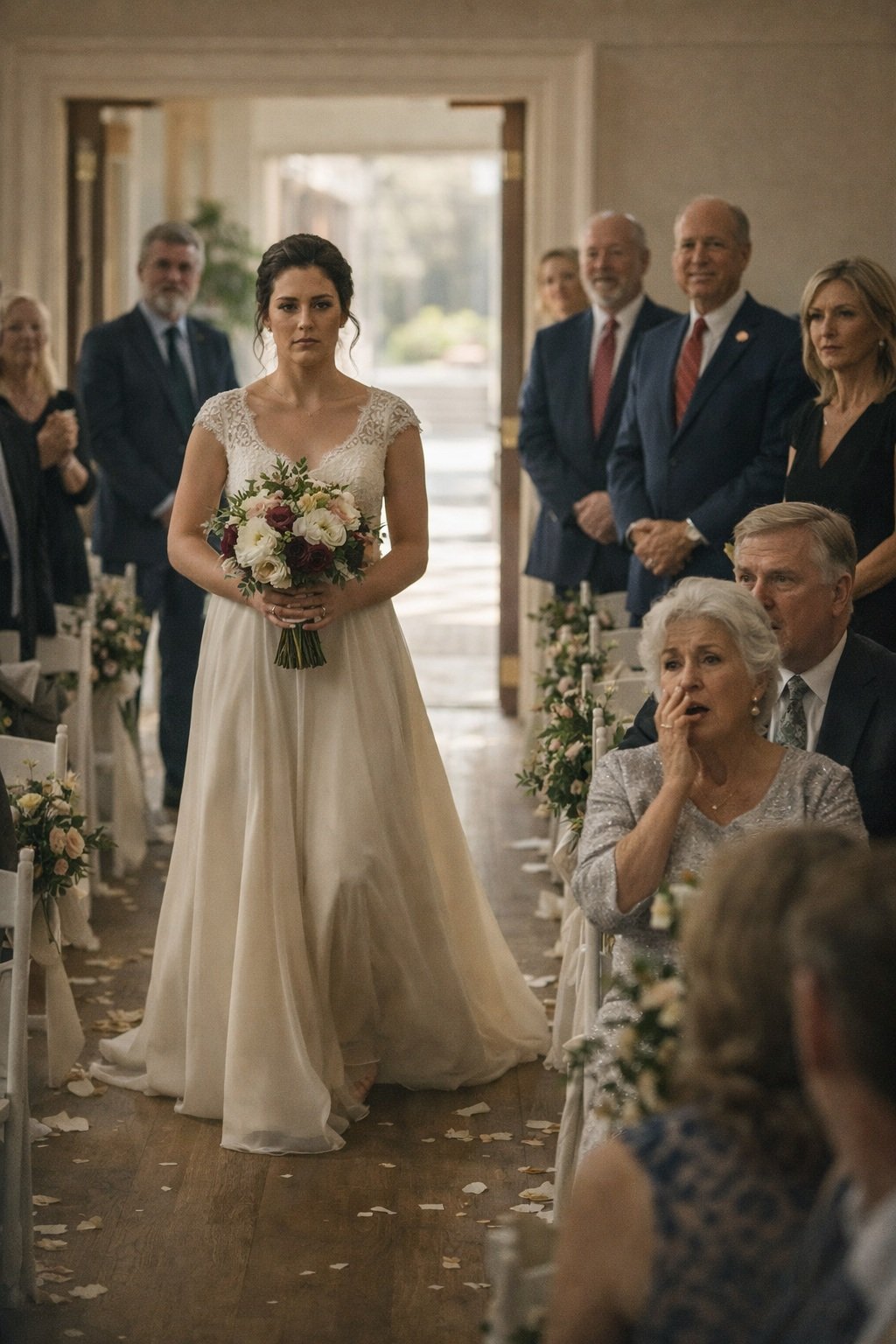
We were married at a renovated ranch venue north of Dallas, the kind with white stone walls, oak beams, a long covered patio, and strings of warm lights hanging over the dance floor. The late-spring weather had cooperated. My mother cried during the vows. Jason’s father gave a toast that made everyone laugh. The florist remembered the extra arrangement for my grandmother. The caterer served dinner on time. Even the little things that usually go wrong at weddings seemed to have decided to leave us alone.
By the end of the reception, my cheeks hurt from smiling.
My feet hurt from dancing.
My voice was nearly gone from thanking people.
And I was happy.
Ridiculously, embarrassingly happy.
Jason Miller and I had been together for three years. Four months earlier, when we bought a brick house in a quiet neighborhood outside Dallas, we had signed the civil marriage paperwork for practical reasons connected to the closing and insurance. But the wedding had always been the day that mattered emotionally.
The dress.
The vows.
Our families.
Our friends.
The moment we stopped being two people planning a marriage and started living inside one.
Everyone told me I had chosen well.
Jason was thirty-one, handsome in an easy, approachable way, with dark brown hair and the kind of smile that made older women call him charming and younger men trust him almost immediately. He worked in commercial sales, earned a good living, remembered birthdays, tipped restaurant staff generously, and rarely raised his voice.
My parents loved him.
My coworkers liked him.
His family treated me as though I had already belonged to them for years.
And my childhood best friend, Amber Collins, used to tell me I had found the kind of man women spent years hoping would eventually show up.
Amber had known me since fourth grade.
She had been there when I got braces, when my parents separated for six months and then reconciled, when I failed my first driving test, when I broke up with my college boyfriend, and when I first met Jason.
She knew every version of me.
That was why I had never hesitated to let her stay in our guest room during the wedding week.
Her parents had moved overseas several years earlier. A hotel seemed ridiculous when we had a spare bedroom.
“You’re family,” I had told her.
She had hugged me.
“I know.”
That sentence would come back to me later.
After the reception, Jason and I returned home just after nine.
White flower arrangements from the venue were packed into the back of his SUV. Wedding cards filled two canvas bags. My veil was folded over my arm. Amber had driven back ahead of us because she had changed out of her bridesmaid dress before the reception ended.
The house looked strange when we walked inside.
Familiar, but transformed by the fact that we were entering it after our wedding.
There were gifts stacked near the dining room.
My shoes landed beside the stairs.
Jason carried two flower arrangements toward the kitchen.
I remember looking at him and thinking, That’s my husband.
It was such a simple thought.
I had no idea how little time it had left.
Around nine-thirty, Jason checked his phone and frowned.
“What?”
“Brian says some of the guys left decorations and liquor at the hotel.”
“Tonight?”
“He’s leaving early tomorrow.”
I groaned and leaned against the kitchen island.
“Tell him to throw everything in his trunk.”
Jason laughed.
“I’ll help him for twenty minutes.”
“You are a better person than I am.”
He kissed my forehead.
“Go change. I’ll be right back.”
I believed him because I had spent three years believing him.
I went upstairs, peeled myself out of my dress, washed off layers of makeup, and pulled on an old oversized T-shirt with soft pajama pants.
The bedroom still looked like a wedding had happened there.
My bouquet sat in a glass pitcher because we had forgotten to buy another vase.
Two champagne glasses waited on the nightstand.
My earrings were beside them.
My wedding dress hung from the closet door.
I sat on the edge of the mattress and looked at my ring.
I wasn’t thinking about grand romance.
I was thinking about ordinary things.
Sunday breakfasts.
The grocery list.
Finishing the guest bathroom.
Arguing about whether the front room needed a rug.
Maybe trying for a baby the following year.
Family Christmases.
A dog.
Retirement accounts.
Gray hair.
The comfortable, boring life I had always wanted.
Ten o’clock passed.
Then ten-thirty.
I texted Jason.
Where are you?
No reply.
At eleven, I called.
Voicemail.
I told myself the cleanup had taken longer.
At eleven-fifteen, another possibility entered my mind.
Maybe he had come home through the garage and gotten pulled into some conversation with Amber downstairs.
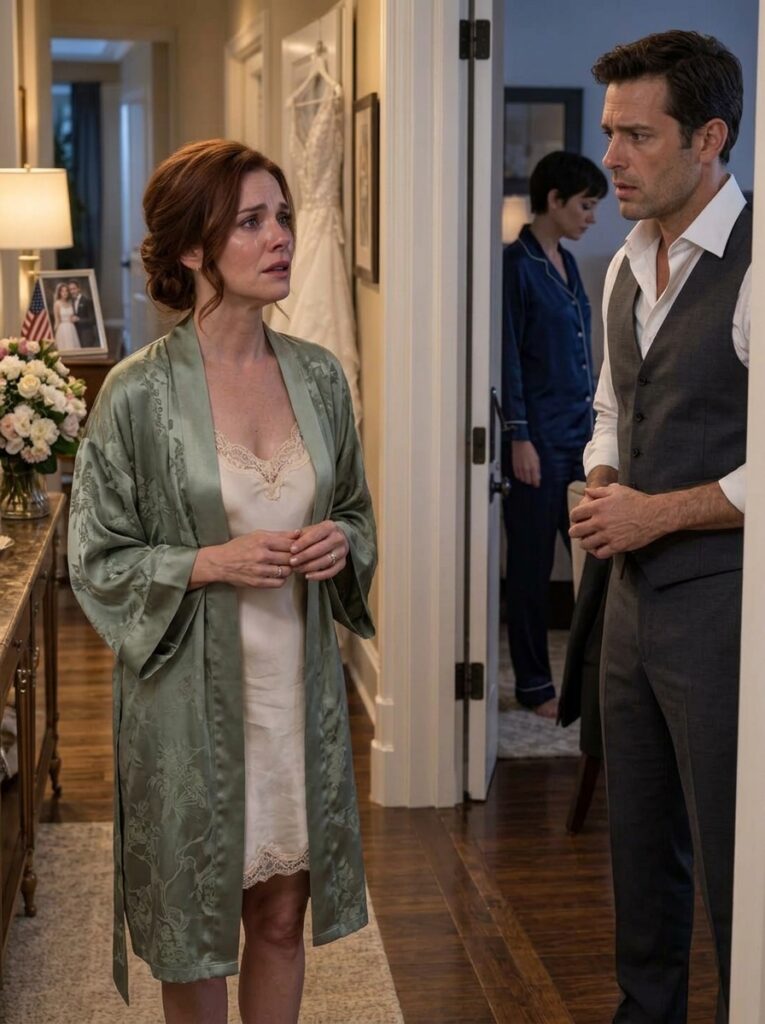
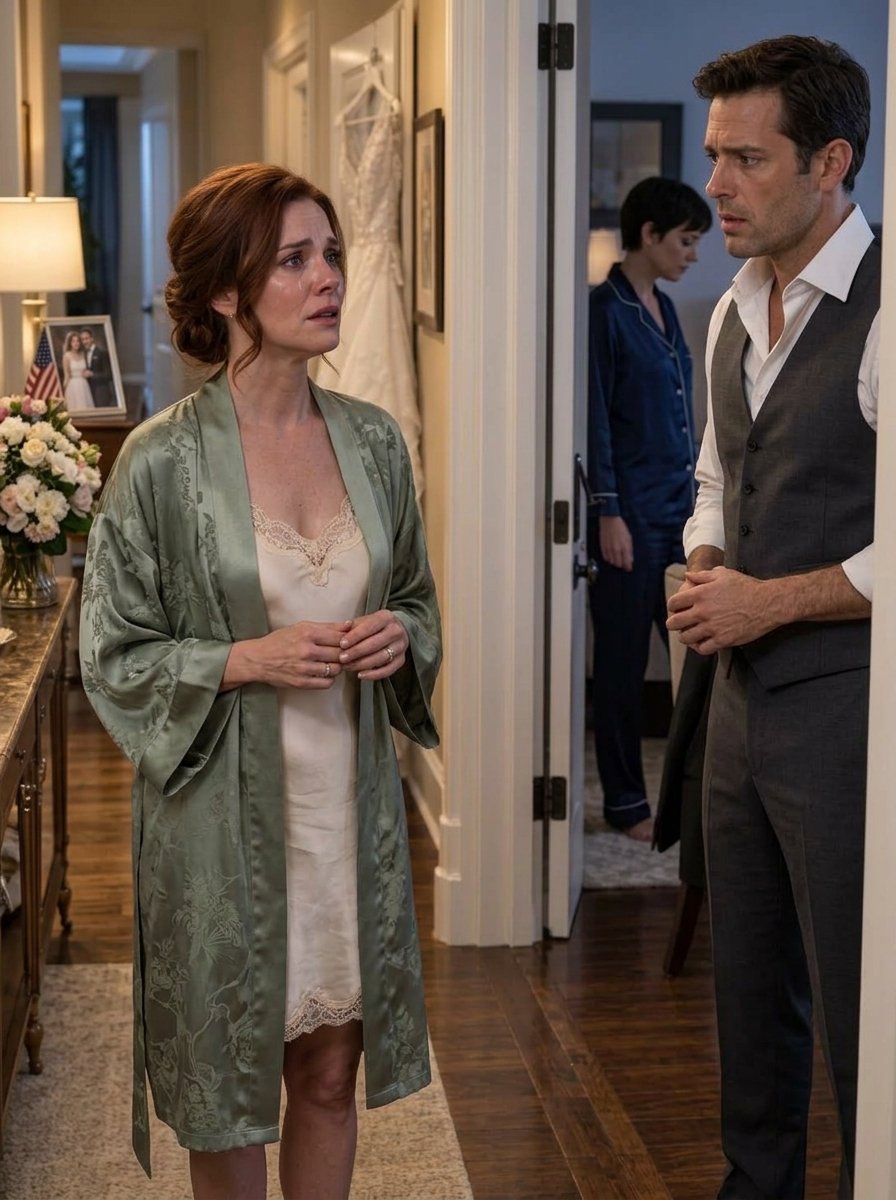
I stepped into the hallway.
The house was quiet.
Too quiet.
Amber’s room was at the far end.
I walked toward it.
Before I reached the door, I heard movement inside.
Then the door opened.
Jason stepped into the hallway.
He stopped so quickly that one hand caught the doorframe.
His tuxedo jacket was gone.
His white dress shirt was wrinkled, the top buttons open.
His bow tie had disappeared.
His hair was damp around his forehead.
But it was his face that told me everything before either of us spoke.
Not confusion.
Not annoyance.
Recognition.
The instant expression of a man realizing the explanation he had prepared was already useless.
“Rachel.”
I looked past him.
The guest-room bed was unmade.
A pillow sat on the carpet.
Amber was somewhere behind the partially open door.
My mind rejected what my eyes had already accepted.
“No.”
Jason glanced toward the stairs.
I lowered my voice.
“What were you doing in there?”
He said nothing.
“Jason.”
His throat moved.
“Please.”
“Please what?”
“Not like this.”
I remember that sentence because it was such a strange thing to say.
Not like this.
As though the problem was the timing of my discovery.
Not the betrayal itself.
I looked again at the room.
Then at him.
“You left me alone on our wedding night.”
“I know.”
“To go into Amber’s room.”
He rubbed both hands over his face.
“Rachel, listen to me.”
I waited.
He looked exhausted.
Almost frightened.
Then he said the words that changed the meaning of the entire night.
“It was one last time.”
For a second, I heard only the refrigerator humming downstairs.
“One last time?”
He closed his eyes.
“I shouldn’t have said it that way.”
“How should you have said it?”
“Rachel.”
“One last time means there were other times.”
His silence answered.
I felt the floor underneath my bare feet.
I felt the cold air from the vent.
I noticed a tiny loose thread hanging from the cuff of his shirt.
Everything became strangely detailed.
“How long?”
“That doesn’t matter tonight.”
“It matters to me.”
“We have been awake since dawn. We’ve both been drinking. You’re exhausted.”
“I’m completely awake now.”
His jaw tightened.
“I’m telling you it’s over.”
“What is over?”
“Amber.”
The fact that he said her name so naturally hurt more than I expected.
“How long?”
He looked toward the closed guest-room door.
Then back at me.
“The point is I married you.”
“That was yesterday.”
“I chose you.”
“You left our bedroom and came down this hallway.”
“I made a terrible decision.”
“One?”
He exhaled.
“Rachel, I am not going to spend the rest of our marriage answering the same question.”
“The rest of our marriage started a few hours ago.”
“Exactly. So we decide what kind of marriage it’s going to be.”
I stared at him.
Jason straightened.
Perhaps he mistook my silence for weakness.
“If you can accept that this was the last time, we move forward. Amber leaves tomorrow. I never see her again.”
“And if I can’t?”
His expression hardened.
“Then maybe we shouldn’t be married.”
There are sentences that hurt.
And there are sentences that remove pain by making something completely clear.
That one did the second.
He believed he held the stronger position.
He believed the wedding was leverage.
The venue.
The photographs.
Our families.
Three years together.
The house.
My age.
My plans.
The embarrassment of telling everyone our marriage had ended almost before the flowers wilted.
He thought all those things would make me negotiate against myself.
I looked at him and suddenly understood something important.
He was not asking forgiveness.
He was setting terms.
Accept what I did.
Or lose the future you built around me.
The guest-room door opened behind him.
Amber stepped out.
Her hair was loose around her shoulders.
Her eyes were red.
She was wearing sweatpants and one of the oversized shirts she had borrowed from me earlier in the week.
“Rachel.”
I looked at her.
She immediately started crying.
“I’m so sorry.”
I said nothing.
“This is my fault.”
Jason turned slightly toward her.
“Amber.”
“No. She deserves to hear it.”
“Then tell me,” I said.
Amber wiped her face.
“I was emotional. It was the wedding. Everything felt final.”
I blinked.
“Final for whom?”
Her mouth opened.
Nothing came out.
She looked at Jason.
That look mattered.
It was quick.
Familiar.
The kind of glance people use when there is already a private language between them.
Something cold settled in my chest.
“You two have done this before.”
Neither answered.
I nodded.
“Okay.”
Amber stepped forward.
“Rachel, please.”
I held up one hand.
She stopped.
I wasn’t angry anymore.
Not in the way they expected.
I was watching.
Listening.
Collecting.
“How long?”
Jason’s voice sharpened.
“Enough.”
I turned toward him.
“Enough?”
“You’re exhausted. You’re going to say things you regret.”
“I haven’t said much.”
“That’s exactly what worries me.”
Good, I thought.
It should.
Amber was crying harder now.
“Don’t throw away your marriage because of me.”
I looked at her.
That sentence was almost impressive.
Not because of me.
As though she were some unfortunate weather event.
As though Jason and I had collided with her rather than been deceived by her.
“I’m not throwing away anything.”
Jason’s shoulders relaxed a little.
Then I finished.
“I’m putting down something that was already broken.”
His face changed.
“Rachel.”
“You gave me two choices.”
“I didn’t mean it like that.”
“You were very clear.”
“I’m upset.”
“You didn’t sound upset.”
Amber whispered, “You love him.”
I looked at her.
“I did.”
Jason stared at me.
“Did?”
“That’s the part you should have thought about before making forgiveness a condition of marriage.”
I turned toward our bedroom.
Jason followed me two steps.
“Rachel, don’t be dramatic.”
My hand stopped on the doorknob.
I looked back.
“Dramatic would be waking the neighbors.”
His expression tightened.
“I’m going to bed.”
I entered the bedroom and locked the door.
Only then did I cry.
Quietly.
Not because I was trying to be dignified.
Because I had no energy left for anything louder.
I sat on the floor beside my wedding dress.
The dress looked absurdly beautiful.
White satin.
Tiny covered buttons.
A train carefully steamed that morning by two bridesmaids who had no idea the marriage would barely survive the reception.
On the dresser were wedding cards addressed to Mr. and Mrs. Miller.
On the nightstand were two champagne glasses we had never used.
A garment bag leaned against the wall.
Everything in that room represented a future I had been building while two people closest to me apparently knew there was another version of my life happening just outside my view.
I cried until after two.
Then something changed.
Not dramatically.
I simply ran out of tears.
I stood.
Washed my face.
Pulled my hair into a ponytail.
And opened my suitcase.
I packed work clothes first.
Jeans.
Sweaters.
Toiletries.
My laptop.
Documents from the desk.
Then I went into the closet and removed the small fireproof file box where I kept my passport, tax records, copies of the house-closing paperwork, and statements from the investment account I had owned before Jason and I met.
The house mattered.
Four months earlier, I had put roughly $140,000 of my premarital savings and a gift from my parents into the down payment.
Jason contributed around $60,000.
I had paid for most of the new appliances and nearly $25,000 in renovations from funds I had saved before the marriage.
Until that morning, those numbers had felt irrelevant.
We were building one life.
Now they became boundaries.
Around three-thirty, I opened the household laptop.
I wanted copies of our mortgage statements and recent bank activity.
Nothing more.
Then a notification appeared in the corner of the screen.
Jason’s old iPad was still synchronized to our home account.
A message preview appeared.
Amber’s name.
Please tell me she didn’t see everything.
I stared at the screen.
My heartbeat changed.
Not faster.
Sharper.
I opened the synchronized message history.
And the world I had lived in for three years began rearranging itself.
There were hundreds of messages.
Not from one night.
Not from one month.
Years.
I scrolled slowly.
At first, my brain kept searching for an innocent explanation.
Maybe they had become close friends.
Maybe they were discussing me.
They were.
That was worse.
Amber had shared things I told her privately.
Arguments Jason and I had.
Fears I had about work.
Money worries.
Questions about whether Jason and I should buy the house.
Even conversations about children.
My best friend had been carrying my private life into a second conversation with my partner.
Then came the restaurant reservations.
Transfers.
Weekend plans.
Hotel confirmations.
Photographs.
Messages sent during evenings when Jason told me he was too busy to talk.
Christmas.
New Year’s.
Birthdays.
One Valentine’s Day, he had ordered two nearly identical necklaces from the same jeweler.
One for me.
One for Amber.
I touched the necklace hanging around my neck.
I had worn it to our rehearsal dinner.
I removed it and placed it on the desk.
The room was very quiet.
One message stopped me.
It was almost three years old.
Amber had written:
You always pick the safe choice.
Jason replied:
Safe is what you marry.
I read it twice.
Then farther down:
You know I’ll always come back to you.
Jason:
I know.
My stomach turned.
I kept reading.
There were gaps where messages had been deleted.
But enough remained.
Weekend trips I had never known about.
Lunches.
Hotel reservations for two guests.
Late-night calls.
A weekend when Jason told me he needed space after a stressful quarter at work.
He had spent it with Amber.
Another message appeared six months before our house purchase.
Amber:
Once you buy with her, this gets complicated.
Jason:
I know what I’m doing.
Amber:
You always say that.
Jason:
Rachel is the life part. You’re different.
Rachel is the life part.
I leaned back from the screen.
The sentence was almost clinical.
Suddenly all the little things I had once interpreted as proof Jason cared about my friend looked different.
He remembered Amber’s coffee because he knew it.
He volunteered to drive her home because he wanted the time.
He bought her birthday gifts because they were not really gifts from my boyfriend to my friend.
He was maintaining another relationship.
The history went back so close to the beginning of mine with Jason that I could no longer identify where one betrayal started and another ended.
I took screenshots.
Downloaded statements.
Saved receipts.
Forwarded relevant records to an email address only I controlled.
Then I found a hotel charge from two months after our civil marriage paperwork had been signed.
That changed the practical side of things.
I searched online for family-law attorneys.
At four-forty in the morning, I sent an intake request to a Dallas firm.
I kept the message short.
Recently married. Jointly owned home. Significant separate-property contribution. Evidence of long-term undisclosed relationship and marital spending. Need immediate consultation.
Then I began packing again.
By five-thirty, I had two suitcases in my car.
I moved quietly.
Jason was asleep downstairs on the living-room couch.
Amber’s door was closed.
I stood at the top of the stairs looking at them.
Part of me expected some dramatic final feeling.
There wasn’t one.
I was tired.
That was all.
Tired of the wedding.
Tired of crying.
Tired of discovering that memories required reinterpretation.
I went back into our bedroom.
Removed my wedding ring.
Held it in my palm.
The ring was beautiful.
Simple platinum band.
Jason had chosen it.
Or perhaps Amber helped.
I realized I did not care enough to wonder.
I found a plain white envelope in the desk.
Inside, I placed the ring and one sheet of paper.
It contained only two sentences.
I know about the three years.
My attorney will contact you.
I sealed the envelope.
Wrote Jason across the front.
Then I carried it downstairs and placed it in the center of the kitchen island.
Nothing else.
No smashed photographs.
No dramatic letter.
No explanation.
The envelope was enough.
Before sunrise, I drove away.
My parents lived about forty minutes south.
I did not call until I reached a gas station halfway there.
My mother answered on the second ring.
“Rachel?”
Her voice was sleepy.
“Mom.”
One word was enough.
She sat up immediately.
“What happened?”
“I’m coming over.”
“Are you okay?”
“No.”
“Are you safe?”
“Yes.”
“Come home.”
Home.
I cried again when she said it.
Not because I was weak.
Because someone had finally asked the right question.
When I reached my parents’ driveway, my father was standing on the porch in sweatpants and an old Cowboys sweatshirt.
He opened my car door before I could.
He saw the suitcases.
Then my face.
He did not ask for details.
He simply pulled me into his arms.
My mother stood behind him holding the front door open.
I had spent the entire wedding day hearing congratulations.
The morning after, the most comforting sentence anyone said to me was my father’s.
“You don’t have to decide anything today.”
I almost laughed.
“I already did.”
Jason called at seven-twelve.
I watched his name appear on my phone.
Then disappear.
Then appear again.
Four calls.
Nine texts.
Rachel, where are you?
What is this envelope?
Pick up.
Please.
Did you go through my iPad?
We need to talk before you do something crazy.
That last message ended any temptation to answer.
Crazy.
I had packed my clothes, protected my records, and left quietly.
Jason had maintained a hidden relationship for years and disappeared into my best friend’s room on our wedding night.
Yet I was the one in danger of doing something unreasonable.
At eight-thirty, Amber texted.
I’m so sorry. Please don’t destroy your marriage because of me.
I blocked her.
At nine-fifteen, Jason’s mother called.
I didn’t answer.
She called my mother.
That was when the real campaign began.
Diane Miller had spent most of the wedding telling people how thrilled she was finally to have a daughter.
By breakfast the next morning, apparently daughterhood had conditions.
My mother came into the guest room holding her phone.
“Jason’s mother says he made a mistake.”
“A three-year mistake?”
Her eyebrows lifted.
“She didn’t mention that.”
“Of course she didn’t.”
“What happened?”
So I told my parents.
Not every detail.
Enough.
My father sat silently at the kitchen table, one hand around a coffee mug.
My mother covered her mouth when I told her about Amber.
When I showed them the synchronized records, Dad looked away from the screen.
“Three years?”
“Yes.”
“And they both stood at your wedding yesterday?”
“Yes.”
My mother’s eyes filled.
“She helped me button your dress.”
I had forgotten.
That detail almost broke me again.
Amber had stood behind me in the bridal suite and fastened tiny satin buttons while telling me I looked beautiful.
She had adjusted my veil.
Held my bouquet while the photographer fixed my train.
She had cried during my vows.
And she had known.
My father pushed his chair back.
“I’m calling—”
“No.”
He stopped.
“I’m handling it legally.”
“Rachel.”
“Please.”
His jaw tightened.
Then he nodded.
“Tell me what you need.”
That was the first moment I felt power returning.
Not because I had control over Jason.
Because I had stopped trying to.
My attorney called at ten.
Her name was Marissa Cole.
Her voice was calm, practical, and exactly what I needed.
She did not tell me I deserved better.
She did not call Jason names.
She asked questions.
Date of civil marriage.
Date the house closed.
Source of down payment.
Title structure.
Mortgage balance.
Accounts.
Wedding expenses.
Insurance.
Any joint credit cards.
Any evidence marital funds had been spent outside the marriage.
I answered.
When I mentioned the old iPad, she interrupted gently.
“Do not access anything you do not already have lawful access to. Save copies of what is already synchronized to shared devices and accounts. Don’t guess passwords. Don’t alter anything.”
“Okay.”
“Do not empty joint accounts.”
“I wasn’t planning to.”
“Good.”
“Jason’s parents are already calling.”
“Stop discussing finances with them.”
“Gladly.”
“And Rachel?”
“Yes?”
“Do not let anyone pressure you into signing anything today.”
That warning proved useful faster than either of us expected.
Jason arrived at my parents’ house shortly after noon.
My father saw his truck and stood.
I touched his arm.
“I’ll handle it.”
Jason walked to the porch carrying the white envelope.
His face looked exhausted.
He had changed into jeans and a blue shirt.
My wedding ring was inside his pocket.
“Can we talk?”
I stepped outside and closed the front door behind me.
He held up the envelope.
“You left.”
“Yes.”
“You didn’t even talk to me.”
“We talked.”
“Not really.”
“You told me to accept it or get divorced.”
“I was angry.”
“You sounded very organized.”
He looked toward the driveway.
“Can we go somewhere?”
“No.”
“Rachel, everybody is calling me.”
“That sounds exhausting.”
His eyes snapped back to mine.
“You think this is funny?”
“No.”
“This is our marriage.”
“You remembered that quickly.”
He rubbed his forehead.
“I said stupid things.”
“And did stupid things.”
“I know.”
“For three years.”
He went still.
“So you did go through everything.”
“I saw enough.”
His voice changed.
“How much?”
That question confirmed more than denial could have.
Not what are you talking about?
How much?
“Hotel receipts. Transfers. Messages. Trips. Gifts. Three years.”
Jason looked toward the porch again.
My father was visible through the glass.
“You don’t understand.”
“I understand the dates.”
“It wasn’t constant.”
I almost smiled.
“Is that the defense?”
“No.”
“Because it needs work.”
He lowered his voice.
“Amber and I had history.”
That was new.
“What kind of history?”
He hesitated.
“We knew each other before you and I got serious.”
I stared at him.
“How?”
“A mutual friend introduced us at a party.”
“Amber never told me.”
“It was brief.”
“How brief?”
“A few months.”
My mind moved backward.
Amber had introduced Jason to me as though she had never seen him before.
I remembered the exact evening.
A Tex-Mex restaurant.
Amber arriving late.
Jason standing when she reached the table.
Their hug.
The way Amber had smiled.
I had thought she was happy for me.
“Was she your first love?”
Jason’s expression tightened.
“I don’t know.”
“That means yes.”
“Rachel, it was complicated.”
The required opening sentence I would someday use to describe my wedding night finally made sense inside my own head.
My husband had not discovered feelings for my best friend after meeting her through me.
He had been reconnecting with someone he already had history with.
They had both let me believe I introduced them.
I laughed once.
Quietly.
Jason looked uneasy.
“What?”
“You two staged meeting each other.”
“It wasn’t like that.”
“It was exactly like that.”
“We didn’t plan for you and me to get serious.”
“But once we did, nobody thought honesty might be useful?”
He said nothing.
“How long after we started dating did it start again?”
“Rachel.”
“How long?”
“A few months.”
There it was.
Almost our entire relationship.
I looked at him.
“If you wanted Amber, why marry me?”
He gave the answer slowly at first.
Then, perhaps because he was tired, it became more honest than he intended.
“Amber and I don’t work as a couple.”
“But you work secretly.”
“That’s not what I mean.”
“What do you mean?”
He exhaled.
“She’s intense.”
I waited.
“She changes jobs. Changes plans. She needs constant reassurance. We argue. Everything gets dramatic.”
“And I don’t.”
“No.”
“You liked living with me.”
“Yes.”
“You liked that I budgeted.”
“That’s not a crime.”
“I cooked.”
“Rachel.”
“I remembered your mother’s birthday.”
“This is ridiculous.”
“I helped you plan for a house.”
“Yes.”
“I made the life stable.”
He looked away.
I understood.
“You wanted me for the life.”
“That sounds terrible.”
“Then say it better.”
He could not.
“And Amber?”
He rubbed his face.
“She makes me feel different.”
“Different how?”
“Wanted.”
That sentence should have hurt.
Instead, it completed a picture.
I had been busy being his partner.
Amber had been busy being his secret.
Those roles required different performances.
I looked at him.
“You didn’t marry me because you loved me more.”
“I love you.”
“You married me because I was more useful.”
“That is not fair.”
“It’s the first thing that makes sense.”
He stepped closer.
“Rachel, we can fix this.”
“No.”
“Counseling.”
“No.”
“I’ll cut Amber off completely.”
“You already said that.”
“I mean it.”
“You also told her you would always come back.”
His face changed.
I had found that message.
He knew it.
I continued.
“You told her I was the safe choice.”
“I said stupid things.”
“You told her safe is what you marry.”
“People say things.”
“Apparently people also buy two women the same necklace.”
He closed his eyes.
I touched the bare place around my neck.
“I found that too.”
He lowered his voice.
“I’m sorry.”
For the first time, he actually sounded sorry.
It was too late.
“I believe you.”
His eyes opened.
Hope appeared.
Then I said, “Sorry doesn’t make me stay.”
His face hardened again.
“So that’s it?”
“Yes.”
“Three years gone?”
“You made that decision in pieces.”
“I chose you.”
“No. You chose both of us and expected me not to notice.”
He stared at me.
“You are going to regret blowing up your life over this.”
“My life is in the house behind me.”
I turned toward the door.
“My attorney will contact yours.”
“Your attorney?”
“Yes.”
“You hired a lawyer already?”
“I sent the email before sunrise.”
That was the moment Jason finally understood the envelope.
Not as anger.
Not as a dramatic bride threatening to leave.
A decision.
His expression changed completely.
The confidence disappeared.
“Rachel.”
I opened the door.
“Goodbye, Jason.”
His parents arrived that evening.
This time I did not go outside.
Diane and Robert sat in my parents’ living room while my father stood near the fireplace with his arms crossed.
Diane began softly.
“Rachel, honey, nobody is excusing what happened.”
That sentence usually means someone is about to excuse what happened.
“Jason behaved terribly.”
I waited.
“But marriages survive terrible moments.”
“This wasn’t a moment.”
Her expression tightened.
“Jason says the relationship with Amber was complicated.”
“My attorney has records.”
Robert shifted in his chair.
“Let’s not turn this into a legal war.”
“I didn’t.”
“You hired an attorney within hours.”
“Yes.”
Diane leaned forward.
“You had a beautiful wedding yesterday.”
I almost admired how quickly she arrived at appearances.
“People are confused.”
“They’ll recover.”
“You know what I mean.”
“I do.”
She sighed.
“You leave immediately after the wedding and everyone is going to talk.”
My mother spoke before I could.
“Your son left his wife alone on their wedding night.”
Diane’s face changed.
“We’re not discussing details.”
“We are in my house,” Mom said. “We’ll discuss whatever Rachel needs discussed.”
Robert intervened.
“Everyone needs to calm down.”
My father laughed once.
Nobody joined him.
Diane turned back to me.
“Marriage requires forgiveness.”
“So does forgiveness require the truth?”
“Yes.”
“Great. Ask Jason how long he and Amber were involved.”
Diane looked at Robert.
Then me.
“He said it was an old situation that resurfaced.”
“He said wrong.”
I placed several printed pages on the coffee table.
Nothing private enough to humiliate anyone.
Dates.
Hotel receipts.
Transfers.
A timeline.
Diane stared down.
Her face lost color.
“This goes back…”
“Almost three years.”
Robert picked up one sheet.
“This can’t be right.”
“It is.”
Diane whispered, “Before the house?”
“Yes.”
“Before the engagement?”
“Yes.”
She looked furious.
Not at Jason.
At reality.
Then her attention shifted.
“What about the house?”
There it was.
Money.
“The lawyers will handle it.”
“Our family helped with that house.”
“Your son contributed money. So did I.”
“We paid twenty-five thousand toward the wedding.”
“That was a gift toward a wedding that happened.”
Diane’s voice sharpened.
“If you’re choosing to end the marriage, don’t expect to keep everything our family gave you.”
“I don’t.”
“The wedding jewelry.”
“Have your attorney identify anything legally belonging to Jason.”
She looked offended.
“Don’t talk to me like this is a business transaction.”
“You came here to discuss property.”
Robert leaned forward.
“Jason needs somewhere to live.”
“He has the house.”
“For now.”
“My attorney will handle it.”
Diane stood.
“This is cold.”
I looked at her.
“No. Cold was telling me yesterday that I was family and arriving today to negotiate assets before asking whether I slept.”
Silence.
My mother looked away because she was trying not to smile.
Diane picked up her purse.
“Jason made a mistake.”
I shook my head.
“Three years is not one mistake.”
“You don’t get to decide what every marriage should survive,” she said.
“No.”
I stood.
“I only decide what mine will.”
They left.
Three days later, Amber emailed me.
Not texted.
Emailed.
Perhaps she believed the formality made her more sincere.
Rachel,
I know you hate me. I understand. I’ve replayed everything and I know there is no explanation that makes what happened okay. But I need you to understand that Jason and I had feelings long before you knew him. I tried to stay away. I tried to accept that he chose you. I failed. I’m sorry.
I read it once.
Then I replied with five words.
Do not contact me again.
She honored that for almost two months.
Jason did not.
The moment the divorce petition was filed, his personality seemed to split into stages.
First came anger.
You’re embarrassing both families.
Then disbelief.
You cannot seriously end a marriage this quickly.
Then negotiation.
We can sell the house and start somewhere else.
Then romance.
Remember Santa Fe?
Remember our first Christmas?
Remember when we stayed up all night painting the kitchen?
Then panic.
I will go to counseling.
I will change jobs.
I will give you access to every account.
I will sign anything.
And finally:
I love you more than her.
I never answered.
Our attorneys did.
The property process was less cinematic than Jason’s family had imagined.
There was no dramatic moment when someone handed me a mansion and left Jason standing on the sidewalk.
There were statements.
Appraisals.
Tracing of separate funds.
Closing records.
Receipts.
Settlement offers.
The house became arithmetic.
My initial contribution was documented.
So was Jason’s.
Some renovation expenses were traceable to my premarital account.
Some were mixed.
Our lawyers argued.
Then compromised.
Eventually we agreed to sell the house rather than fight over who stayed.
That decision hurt more than I expected.
I had chosen every light fixture.
I had painted the guest room where I discovered Jason.
I had planted two crepe myrtles beside the driveway.
I had stood in the empty kitchen months earlier with Jason eating takeout from the countertop because our furniture had not arrived yet.
The house had been real even if the marriage inside it had not been.
On the morning we listed it, I met the realtor there alone.
Amber’s old guest room was empty.
The bed stripped.
The walls bare.
I stood in the doorway for a while.
Then I closed it.
Some rooms do not deserve memorials.
While preparing financial records, my attorney found something else.
Repeated payments from joint accounts connected to trips and gifts involving Amber during the legal marriage.
The amounts were not enormous compared with the house.
They mattered anyway.
Not because they would make me rich.
Because they destroyed Jason’s favorite argument.
One mistake.
The money had dates.
Dates do not care about explanations.
One hotel charge followed another.
A restaurant.
A weekend.
A gift.
Fuel purchases in cities Jason supposedly visited for work.
Nothing dramatic by itself.
Together, they formed a map.
Then an older laptop created a second map.
Jason had left it in a closet when he upgraded.
The device was legally part of the household property, and my attorney instructed me not to conduct any amateur investigation. A professional copied only the information we were entitled to preserve.
What surfaced surprised even me.
Amber had not been the beginning.
Jason had overlapped relationships before.
College.
After college.
A former girlfriend named Lauren.
Another woman whose name appeared repeatedly during that relationship.
Then someone else.
The pattern was not Amber.
The pattern was Jason.
That discovery gave me a kind of relief I had not known I needed.
For weeks I had been comparing myself with Amber.
She was more spontaneous.
More emotional.
More flirtatious.
More demanding.
Maybe I had become too practical.
Maybe buying a house turned me into a mortgage manager instead of a girlfriend.
Maybe I should have traveled more.
Maybe I should have worn different clothes.
Maybe I had somehow become the safe woman Jason described in his messages.
Then I looked at his history.
Different women.
Different personalities.
Same pattern.
The problem had existed before me.
There had never been a version of Rachel Bennett lively enough, beautiful enough, relaxed enough, or exciting enough to turn deception into loyalty.
That burden was never mine.
I stopped carrying it.
Three months after the wedding, I ran into Amber in a grocery store.
I was reaching for coffee when I heard my name.
I turned.
She looked different.
Not physically.
The confidence was gone.
“Rachel.”
“Amber.”
For twenty years, seeing her in public would have meant an automatic hug.
Now we stood six feet apart beside shelves of coffee.
“I heard you’re selling the house.”
“That isn’t your concern.”
She nodded.
“I know.”
I reached for the coffee.
“Jason and I aren’t together.”
My hand stopped.
I turned back.
“That isn’t my concern either.”
Her eyes filled.
“He told me after you filed that he needed space.”
I almost smiled.
“Of course he did.”
“He said everything had gotten too complicated.”
“Amber.”
She stopped.
“I’m not the person to help you understand Jason.”
“I know.”
“Do you?”
Her face tightened.
“You think I deserve this.”
“I don’t think about what you deserve.”
That hurt her more than anger would have.
“I just wanted you to know I didn’t win.”
I held the coffee against my chest.
“This was never a competition.”
She looked down.
“For me it was.”
There it was.
The first honest thing Amber had said since the wedding.
I waited.
She swallowed.
“You were always the one people trusted. The responsible one. Your parents were proud of you. Teachers liked you. You had plans. You finished things.”
“Amber.”
“I know how it sounds.”
“It sounds like you were my friend while keeping score.”
Her eyes filled.
“Maybe I was.”
Twenty years of memories shifted quietly.
Not erased.
Reinterpreted.
I thought about every time she had called me lucky.
Every joke about my stable job.
Every comment about how easy my life looked.
Every time I had minimized my own work because I did not want her to feel behind.
I had believed friendship meant celebrating someone without comparing.
Amber had apparently experienced it differently.
“I hope you figure that out,” I said.
“Rachel.”
“But not with me.”
I walked away.
The divorce took seven months.
By the final hearing, the wedding photographs had already been delivered.
I never opened the album.
My mother stored it in a closet at her house until I decided what to do.
Jason’s attorney eventually stopped repeating the phrase one drunken mistake because the records made it impossible.
The court process was practical.
Property.
Reimbursements.
Fees.
Financial conduct.
The judge did not care about Jason’s explanation that the relationship with Amber was complicated.
Complicated was not a legal category.
Records were.
My separate contributions were recognized where properly documented.
The remaining property was divided under the applicable rules after the financial evidence was considered.
Jason did not leave with nothing.
Neither did I.
Reality was less dramatic and far more satisfying than revenge.
I left with the money that could be traced to me, a fair share of what we had built together, and no future obligation to maintain a marriage that existed mostly because I had not known the truth.
Jason sat across the courtroom looking older than he had seven months earlier.
When the judge finished, he looked at me.
I knew that expression.
I had seen it in the hallway on our wedding night.
The face of a man realizing events had moved beyond his ability to talk his way back into control.
Outside the courtroom, he approached me.
Our attorneys were nearby.
“Rachel.”
I stopped.
He looked down the hallway.
“Can I say something?”
“You just did.”
His mouth tightened.
Then relaxed.
“I’m sorry.”
I waited.
“For all of it.”
“Okay.”
His eyes lifted.
“That’s it?”
“What do you want me to say?”
“I don’t know.”
“That’s been part of the problem.”
He almost smiled.
It disappeared quickly.
“I really did love you.”
“I believe you loved what life with me gave you.”
“That’s not fair.”
“Maybe.”
I no longer needed every conversation to end with him agreeing.
He looked tired.
“Amber and I ended things.”
“I know.”
“You know?”
“She told me.”
His expression changed.
“Of course she did.”
There was irritation in his voice.
I noticed it.
The great first love.
The woman who made him feel wanted.
The secret relationship important enough to risk our marriage.
Reduced, once exposed, to irritation.
“Was it worth it?” he asked.
I frowned.
“Divorcing me.”
I looked down the courthouse hallway.
People moved around us carrying folders.
A family sat on a bench.
A lawyer whispered to a client beside a window.
Outside, afternoon traffic moved through downtown Dallas.
“Yes.”
He flinched.
I continued.
“Not because divorce was easy.”
He said nothing.
“It wasn’t. Selling the house hurt. Losing Amber hurt. Learning what our relationship actually was hurt.”
“Then how can you say it was worth it?”
“Because staying would have required me to pretend I didn’t know.”
That answer seemed to reach him.
For the first time, he had nothing to say.
I walked away.
A year after the wedding, the date arrived again.
I expected it to hurt more.
Instead, I almost forgot.
My mother remembered.
She texted that morning.
Dinner tonight?
I replied.
Sure.
I had moved into a townhouse near work.
Nothing glamorous.
Two bedrooms.
Small patio.
Attached garage.
The kitchen was half the size of the one Jason and I had renovated.
I loved it.
Every bill was mine.
Every drawer contained only things I had put there.
Nobody disappeared down a hallway and asked me to mistrust my own eyes.
I had started dating again slowly.
Nothing serious.
That was fine.
Peace stopped feeling boring after I understood what chaos cost.
That evening, before driving to my parents’ house, I opened the small drawer beside my bed.
Inside was the white envelope.
Jason had returned it through our attorneys months earlier.
The ring was still inside.
I had considered selling it.
Then I decided I didn’t need money badly enough to rush.
I held the band in my palm.
For a long time, I thought that ring represented the biggest mistake I ever made.
It didn’t.
The mistake had not been loving Jason.
Loving someone in good faith is not foolish simply because they misuse it.
The mistake would have been learning the truth and deciding the years already invested required me to invest more.
I put the ring back.
Closed the drawer.
Then I went downstairs.
My phone buzzed while I was locking the door.
A message from an unknown number.
For a moment, I assumed spam.
Then I read it.
Rachel. It’s Diane. I know I’m probably the last person you want to hear from. I wanted to apologize for how I treated you after the wedding. I was more concerned about protecting Jason than understanding what he had done. You did not deserve that.
I stared at the message.
A year earlier, Diane had told me marriages survived mistakes.
That people would talk.
That I should think about the money her family spent.
Now there was no demand.
No excuse.
No request.
I typed:
Thank you.
Then deleted it.
Typed again.
I appreciate you saying that.
Sent.
That was enough.
Forgiveness did not require reunion.
Closure did not require friendship.
Sometimes an apology could simply be accepted and left where it landed.
At my parents’ house, Dad had steaks on the grill.
Mom made the same potato salad she had made at summer cookouts since I was a child.
We ate on the back patio.
Nobody mentioned the anniversary until dessert.
Then Dad lifted his glass.
“To better timing.”
I laughed.
“What does that mean?”
He smiled.
“You found out at twenty-seven.”
Mom gave him a look.
“Robert.”
“No, hear me out.”
He looked at me.
“You wanted kids someday.”
“Yes.”
“You wanted the whole thing.”
“Yes.”
“You could have discovered who he was at thirty-seven. Forty-seven.”
The evening became quiet.
Dad shrugged.
“It was a terrible wedding gift.”
I smiled.
“But useful.”
“Exactly.”
I thought about that later while driving home.
For months I had described the wedding night as the night everything ended.
That was true.
But incomplete.
It was also the night something began.
Not some inspirational new version of me who woke up fearless.
I was not fearless.
I was devastated.
I doubted myself.
I cried in grocery-store parking lots.
I woke from dreams where the wedding had gone differently.
I missed Jason sometimes.
That was embarrassing to admit, but true.
You can miss the person you believed someone was.
You can miss routines.
Inside jokes.
Sunday coffee.
A hand on your back while you cook.
Missing those things does not mean leaving was wrong.
Pain is not proof you should return.
By the second year, the story lost its sharp edges.
People stopped asking.
The wedding photographs became just photographs.
Amber’s name stopped creating tension in my chest.
Jason became someone I had once known very well and, somehow, not known at all.
I heard through mutual friends that he moved to Houston for work.
I hoped he changed.
Not for me.
For whoever met him next.
And I hoped Amber found a life that did not require measuring herself against someone else’s.
That was the strangest part of healing.
Eventually, I stopped needing either of them to fail.
Their failure would not restore anything to me.
My success did not require their regret.
The power shift I had once imagined as Jason begging while I walked away turned out to be much quieter.
It was the day I realized I could hear his name without needing to know what happened after I left.
My life was mine again.
I was thirty when I eventually became engaged for the second time.
His name was Michael.
He was not dramatic.
He did not love grand gestures.
He forgot restaurant names and needed calendar reminders for birthdays.
He made terrible pancakes.
He asked uncomfortable questions instead of assuming silence meant everything was fine.
On our third date, I told him I had been married before.
“How long?”
“Legally? About a year.”
He nodded.
“And the wedding?”
I laughed.
“That marriage lasted less than a day in my head.”
He did not ask for gossip.
He asked something better.
“What did you learn?”
I thought about the answer.
“That trust isn’t pretending you never feel uncomfortable.”
He waited.
“It’s knowing you can ask the uncomfortable question and the other person won’t punish you for asking.”
Michael nodded.
“That seems reasonable.”
“It took me a while.”
Three years later, on the morning of our wedding, my mother found me alone in the bridal room.
For half a second, the scene felt familiar enough to make my stomach tighten.
White dress.
Flowers.
Hair pinned up.
A ring waiting.
Mom noticed.
“You okay?”
“Yes.”
“You can still change your mind.”
I looked at her.
She smiled.
“I mean it.”
That was the difference.
My first wedding had felt like the final step in a plan I could not imagine interrupting.
The second felt like a choice I was still allowed to make.
I looked out the window.
Michael stood near the garden talking to my father.
No secret hallway.
No hidden history.
No best friend carrying another version of my relationship.
Just an imperfect man I knew honestly.
“Yes,” I said.
“I’m okay.”
That night, after everyone left, Michael and I drove to a small hotel because I refused to spend another wedding night in a house full of guests.
He laughed when I told him why.
“Fair.”
We checked into the room.
He dropped the overnight bag beside the dresser.
Then looked at me.
“You want room service?”
I started laughing.
“What?”
“Nothing.”
“What did I do?”
“Nothing.”
He looked suspicious.
“Good nothing?”
“The best kind.”
We ordered fries and sandwiches at midnight.
I sat barefoot on the bed in my wedding dress because I was too tired to change.
Michael handed me ketchup packets.
There were no champagne glasses.
No dramatic speeches.
No grand expectations.
Just a quiet room and a man who was exactly where he said he would be.
Before falling asleep, I thought about the white envelope I had left on the kitchen island years earlier.
At the time, I believed it was a symbol of ending my marriage.
Now I understood it differently.
The envelope had been the first boundary I ever set without asking permission.
Inside it was my ring.
But what I had really left behind was the version of myself who believed loyalty meant staying no matter what.
Jason thought the wedding would trap me.
Amber thought history gave her a claim on something that belonged to me.
Jason’s parents thought appearances would frighten me into silence.
For a while, even I believed three years together, a house, a wedding, and a future imagined in detail were reasons to keep negotiating.
They weren’t.
They were sunk costs attached to a lesson.
I did not leave because I stopped caring overnight.
I left because I finally understood that caring about someone and trusting them were not the same thing.
I did not file for divorce because my wedding had been ruined.
I filed because the truth had clarified what marriage I was actually being offered.
A stable wife at home.
A secret relationship somewhere else.
Two versions of one man.
And an expectation that I would be grateful because I was the one wearing the ring.
No.
I had wanted ordinary.
Sunday breakfasts.
Grocery lists.
Mortgage payments.
Children.
A safe house.
Someone beside me when my hair went gray.
Jason had once told me those things made me boring.
Years later, I understood they were not boring at all.
They were precious.
Stability is valuable when it is shared.
Dependability is beautiful when it moves both directions.
Peace is not the absence of passion.
Sometimes peace is the reward for finally refusing chaos.
I never got my first wedding night back.
I never got twenty years of friendship with Amber back.
I never got the version of Jason I thought I married.
But I kept something more important.
The right to decide what happened after I learned the truth.
And in the end, that decision began before sunrise, with two suitcases in my car, my parents’ address in the navigation system, and one sealed white envelope sitting alone in the middle of a kitchen island.
Jason had believed I would wake up ashamed of leaving.
Instead, he was the one who woke to an empty house.
And when he opened that envelope and saw my wedding ring beside the words “I know about the three years,” he finally understood something I had needed only one night to learn.
He could decide how he behaved.
He could decide whom he lied to.
He could decide what story he told his parents, his friends, or himself.
But he did not get to decide what I would tolerate.
That choice was mine.
And once I understood that, it stayed mine forever.
“`