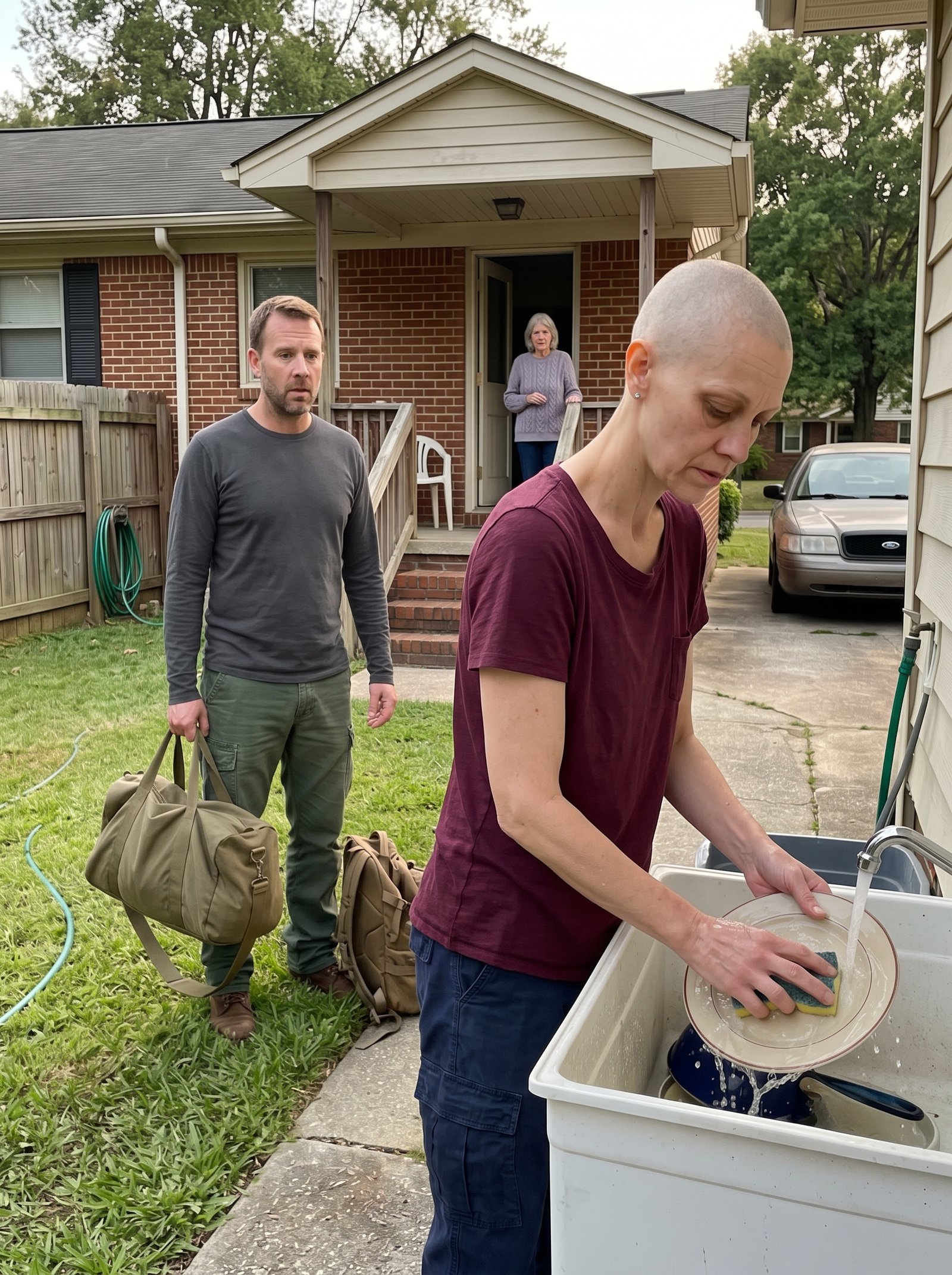
I woke before dawn, careful not to disturb Gwen, who had finally fallen into the first real sleep I’d seen her get since I arrived. I left her wrapped in the one clean blanket I could find and quietly made my way through the house while Margaret and Paige were still asleep upstairs.
I started in the kitchen, where a drawer stuffed with receipts told its own story. New furniture. A designer purse. Salon appointments. Not one receipt for a doctor’s visit, a prescription, or anything resembling medical care for the woman sleeping in a storage room downstairs.
In the study, I found a folder of bank statements Margaret had apparently kept for her own records, careless enough to assume no one would ever look closely. Line after line showed my deployment pay arriving every month like clockwork, and line after line showed it disappearing into home renovations, a new truck payment, and cash withdrawals with no explanation attached.
Then I found the message.
Margaret’s phone, left charging on the kitchen counter, lit up with a notification I wasn’t supposed to see. A text from Paige, sent five months earlier:
Gwen’s asking about a doctor again. Just tell her there’s no extra money this month. She’ll stop asking eventually.
Margaret’s reply, sent an hour later:
She’ll be fine. She’s probably just being dramatic for attention since he’s been gone so long.
I sat there in the quiet kitchen, phone in hand, and felt something in me go very still, the same stillness I remembered from firefights, when panic had to be set aside because the only thing that mattered was thinking clearly enough to survive the next five minutes.
I photographed every message, every bank statement, every receipt, and returned everything exactly as I’d found it.
By the time Margaret came downstairs, dressed already in a new robe I hadn’t seen before, she found me sitting calmly at the kitchen table with two cups of coffee poured, one for her, one for myself.
“You’re up early,” she said, settling into the chair across from me, still riding the high of the news I’d given her the day before. “I was thinking, with the new money coming in, we should really talk about expanding the back of the house. Maybe a proper guest suite.”
“That sounds like a big project,” I said evenly.
“It is. But we’ve earned it, don’t you think? All these years, holding this family together while you were gone.”
I studied her over the rim of my coffee cup, thinking about Gwen selling her own hair for a hundred and fifty dollars to afford a bus ride to a specialist, while this woman sat across from me discussing guest suites funded entirely by money meant to build a life for my wife and me.
“Mom,” I said carefully, “I need to ask you something, and I need you to think very carefully before you answer.”
Something in my tone made her set her cup down.
“Did Gwen ever ask you for money to see a doctor?”
The pause before she answered was answer enough.
“She exaggerates things,” Margaret said finally, recovering her composure quickly. “You know how she is. Always looking for sympathy.”
“That’s not what I asked,” I said. “I asked if she requested money for a doctor’s visit, and whether you gave it to her.”
Margaret’s expression shifted, calculating now, trying to read how much I already knew.
“There wasn’t extra to spare at the time,” she said. “We had expenses too.”
Upstairs, I heard Paige’s footsteps moving toward the staircase, and I knew whatever came next would happen with both of them in the room. I thought about Gwen, still asleep in that storage room, unaware that the ground beneath this entire household was about to shift.
I set my coffee cup down deliberately.
“I know about the biopsy,” I said. “I know about the hair. I know exactly how much of my money went into this house instead of into keeping my wife alive.”
Margaret’s face went pale, and for the first time since I’d walked through that gate the day before, she had absolutely nothing to say.
Paige came down the stairs at exactly the wrong moment, phone in hand, scrolling through something trivial, completely unaware of the silence she was walking into.
“What’s going on?” she asked, glancing between Margaret’s pale face and my level stare. “Why does it look like someone died in here?”
“Sit down, Paige,” I said.
She hesitated, some instinct finally catching up to the room’s tension, and slowly lowered herself into a chair.
“I found the messages,” I said, setting my phone on the table between us, the screenshot of her text still open on the screen. Just tell her there’s no extra money this month. She’ll stop asking eventually.
Paige’s face went through the same rapid sequence Margaret’s had, denial reaching for an excuse before her mind could fully catch up.
“That’s not—I mean, we didn’t know it was serious,” she said. “She’s always been dramatic about her health.”
“She has a biopsy scar on her chest and a shaved head from selling her own hair to pay for transportation to a specialist,” I said. “Tell me again how dramatic that sounds to you.”
Margaret finally found her voice. “We didn’t have the money to spare at the time. There were expenses—”
“There was a new truck,” I said. “There was a renovation fund. There were purses and salon visits and phones. Don’t tell me there wasn’t money to spare. Tell me the truth, that you decided a doctor’s visit for my wife mattered less than any of that.”
Neither of them answered. The silence stretched long enough that I heard, faintly, the storage room door creak open down the hall. Gwen appeared in the doorway a moment later, still weak, still wrapped in that thin blanket, having heard enough of the conversation to know exactly what was happening.
“Gwen,” Margaret started, “I can explain—”
“You don’t need to explain anything to her,” I said, standing and crossing the room to help my wife to a chair. “You need to explain it to me, and then you need to explain it to whoever handles what happens to this house next.”
“What does that mean?” Paige asked, her voice sharpening with the first real note of fear.
“It means this house, the truck, everything sitting in this room right now, was paid for with money I sent home to support my wife,” I said. “Money that was supposed to keep her safe while I was gone. Instead, she was left to sell her own hair for bus fare while you two lived like this was a vacation home.”
“You can’t just take it all back,” Margaret said, panic creeping into her voice now. “We’re your family.”
“Family doesn’t let someone die quietly in a storage room to protect a renovation budget,” I said. “I already spoke to a military family liaison this morning, before either of you woke up, about how allotments and dependent benefits can be redirected. I also spoke to a lawyer about what it means when funds meant for a service member’s dependent are deliberately withheld from that dependent’s medical care.”
Margaret’s composure finally cracked completely. “You’re going to punish your own mother over this?”
“I’m going to make sure my wife gets the treatment she needed five months ago,” I said. “Whatever happens to you as a result of that is a consequence of what you chose to do, not something I’m doing to you.”
Gwen’s hand found mine under the table, weak but steady, and I looked down at her, at the scarred scalp she’d hidden under a knitted cap for months, at the biopsy mark she’d been carrying alone while I sent money home believing it was buying her safety.
“I’m taking Gwen to Walter Reed’s oncology program this week,” I said, looking back at Margaret and Paige. “After that, we’re not coming back to this house. Either of you.”
Paige opened her mouth to argue, but for the first time in as long as I could remember, Margaret reached over and stopped her, some flicker of understanding finally settling into her expression that this wasn’t a fight either of them was going to win.
I helped Gwen to her feet, and as we walked toward the door together, I heard Margaret’s voice behind us, quiet, almost small.
“Please. Don’t take everything.”
I didn’t turn around.
“You should have thought about what mattered more before you decided her life was worth less than a truck payment.”
The drive to Walter Reed took six hours, and I spent every one of them glancing over at Gwen in the passenger seat, still fragile, still wrapped in blankets despite the warm afternoon, but sitting a little straighter with every mile that put distance between her and that storage room.
“I keep waiting to feel guilty,” she admitted somewhere past the state line. “For leaving them like that.”
“Don’t,” I said. “You spent five months hiding a biopsy scar and selling your own hair so you wouldn’t have to ask them for anything else. You don’t owe them guilt. If anything, they owe you five months you should never have had to survive alone.”
The oncology team at Walter Reed moved quickly once they reviewed the biopsy results Gwen had kept, folded carefully in an envelope hidden beneath the floorboard of the storage room, evidence she’d preserved without knowing if she’d ever get the chance to use it. The tumor, they confirmed, was stage two, aggressive but treatable, especially caught when it was, before it had progressed further during the months she’d gone without proper care.
“Five more months without treatment could have changed this conversation entirely,” the oncologist told us both, and I watched something in Gwen’s face crumble and then steady itself, the weight of how close this had actually come finally landing somewhere she could process it.
Treatment began within the week. Chemotherapy first, then a scheduled surgery once the tumor responded enough to be safely removed. I took an extended leave to be there for every appointment, every difficult night, every moment Gwen needed someone beside her instead of hiding what she was going through out of fear it would cost her more than she could afford.
Back home, the fallout moved just as quickly. My lawyer helped me formally document the pattern of withheld funds, and while pursuing full legal consequences against my own mother felt like walking through fire, I filed a formal complaint regarding misuse of a dependent’s allotment, which triggered a military family support investigation into how the funds had actually been used. Margaret and Paige were required to vacate the house within sixty days, once it became clear the property had been purchased and maintained almost entirely through funds designated for Gwen’s support, funds I redirected the moment the investigation confirmed what I already knew.
Margaret called several times over those two months, oscillating between apology and justification, sometimes in the same conversation. I answered exactly once, briefly, mostly for Gwen’s sake, so she wouldn’t have to wonder what was being said behind her back.
“I hope you understand what you’re doing to this family,” Margaret said.
“I understand exactly what I’m doing,” I said. “I’m making sure the person who actually needed protecting finally gets it. That’s not destroying a family. That’s what should have been happening the whole time.”
I didn’t hear from Paige at all after that. I assumed she’d moved in with friends, still riding whatever entitlement she thought the situation still owed her, and I decided that assumption didn’t require any further attention from me.
Gwen finished chemotherapy eight months later. Her hair grew back slowly, first in soft patches, then fully, dark and full in a way that made her cry the first time she saw it in the mirror without a knitted cap covering the scars beneath.
“I kept thinking I’d never get to see this again,” she said, running her fingers through hair she’d once sold for a hundred and fifty dollars just to buy herself a chance at survival.
We used part of the redirected funds to buy a small house of our own, modest, nothing like the two-story dream I’d been so proud of walking up to that first day, but entirely, honestly ours, built on nothing but what we’d actually earned and protected together.
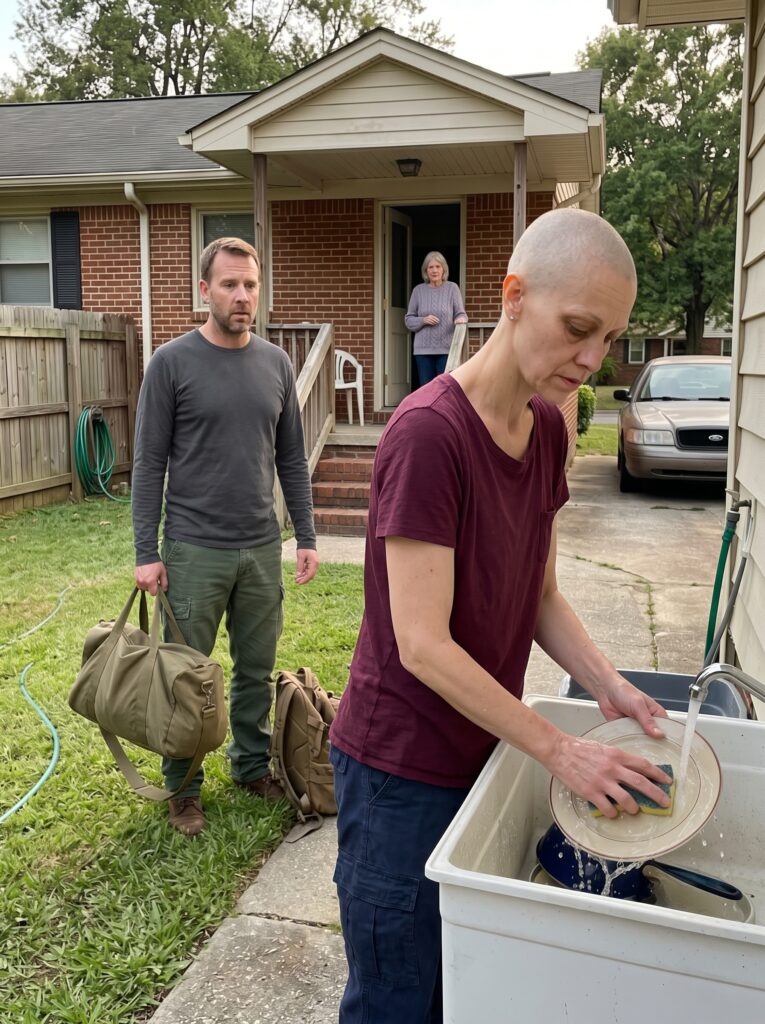
Sometimes, in the evenings, Gwen sits on our back porch, running her hand through hair that finally reaches her shoulders again, and I think about that first afternoon, walking around the side of that beautiful house and finding her kneeling in the dirt with a shattered plate, silent, because she’d learned that speaking up had never once been safe in that family.
She doesn’t stay silent anymore. And every dollar I send now, every plan we make, goes exactly where it was always supposed to go.
To her. To us. To the life we almost lost the chance to build together.