The door swung open, and Renee walked in carrying two grocery bags, her hair slightly disheveled, her phone tucked into her back pocket, playing the part she’d already prepared for.
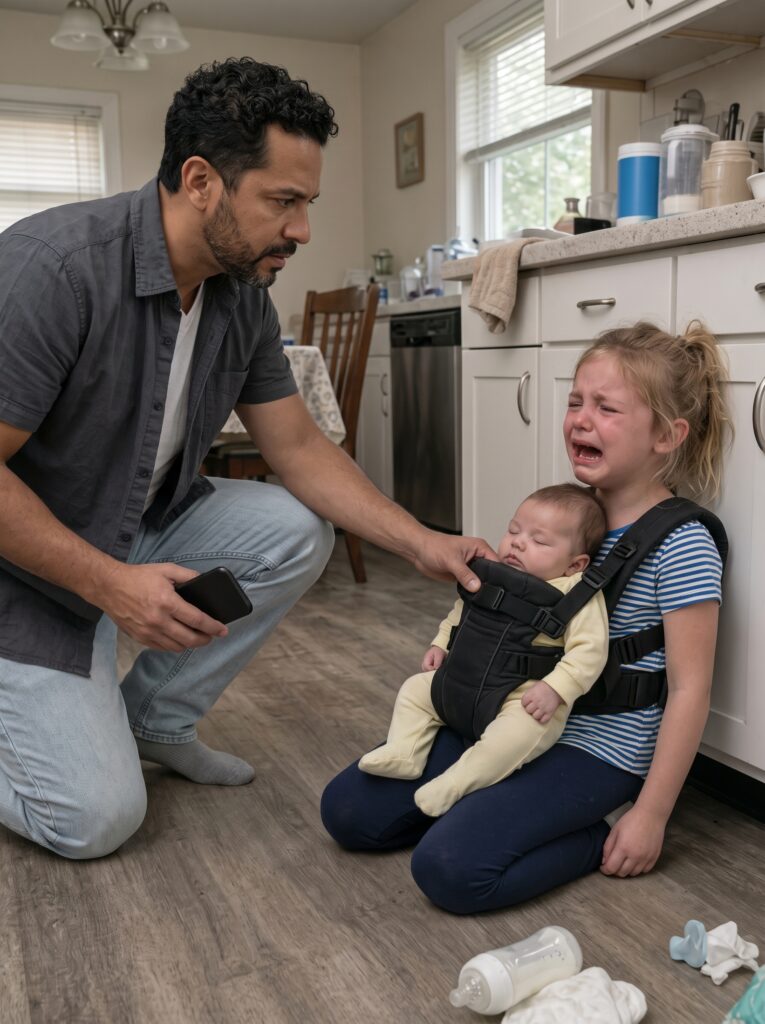
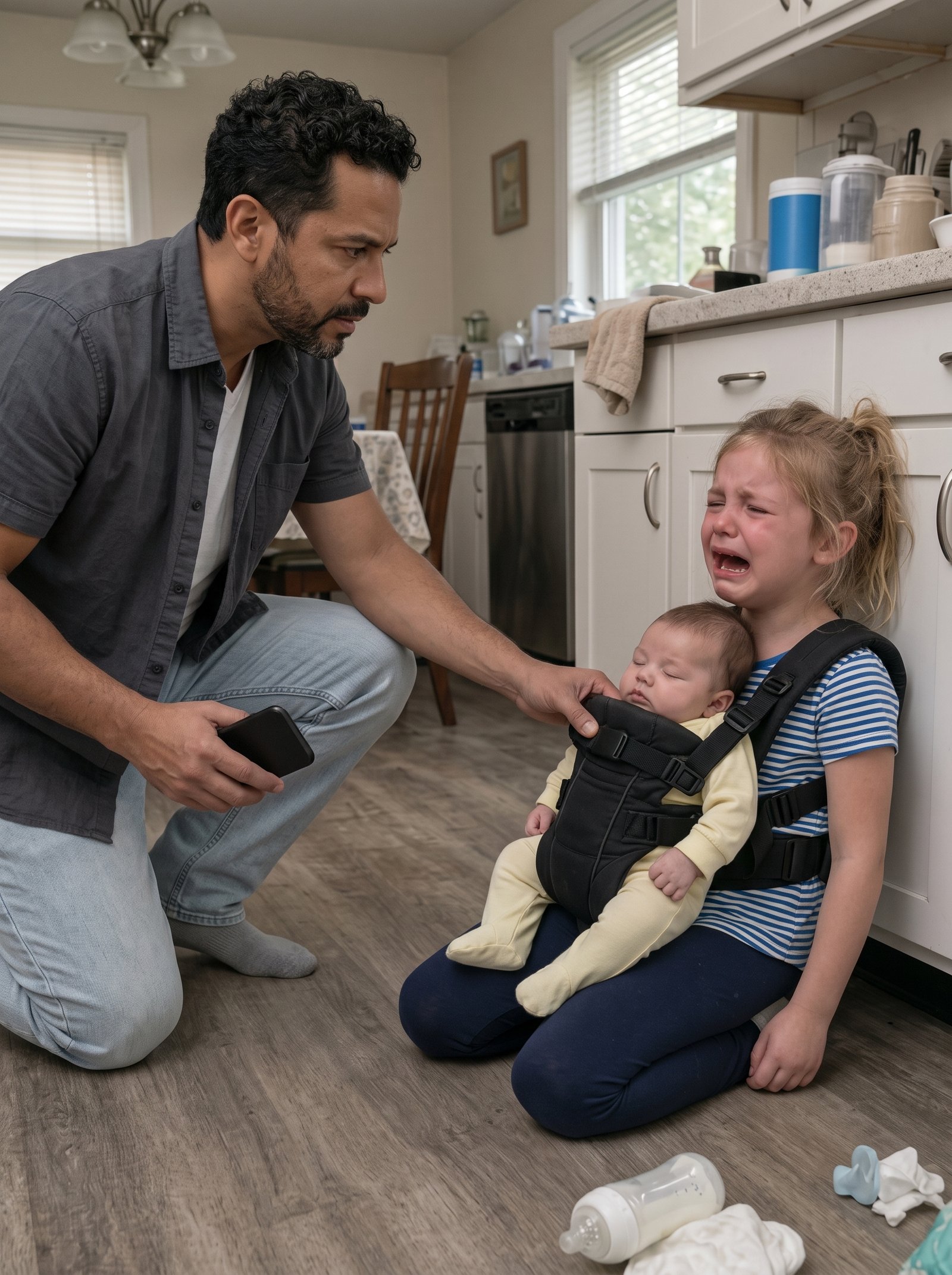
She stopped short when she saw me sitting on the kitchen floor, Miles asleep against my chest, Tessa beside me with red-rimmed eyes, and the second phone sitting on the counter between us, its screen still lit with notifications.
“Grant,” she said, her voice shifting instantly into practiced surprise. “You’re home early. I just ran out for—”
“Seventeen minutes,” I said quietly. “That’s what you told Tessa. It’s been almost three hours.”
Her eyes flicked to the phone on the counter, and I watched the color drain out of her face in real time.
“I can explain that,” she said.
“Then explain it,” I said. “Explain why our nine-year-old was told to lie to me about groceries. Explain why she was left alone with an eight-month-old for three hours because someone named R told her to ‘leave the kids with Tessa and come now.'”
Renee set the grocery bags down slowly, buying herself time she clearly didn’t have a good use for.
“It’s not what it looks like,” she said.
“I haven’t even told you what it looks like yet,” I said. “So far all I know is you have a secret phone hidden in our bedroom, a man texting you to come meet him, and a plan in place for our daughter to lie to me if I got home before you did. Tell me which part of that isn’t what it looks like.”
Tessa shrank slightly beside me, and I put a steadying hand on her shoulder, aware suddenly that whatever came next, she didn’t need to be sitting in the middle of it.
“Tessa,” I said gently, “can you take Miles’s bottle and go warm it up in the other room? I’ve got this.”
She nodded, grateful for the excuse, and slipped away with a speed that told me she’d been waiting for permission to leave the tension in that kitchen for a while.
Once she was gone, I stood, laying Miles carefully in the bouncer nearby, and turned back to Renee.
“How long has this been going on?”
“It’s complicated,” she said, which was, I was learning quickly, what people say when the honest answer is worse than the question implies.
“Uncomplicate it,” I said.
She sat down heavily at the kitchen table, and for a moment I thought she might actually tell me the truth without me having to drag it out of her one denial at a time.
“His name is Ryan,” she said. “We reconnected a few months ago. It wasn’t supposed to become anything serious.”
“How many months?”
“Four,” she admitted. “Maybe five.”
I picked up the second phone from the counter and started scrolling, no longer interested in being polite about her privacy, given that she’d shown none for the safety of our children.
Messages going back to early spring. Meetups timed around my dog-training sessions, which ran predictably every Tuesday and Thursday afternoon. A pattern, deliberate and repeated, of leaving Tessa in charge of Miles for “quick errands” that stretched far longer than seventeen minutes, every single time.
“You built a schedule around when I wasn’t home,” I said, more to myself than to her, piecing it together as I read. “And you used our daughter as the alibi.”
“She was fine,” Renee said. “Nothing happened to her.”
“She was on the kitchen floor exhausted, holding a crying baby for three hours, coached to lie to me if I asked,” I said. “That’s not fine, Renee. That’s neglect, and you built an entire system to make sure I’d never catch it.”
She didn’t have a response to that. For the first time since walking through that door, she looked less like a woman caught in an affair and more like someone finally confronted with exactly how much damage the affair had required to maintain.
I set the second phone down on the table between us.
“I need you to pack a bag tonight,” I said. “You’re not staying here while I figure out what comes next for the kids.”
“Grant, you can’t just—”
“I can,” I said. “And I will. Because right now, the only priority I have is making sure Tessa never has to sit on a kitchen floor again, hoping her mother comes back before something goes wrong.”
Renee didn’t argue further that night. She packed a bag with shaking hands while I stayed in the kitchen with Tessa and Miles, and by the time she left, quietly, without another word, I’d already called my sister to come stay with the kids so I could think clearly without an audience of small ears.
The next morning, I brought both phones, hers and the second one, to a family law attorney named Patricia Vance, along with a written timeline Tessa had helped me piece together, dates and times she remembered her mother leaving, cross-referenced against my own training schedule.
“This is more than an affair,” Patricia said, scrolling through months of messages. “This is a documented pattern of leaving a minor child solely responsible for an infant, repeatedly, over an extended period, with instructions to deceive the other parent. That’s relevant to any custody proceeding, and depending on how a judge views it, it could also draw attention from child protective services.”
“I don’t want to destroy her,” I said. “I want my kids safe. That’s the only thing I actually care about.”
“Those aren’t mutually exclusive,” Patricia said. “But you do need to be prepared that once this is documented formally, it’s out of your hands how far it goes.”
Over the following weeks, the full picture came into focus. Ryan, it turned out, was not just an affair partner but someone Renee had known years before we met, an ex-boyfriend she’d reconnected with online, and the “quick errands” had escalated from occasional visits to a near-weekly arrangement that revolved entirely around my schedule at the training facility.
Tessa, when gently interviewed by a child psychologist as part of the custody evaluation, confirmed what I already suspected but hadn’t wanted to fully accept: this hadn’t been the first time she’d been left responsible for Miles for hours at a stretch, just the first time it had gone on long enough, and gone wrong enough, that she’d finally broken the rule and called me.
“She told me if I called you and nothing bad happened, I’d get in trouble for overreacting,” Tessa told the psychologist, according to the report I later read. “So I waited as long as I could.”
Reading that sentence undid something in me that the phone messages hadn’t managed to. My nine-year-old had weighed the risk of being punished for “overreacting” against the actual risk to her baby brother, and she’d made that calculation entirely on her own, because the adult meant to protect her had made her responsible for a decision no child should ever have to make.
The custody hearing, when it came, wasn’t close. Between the documented pattern of neglect, Tessa’s testimony, and Renee’s own admission on record about the frequency and duration of her absences, the judge granted me primary custody of both children, with Renee receiving supervised visitation pending a full evaluation and completion of a parenting course.
Renee tried, through her attorney, to argue that I was “overreacting to a private relationship matter,” an echo of the exact phrase Tessa had been taught to fear.
The judge did not agree.
“This case isn’t about your relationship with Mr. Doyle,” she said during the ruling. “It’s about a pattern of decisions that repeatedly put a minor child in a position of caregiving responsibility beyond her years, with instructions to conceal it. That is the court’s concern, and it will remain the court’s concern going forward.”
Outside the courthouse, Tessa asked me quietly if she was going to get in trouble for “telling on Mom.”
I knelt down in front of her, right there on the courthouse steps, and told her the only thing I wanted her to carry forward from all of it.
“You didn’t tell on anyone,” I said. “You kept your brother safe, and you trusted me enough to call when you needed help. That’s not something you ever get in trouble for. That’s something I’m proud of you for, for the rest of your life.”
The months that followed the custody ruling were quieter than anything our house had felt in years, not because the hurt disappeared, but because for the first time, nothing in that house was hiding.
I cut back my hours at the training facility, shifting most of my clients to morning sessions so I could be home by early afternoon, and hired a part-time sitter for the two days a week I still needed coverage, someone background-checked, vetted, and entirely unconnected to any version of “just for a few minutes.” Tessa never had to be responsible for Miles alone again, not for a single afternoon, and I made a point of telling her that out loud, more than once, so she’d stop watching the clock the way I noticed she still did for a while after everything happened.
Renee’s supervised visitation started slow, an hour every other Saturday at a family center downtown, a caseworker present the entire time. She completed the required parenting course, and over time, the visits extended, first to unsupervised afternoons, eventually to occasional weekends, once the court was satisfied enough time and evidence of change had passed. I never stood in the way of that progress, because whatever had happened between us, I still believed Tessa and Miles deserved a relationship with their mother, just not one built on secrecy or risk ever again.
Ryan, as it turned out, disappeared from the picture almost as quickly as he’d appeared in it, unwilling, it seemed, to stick around once the relationship required anything beyond stolen afternoons.
Tessa started seeing a child therapist twice a month, someone who helped her unpack the quiet guilt she’d been carrying, the sense that she should have called sooner, that she’d somehow failed by waiting as long as she did. It took time, but slowly I watched her stop flinching every time Miles cried a little too long, stop glancing toward the door like she was still half-expecting to be the only one responsible for handling it.
One evening, almost a year after that first frantic phone call from the training field, I found Tessa in the kitchen, sitting on the floor exactly where I’d found her that day, except this time she was laughing, stacking blocks with Miles while he babbled and knocked them down just to watch her rebuild them.
“You okay down there?” I asked, leaning against the counter.
“Yeah,” she said, glancing up at me with an ease I hadn’t seen from her in a long time. “It’s different now. I’m not, like, in charge. I’m just playing with him.”
That distinction, the difference between being in charge and simply being a kid who got to play with her little brother, was everything I’d been fighting for since the moment I found her exhausted against those cabinets.
I sat down on the floor with them, letting Miles climb into my lap, and watched Tessa knock over the block tower on purpose this time, both of them dissolving into laughter over something so small and so wonderfully ordinary.
We’d built a new routine in that kitchen, one with no hidden phones, no secret timelines, no seventeen minutes that quietly became three hours.
Just a father, home when he said he’d be, and two kids who never again had to wonder who was actually looking out for them.